
NEWS

Breeding beyond boundaries: IITA, partners, and CGIAR chart a more connected future
October 16, 2026
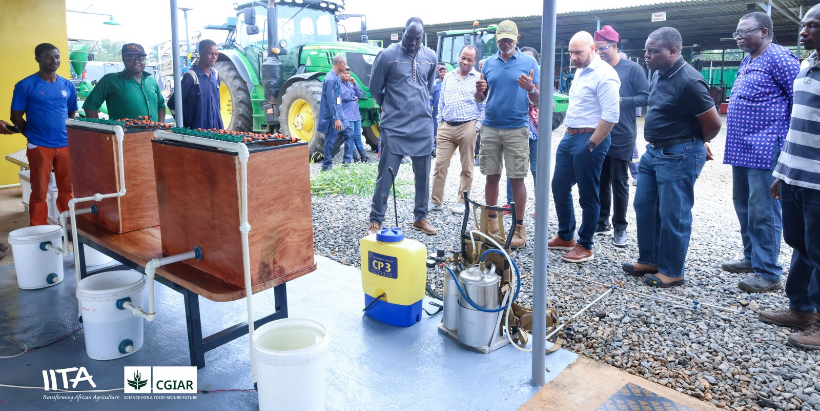
Makram Geha at IITA Farm Office to observe technologies, facilities, and innovations supporting the institute's breeding programs and accelerating crop improvement efforts.
Makram Geha at IITA Farm Office to observe technologies, facilities, and innovations supporting the institute’s breeding programs and accelerating crop improvement efforts.

The future of crop breeding will not be built by breeders working alone. This message resonated throughout the five-day visit of Makram Geha, Director of CGIAR’s Breeding for Tomorrow (B4T) Science Program, to IITA–CGIAR from 14 – 18 September. Across presentations, technical discussions, laboratory interactions, field visits, and partner engagements, the visit highlighted a common theme: delivering genetic gains to farmers requires a connected system in which breeders, national agricultural research and extension systems, seed companies, laboratories, policymakers, farmers, processors, and other private-sector actors work together.

IITA’s breeding programs already operate within such networks.

The National Centre for Genetic Resources and Biotechnology (NACGRAB), represented by the Deputy Director, Adedotun Afolayan, described its longstanding collaboration with IITA–CGIAR in genetic resource conservation, varietal release processes, and seed system development. The partnership helps connect genetic resources to breeding programs while ensuring documentation, data management, and regulatory processes remain aligned.

The National Horticultural Research Institute (NIHORT), represented by the Director of Research, Dorcas Ibitoye, presented a strong example of successful partnership. Through collaboration with IITA–CGIAR, NIHORT received 35 banana and plantain accessions, trained staff in tissue culture and macropropagation, and helped develop seed certification guidelines, together with Nigeria’s National Agricultural Seeds Council (NASC). These joint efforts culminated in the release of two plantain and two banana varieties in March 2026, demonstrating the power of coordinated research and seed system development.
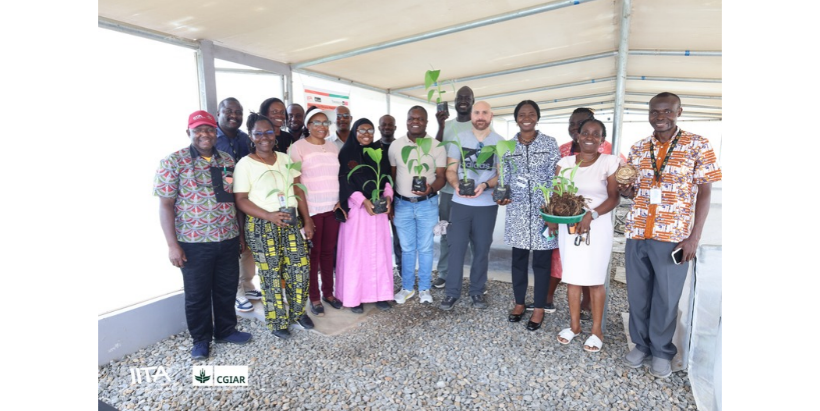
Makram Geha with IITA plantain and banana breeders after observing macropropagation seed multiplication technology in the screenhouse, a key innovation supporting the rapid multiplication and dissemination of clean planting materials.

Prof. Chiedozie Egesi, Executive Director of the National Root Crops Research Institute (NRCRI), highlighted that NRCRI is working with IITA and other national agricultural research and extension systems to test materials across environments and strengthen the connection between international research and local agricultural realities. He highlighted collaborative efforts on seed systems, nutritional improvement, virus mitigation strategies, and technologies such as Semi-Autotrophic Hydroponics (SAH) for rapid multiplication of cassava and yam seeds. He underscored the importance of strong partnerships in translating research into impact, noting that innovation is only successful when it reaches and transforms the lives of end users.

Private-sector collaboration was represented by Samson Afolayan, Head of Research at Premier Seed Nigeria Limited, which produces approximately 13,000 metric tons of seed annually across crops such as maize and cowpea. Such partnerships are crucial for ensuring improved varieties move efficiently from research stations to farmers’ fields. Afolayan shared Premier Seed Nigeria Limited’s role in producing and distributing improved seed to farmers at scale, helping bridge the gap between breeding innovation and adoption.

For Geha, these connections are essential to making breeding more efficient.

The visit also highlighted the critical role of laboratories in supporting breeding success. Geha toured IITA’s Bioscience, Virology, Nutrition, and Genebank facilities, where discussions focused on infrastructure needs, process optimization, and opportunities for collaboration across CGIAR centers. Scientists emphasized the importance of modern facilities in accelerating breeding outcomes and supporting long-term research goals.

A recurring theme was the need to move beyond project-based approaches toward sustainable, long-term investments in research infrastructure. Geha encouraged teams to identify opportunities for shared protocols, coordinated investments, and facility upgrades that can strengthen CGIAR-wide efficiency. The need is particularly urgent in a changing funding environment. IITA scientists acknowledged that budget constraints in recent years have placed pressure on breeding pipelines. Geha emphasized the importance of moving from project-based thinking toward longer-term systems that can sustain breeding programs. This includes diversifying funding, strengthening private-sector engagement, developing stronger life-cycle management approaches for products, and improving the visibility of breeding achievements.
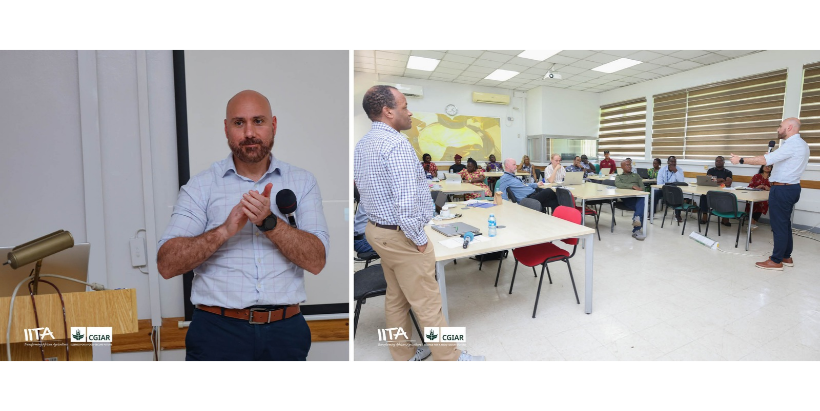
Makram Geha delivers his closing remarks, commending IITA's breeding achievements, strong partnerships, and increasing commitment to developing science-driven solutions that benefit farmers across the continent.
Makram Geha delivers his closing remarks, commending IITA’s breeding achievements, strong partnerships, and increasing commitment to developing science-driven solutions that benefit farmers across the continent.

Innovation is another important part of the future. IITA is already integrating genomic prediction, marker-assisted selection, high-density genome-wide data, pangenomes, precision phenotyping, AI-enabled tools, remote sensing, and other technologies into its breeding work. But technology alone will not deliver impact.

The visit repeatedly returned to the importance of people, processes, products, and partnerships. Breeding gains need to be connected to agronomy. Improved varieties need functioning seed systems. Products need markets. Farmer preferences need to inform target product profiles. And research results need communication strategies that make their value visible.

This systems perspective was also reflected in Geha’s closing reflections. Rather than treating the different components of breeding as isolated activities, he called for greater integration and efficiency, with breeding programs using available resources strategically while continuing to explore new frontiers.

Giving the closing remarks, IITA’s Head of Genetic Resources Center and Director of West Africa Hub, Michael Abberton, expressed appreciation for the rich engagement and valuable contributions of IITA’s partners, scientists, and private-sector collaborators throughout the visit. Commending Geha’s intensive engagements and contributions, he said, “IITA and B4T have the champion it needs for progressive and strategic advocacy in you, Makram Geha.”

The five-day visit thus ended not simply with a review of what IITA has done, but with a shared sense of where the work needs to go next. The challenge is to connect the science, people, infrastructure, partnerships, funding, and delivery systems already in place into an even stronger breeding ecosystem—one capable of developing products for today’s farmers while anticipating tomorrow’s needs.


Contributed by

Folake Oduntan

Scroll to Top
Olaosebikan, Olamide

Olamide Deborah Nwanze is a Senior Research Associate specializing in gender mainstreaming research to inform participatory and inclusive breeding, variety development, and seed systems policies regarding root, tuber, and banana (RTB) crops in the International Institute of Tropical Agriculture Headquarters, Ibadan, Nigeria. She is a PhD candidate at the University of Ibadan and holds an MSc and B. Agric in Agricultural Extension and Rural Development. Olamide is a fellow of the African Women in Agricultural Research and Development – Gender Responsive Agricultural Systems Policy (AWARD-GRASP) and the Gender Responsive Researchers Equipped for Agricultural Transformation (GREAT). She seeks to apply her gender-mainstreaming learnings, gender-responsive research, and policy development, and review expertise to facilitate women, youth, children, and vulnerable social group’s access to and adoption of agricultural Innovations that guarantee food, nutrition, income, and livelihood security in Africa. Her current roles include mentoring research fellows, development of guides and training manuals, implementation and adaptation of gender frameworks and tools, value chain actors’ engagement as citizen science partners, policy review and redesign, data management, and analysis. Her current research explores mixed methods and participatory and interdisciplinary approaches to capture and highlight gender dynamics, needs, preferences, and challenges stakeholders face within the agricultural livelihood value chain to prioritize gender-inclusive strategies in breeding programs, policy design, and implementation.

At IITA, she contributes to the implementation of the CGIAR Accelerated Breeding Initiative and Genetic Innovation Programs; participatory and gender research within the NextGen Cassava, HarvestPlus, RTBFoods, and Tricot-ClimMob 1000Farms Projects; and gender knowledge communication via the G-LENS webinar series, video documentary, policy briefs, publications, and blogs.


Recent publications

de Sousa, K., van Etten, J., Manners, R. Bello, A., Teeken, B., Olaosebikan, O., et al. 2024. The tricot approach: an agile framework for decentralized on-farm testing supported by citizen science. A retrospective. Agron. Sustain. Dev. 44, 8. https://doi.org/10.1007/s13593-023-00937-1

Madu, T., Onwuka, S., Nwafor, S., Onyemauwa, N., Ejechi, M., Ofoeze, M., Ukeje, B., Eluagu, C., Olaosebikan, O., Okoye, B., 2024. Gender-Inclusive Consumer Studies Improve Cassava Breeding in Nigeria in: Frontiers in Sociology, volume 9, number: 1224504, doi: 10.3389/fsoc.2024.1224504

Olaosebikan, O.; Bello, A.; Utoblo, O.; Okoye, B.; Olutegbe, N.; Garner, E.; Teeken, B.; Bryan, E.; Forsythe, L.; Cole, S.; Madu, T. 2023.  Stressors and Resilience within the Cassava Value Chain in Nigeria: Preferred Cassava Variety Traits and Response Strategies of Men and Women to Inform Breeding. Sustainability 15, 7837. https://doi.org/10.3390/su15107837

Okoye, B., Ofoeze, M., Ejechi, M., Onwuka, S., Nwafor, S., Onyemauwa, N., Ukeje, B., Eluagu, C., Obidiegwu, J.*, Olaosebikan, O., Madu, T.* 2023. Prioritizing preferred traits in the yam value chain in Nigeria: a gender situation analysis in: Frontiers in Sociology, volume 8, number: 1232626, pages 1 – 9, ISSN 2297-7775, 2023. https://www.frontiersin.org/articles/10.3389/fsoc.2023.1232626/full

Olaosebikan, O., Bello, A. A., de Sousa, K., Ndjouenkeu, R., Adesokan, M., Alamu, E. O., Agbona, A., van Etten, J., Kegah, F. N.*, Dufour, D., Bouniol, A., Teeken, B. 2023. Consumer acceptability of cassava gari-eba food products across cultural and environmental settings using the triadic comparison of technologies approach (tricot) in: Journal of the Science of Food and Agriculture,

Teeken, B., Olaosebikan, O., Bello, A. A., Madu, T.*, Cole, S. M. 2023. Qualitative assessment on the positionality and preferences of dyads in relation to cassava-related activities: working with tricot trial citizen scientists https://hdl.handle.net/10568/138326 Type: Manual

Bouniol, A., Ceballos, H., Bello, A. A., Teeken, B., Olaosebikan, O., Owoade, D., Agbona, A., Fotso Kuate, A., Madu, T.*, Okoye, B.*, Ofoeze, M.*, Nwafor, S.*, Onyemauwa, N.*, Adinsi, L.*, Forsythe, L., Dufour, D. 2023. Varietal impact on women’s labour, workload and related drudgery in processing root, tuber and banana crops: focus on cassava in sub-Saharan Africa in: Journal of the Science of Food and Agriculture, pages 1 – 25, ISSN 0022-5142,

Bello, A. A., Agbona, A., Olaosebikan, O., Edughaen, G., Dufour, D., Bouniol, A., Iluebbey, P., Ndjouenkeu, R.*, Rabbi, I. Y., Teeken, B. 2023. Genetic and environmental effects on processing productivity and food product yield: drudgery of women’s work in: Journal of the Science of Food and Agriculture, pages 1 – 32, ISSN 0022-5142, 5

Cavicchioli, M., Zimbiti, T., Teeken, B., Nwanze, D.O., Liani, M., Parkes, E. & Bello, A. 2023. IITA-Gender Responsive Breeding Training Report. Genetic Resources Center, IITA-HQ, Ibadan, 21-23 September, 2022. Ibadan, Nigeria: IITA, (34 p.).https://hdl.handle.net/10568/131368

Agbona, A. Peteti P., Teeken B., Olaosebikan O. Bello, A. A., Parkes, E., Rabbi, I. Y., Mueller, L., Egesi, C., Kulakow, P. 2022. Data Management in Multi-disciplinary African RTB Crop Breeding Programs. In: Williamson, H.F., Leonelli, S. (eds) Towards Responsible Plant Data Linkage: Data Challenges for Agricultural Research and Development. Springer, Cham. https://doi.org/10.1007/978-3-031-13276-6_5

Lora Forsythe, Pricilla Marimo, Sarah Mayanja, Olamide D. Olaosebikan, Esme Stuart, Bela Teeken, Benjamin Okoye, Tessy Madu, (2021). Cross-product Gender Analysis of RTBfoods Step 2 Gendered Food Mapping on RTB Products. Understanding the Drivers of Trait Preferences and the Development of Multi-user RTB Product Profiles, WP1. London, UK: RTBfoods Field Scientific Report, 30 p.

Teeken, B., Garner, E., Agbona, A., Balogun, I., Olaosebikan, O., Bello, A., Madu, T., Okoye, B., Egesi, C., Kulakow, P. and Tufan, H.A. 2021. Beyond “Women’s Traits”: Exploring How Gender, Social Difference, and Household Characteristics Influence Trait Preferences. Frontiers Sustainable Food Systems 5:740926. https://doi.org/10.3389/fsufs.2021.740926

Teeken, B., Agbona, A., Bello, A., Olaosebikan, O., Alamu, E., Adesokan, M., Awoyale, W., Madu, T., Okoye, B., Chijioke, U., Owoade, D., Okoro, M., Bouniol, A., Dufour, D., Hershey, C., Rabbi, I., Maziya‐Dixon, B., Egesi, C., Tufan, H. and Kulakow, P. (020. Understanding cassava varietal preferences through pairwise ranking of gari‐eba and fufu prepared by local farmer–processors. Int J Food Sci Technol. https://doi.org/10.1111/ijfs.14862

Bela Teeken, Olamide Olaosebikan, Ireti Balogun, Benjamin Okoye, Tessy Madu, Steven Cole, Abolore Bello, Elizabeth Parkes. (2020). Piloting the G+ customer and product profile tools for gender-responsive cassava breeding in Nigeria. Nigeria: International Institute of Tropical Agriculture (IITA). https://hdl.handle.net/20.500.11766/13000