
IITA NEWS

Chicken is becoming the affordable, favored source for meat and eggs in Burundi, while also driving a business boom
June 13, 2025

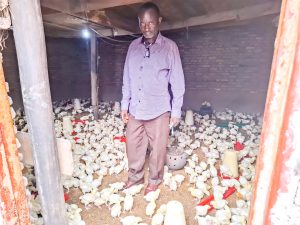
Photo: Maurice Murishi with the three to five days old chicks.

In the quiet village of Buringa in Gihanga Commune, Bubanza Province, a 59-year-old entrepreneur and livestock farmer, Maurice Murishi, is changing the face of poultry farming in Burundi. What began as a small poultry business is now a thriving enterprise that is improving lives and incomes across several provinces.

“People shifted to chicken as their primary source of meat due to the national shortage of beef,” Maurice explains. “Since then, the demand has increased tremendously.”

But as the demand grew, local poultry breeds struggled to keep up. Existing chicken breeds were disease-prone and of low productivity, making it hard for farmers to meet market needs. That changed when the Great Lakes Accelerated Innovation Delivery Initiative Rapid Delivery Hub (AID-I GLR), locally known as the Kugwiza Project, stepped in.

With support from local partners like Confederation des Associations des Producteurs Agricoles pour le Developpement (CAPAD), Association de Coopération et de Recherche pour le Développement (ACORD), Welthungerhilfe (WHH), and International Livestock Research Institute) ILRI, the project introduced an innovative small pack approach, distributing a few high-quality chicks per household to demonstrate the benefits of the disease-resistant poultry breed called SASSO. This strategy allowed farmers to test the breed in their own environments, sparking rapid adoption and word-of-mouth demand. According to Maurice, the new breed has been a game-changer.

“The SASSO breed is well-suited to our local climate, resists disease, and can be raised in both zero-grazing and open-grazing systems,” he says. “Our customers love it!”

Maurice’s poultry business has grown rapidly since he started working with the project. In 2022, he sold just over 10,000 chicks. By 2023, that number had climbed to more than 12,000, and in 2024, it more than doubled. From January to March 2025 alone, he had already sold more than 21,000 chicks to local intermediary traders working across Kugwiza-supported zones.

The small-pack approach proved revolutionary. By distributing just five chicks per household; four hens and one rooster; along with starter kits of feed and medicine, the project enabled farmers to see tangible results quickly. “Giving a few chicks per household was an innovation,” Maurice notes. “It allowed people to test the breed in real-time and created high demand. I want to replicate this model in other areas where I have operations.”

To meet this growing demand, Maurice developed a network of four young intermediaries operating in the provinces of Bubanza, Cibitoke, Gitega, and Ruyigi. These young entrepreneurs buy two-month-old chicks and sell them to farmers in rural areas, helping expand access while generating income for themselves.
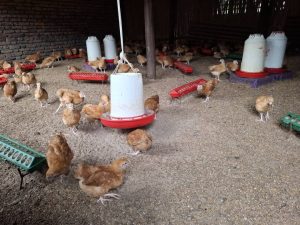
Photo: Two-month-old chicks at Maurice’s poultry house, ready to be distributed to intermediaries for wider dissemination to farmers.

“The marketing strategy was initiated by the Kugwiza Project,” Maurice explains. “It encouraged us to work with intermediaries and offer them profit margins so they could expand distribution in underserved areas.”

One of these intermediaries is 27-year-old Paul Nsabiyumva from Mutaho Commune in Gitega Province. Paul began selling chicks in 2021, but it wasn’t until the SASSO breed was introduced that his business took off.

“I heard about SASSO through CAPAD, and they connected me with Maurice in Bujumbura,” says Paul. “I traveled to meet him, and in 2024, I started ordering SASSO chicks to sell in Mutaho and Bugendana.”

Since then, Paul has witnessed firsthand the benefits of the new breed. Not only do SASSO chickens resist common diseases, but they also lay an average of six eggs per week when well fed, thus doubling the productivity of traditional breeds. Prices have skyrocketed. A two-kilogram chicken that sold for 35,000 Burundian francs (BIF, equivalent to USD 11.66) in 2021 now goes for BIF 70,000 (USD 23.33), while the price of an egg has increased from BIF 800 (USD 0.26) to BIF 1,000 (USD 0.33). In a rare win-win for both producers and consumers, despite this price increase, chicken still remains more affordable than beef, which costs BIF 40,000 per kilo (USD 13.3).

And neither has the rise in price stemmed the business boom. Quite the opposite. A boost. “As demand is still rising, I’m planning to take a loan to expand my business,” Paul says. He also plans to diversify. “I even want to start selling chicken feed to meet the growing needs of farmers.”

The benefits of the Kugwiza Project go beyond distributors and entrepreneurs. In Birimba village, also in Gitega Province, Jovith Ngendakumana, a 45-year-old mother of six, has transformed her family’s income thanks to the SASSO breed.

“Previously, my children raised local chickens for fun,” she explains. “Then I attended a community meeting organized by CAPAD and ILRI, where we learned about the SASSO breed that resists disease and has good egg production.” In terms of meat and egg production, SASSO is amongst the best poultry hybrid breeds for smallholder farming.
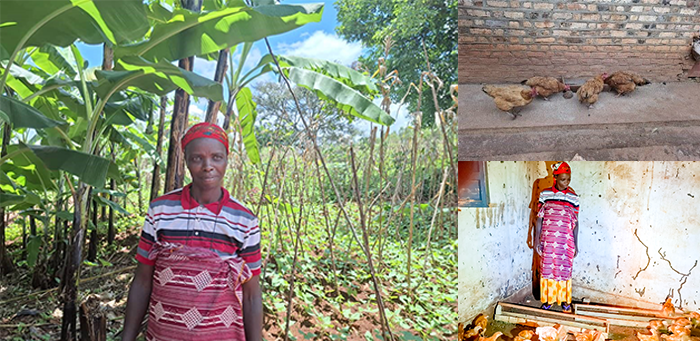
Jovith has received SASSO chicks to test and has just started to breed and market the hens.

Jovith received five chickens, four hens and one rooster, along with feed and medicine. Within four months, her hens are giving her increased production for household consumption and income generation. She sold part of her egg harvest, using the income to buy more chicks and invest in her farm.

“With the profits, I bought 30 chicks from Paul,” she says. “Soon, I’ll be getting a continuous and sustainable egg production and income to help me pay school fees, buy household essentials, and even invest in new activities.”

The popularity of SASSO has also sparked interest among Jovith’s neighbors. At least 12 families – mostly young people – have visited her home, seen the results, and begun poultry farming themselves.

“The Kugwiza Project changed my family’s life,” she says. “Thanks to this breed, I can buy salt, oil, and notebooks for my children. May God bless this project, and please expand it to reach other women-led households in other provinces.”

Suppliers like Maurice Murishi have embraced the small-pack model, integrating it into their marketing strategies to reach more farmers. “The approach is a win-win,” Maurice adds. “Farmers see quick results, and we suppliers benefit from the growing demand. Now, I’m recruiting more intermediaries to expand into new zones using the same method.”

With the chicken market thriving and young people seizing new business opportunities, the disease-resistant SASSO breed has not only brought better meat and egg production but also revitalized rural economies and strengthened Burundi’s livestock value chain.

However, the poultry hybrid breed system in Burundi is not yet fully developed. As a result, SASSO day-old chicks must still be imported from outside the country, since there is currently no local capacity to maintain parent stock. This dependency makes the supply chain fragile and poses a challenge for sustainable growth. Chick suppliers like Maurice Murishi remain reliant on importers to keep their businesses running. Fortunately, farmers do not attempt to produce their own chicks from grown chicks but instead continue to obtain healthy stock from trusted suppliers like Maurice. For long-term resilience and efficiency, Burundi must deliberately invest in establishing facilities to produce and maintain the locally adapted and productive poultry parent stocks, as well as in producing quality feed and vaccines essential for maintaining bird health and productivity.


Contributed by

Related news

No items found
Scroll to Top
Olaosebikan, Olamide

Olamide Deborah Nwanze is a Senior Research Associate specializing in gender mainstreaming research to inform participatory and inclusive breeding, variety development, and seed systems policies regarding root, tuber, and banana (RTB) crops in the International Institute of Tropical Agriculture Headquarters, Ibadan, Nigeria. She is a PhD candidate at the University of Ibadan and holds an MSc and B. Agric in Agricultural Extension and Rural Development. Olamide is a fellow of the African Women in Agricultural Research and Development – Gender Responsive Agricultural Systems Policy (AWARD-GRASP) and the Gender Responsive Researchers Equipped for Agricultural Transformation (GREAT). She seeks to apply her gender-mainstreaming learnings, gender-responsive research, and policy development, and review expertise to facilitate women, youth, children, and vulnerable social group’s access to and adoption of agricultural Innovations that guarantee food, nutrition, income, and livelihood security in Africa. Her current roles include mentoring research fellows, development of guides and training manuals, implementation and adaptation of gender frameworks and tools, value chain actors’ engagement as citizen science partners, policy review and redesign, data management, and analysis. Her current research explores mixed methods and participatory and interdisciplinary approaches to capture and highlight gender dynamics, needs, preferences, and challenges stakeholders face within the agricultural livelihood value chain to prioritize gender-inclusive strategies in breeding programs, policy design, and implementation.

At IITA, she contributes to the implementation of the CGIAR Accelerated Breeding Initiative and Genetic Innovation Programs; participatory and gender research within the NextGen CassavaHarvestPlusRTBFoods, and Tricot-ClimMob 1000Farms Projects; and gender knowledge communication via the G-LENS webinar series, video documentary, policy briefspublications, and blogs.


Recent publications

de Sousa, K., van Etten, J., Manners, R. Bello, A., Teeken, B., Olaosebikan, O., et al. 2024. The tricot approach: an agile framework for decentralized on-farm testing supported by citizen science. A retrospective. Agron. Sustain. Dev. 44, 8. https://doi.org/10.1007/s13593-023-00937-1

Madu, T., Onwuka, S., Nwafor, S., Onyemauwa, N., Ejechi, M., Ofoeze, M., Ukeje, B., Eluagu, C., Olaosebikan, O., Okoye, B., 2024. Gender-Inclusive Consumer Studies Improve Cassava Breeding in Nigeria in: Frontiers in Sociology, volume 9, number: 1224504, doi: 10.3389/fsoc.2024.1224504

Olaosebikan, O.; Bello, A.; Utoblo, O.; Okoye, B.; Olutegbe, N.; Garner, E.; Teeken, B.; Bryan, E.; Forsythe, L.; Cole, S.; Madu, T. 2023.  Stressors and Resilience within the Cassava Value Chain in Nigeria: Preferred Cassava Variety Traits and Response Strategies of Men and Women to Inform Breeding. Sustainability 15, 7837. https://doi.org/10.3390/su15107837

Okoye, B., Ofoeze, M., Ejechi, M., Onwuka, S., Nwafor, S., Onyemauwa, N., Ukeje, B., Eluagu, C., Obidiegwu, J.*, Olaosebikan, O., Madu, T.* 2023. Prioritizing preferred traits in the yam value chain in Nigeria: a gender situation analysis in: Frontiers in Sociology, volume 8, number: 1232626, pages 1 – 9, ISSN 2297-7775, 2023. https://www.frontiersin.org/articles/10.3389/fsoc.2023.1232626/full

Olaosebikan, O., Bello, A. A., de Sousa, K., Ndjouenkeu, R., Adesokan, M., Alamu, E. O., Agbona, A., van Etten, J., Kegah, F. N.*, Dufour, D., Bouniol, A., Teeken, B. 2023. Consumer acceptability of cassava gari-eba food products across cultural and environmental settings using the triadic comparison of technologies approach (tricot) in: Journal of the Science of Food and Agriculture,

Teeken, B., Olaosebikan, O., Bello, A. A., Madu, T.*, Cole, S. M. 2023. Qualitative assessment on the positionality and preferences of dyads in relation to cassava-related activities: working with tricot trial citizen scientists https://hdl.handle.net/10568/138326 Type: Manual

Bouniol, A., Ceballos, H., Bello, A. A., Teeken, B., Olaosebikan, O., Owoade, D., Agbona, A., Fotso Kuate, A., Madu, T.*, Okoye, B.*, Ofoeze, M.*, Nwafor, S.*, Onyemauwa, N.*, Adinsi, L.*, Forsythe, L., Dufour, D. 2023. Varietal impact on women’s labour, workload and related drudgery in processing root, tuber and banana crops: focus on cassava in sub-Saharan Africa in: Journal of the Science of Food and Agriculture, pages 1 – 25, ISSN 0022-5142,

Bello, A. A., Agbona, A., Olaosebikan, O., Edughaen, G., Dufour, D., Bouniol, A., Iluebbey, P., Ndjouenkeu, R.*, Rabbi, I. Y., Teeken, B. 2023. Genetic and environmental effects on processing productivity and food product yield: drudgery of women’s work in: Journal of the Science of Food and Agriculture, pages 1 – 32, ISSN 0022-5142, 5

Cavicchioli, M., Zimbiti, T., Teeken, B., Nwanze, D.O., Liani, M., Parkes, E. & Bello, A. 2023. IITA-Gender Responsive Breeding Training Report. Genetic Resources Center, IITA-HQ, Ibadan, 21-23 September, 2022. Ibadan, Nigeria: IITA, (34 p.).https://hdl.handle.net/10568/131368

Agbona, A. Peteti P., Teeken B., Olaosebikan O. Bello, A. A., Parkes, E., Rabbi, I. Y., Mueller, L., Egesi, C., Kulakow, P. 2022. Data Management in Multi-disciplinary African RTB Crop Breeding Programs. In: Williamson, H.F., Leonelli, S. (eds) Towards Responsible Plant Data Linkage: Data Challenges for Agricultural Research and Development. Springer, Cham. https://doi.org/10.1007/978-3-031-13276-6_5

Lora Forsythe, Pricilla Marimo, Sarah Mayanja, Olamide D. Olaosebikan, Esme Stuart, Bela Teeken, Benjamin Okoye, Tessy Madu, (2021). Cross-product Gender Analysis of RTBfoods Step 2 Gendered Food Mapping on RTB Products. Understanding the Drivers of Trait Preferences and the Development of Multi-user RTB Product Profiles, WP1. London, UK: RTBfoods Field Scientific Report, 30 p.

Teeken, B., Garner, E., Agbona, A., Balogun, I., Olaosebikan, O., Bello, A., Madu, T., Okoye, B., Egesi, C., Kulakow, P. and Tufan, H.A. 2021. Beyond “Women’s Traits”: Exploring How Gender, Social Difference, and Household Characteristics Influence Trait Preferences. Frontiers Sustainable Food Systems 5:740926. https://doi.org/10.3389/fsufs.2021.740926

Teeken, B., Agbona, A., Bello, A., Olaosebikan, O., Alamu, E., Adesokan, M., Awoyale, W., Madu, T., Okoye, B., Chijioke, U., Owoade, D., Okoro, M., Bouniol, A., Dufour, D., Hershey, C., Rabbi, I., Maziya‐Dixon, B., Egesi, C., Tufan, H. and Kulakow, P. (020. Understanding cassava varietal preferences through pairwise ranking of gari‐eba and fufu prepared by local farmer–processors. Int J Food Sci Technol. https://doi.org/10.1111/ijfs.14862

Bela Teeken, Olamide Olaosebikan, Ireti Balogun, Benjamin Okoye, Tessy Madu, Steven Cole, Abolore Bello, Elizabeth Parkes. (2020). Piloting the G+ customer and product profile tools for gender-responsive cassava breeding in Nigeria. Nigeria: International Institute of Tropical Agriculture (IITA). https://hdl.handle.net/20.500.11766/13000