
NEWS

IITA scientist highlights research and innovation as key to unlocking Africa’s cash crop potential
November 20, 2026
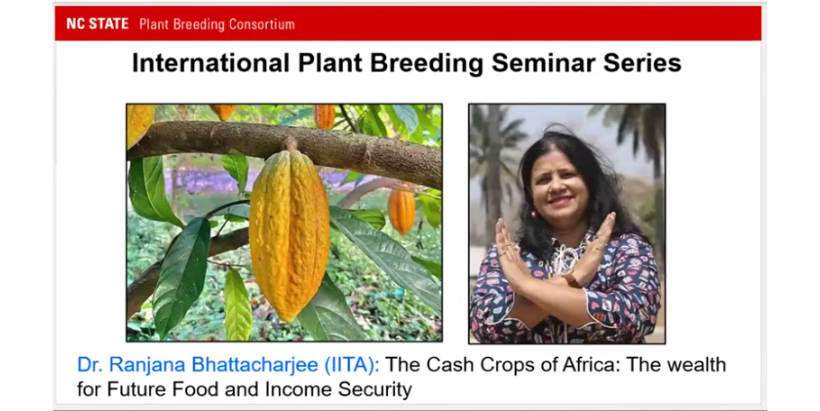
 Dr Bhattacharjee’s presentation.
Dr Bhattacharjee’s presentation.

Africa’s cash crops have significant potential to drive economic growth, improve rural livelihoods, and strengthen food and income security. Realizing this potential will require investment in crop improvement research, climate-resilient production, and local value addition.

This was the central message of a presentation by IITA Senior Scientist and Molecular Breeder, Dr Ranjana Bhattacharjee, titled “The Cash Crops of Africa: The Wealth for Future Food and Income Security.” She delivered the presentation during the third seminar of the 12th International Plant Breeding Seminar Series, hosted by North Carolina State University in the United States.

Dr Bhattacharjee said cash crops should be viewed not only as export commodities but as strategic assets that generate income and employment, support industries, and strengthen food systems. Income from high-value crops can help smallholder farmers purchase a wider variety of foods, access improved seeds, and invest in farm inputs. Intercropping cocoa and coffee with banana, plantain, cassava, and maize can further diversify production and make efficient use of farmland.

West Africa accounts for approximately 60 to 70 percent of global cocoa production, while East Africa is an important coffee-producing region, with Ethiopia recognized as the crop’s place of origin.

Despite their importance, cocoa and coffee production face aging trees, declining soil fertility, high input costs, limited access to credit and extension services, and fluctuating commodity prices. An aging farming population and limited youth participation also threaten the sustainability of production.

Pests and diseases compound these pressures, with the presentation identifying average annual losses of 30 to 40 percent in some production systems. Major cocoa threats include black pod disease, cocoa swollen shoot virus disease, and mirids, while coffee is affected by leaf rust, berry borer, and coffee wilt disease. Climate change further intensifies these challenges through rising temperatures, erratic rainfall, and prolonged droughts, disrupting flowering, crop development, and productivity.

Dr Bhattacharjee highlighted IITA research using genomic tools to strengthen genetic resources and improve key African crops. In yam, an important food and cash crop in sub-Saharan Africa, particularly Nigeria, NSF-BREAD-supported research examined 1,074 accessions, of which 938 shared clonal relationships with one or more samples. The work investigated genetic relationships, flowering, and sex-determination regions to generate resources for future breeding.

Dr Bhattacharjee speaking on ‘The Cash Crops of Africa’ during the seminar.

In cocoa, research under the World Cocoa Foundation-funded African Cocoa Initiative involved DNA fingerprinting 10,040 genotypes from Nigeria, Ghana, Côte d’Ivoire, Cameroon, and Togo. Findings revealed duplication and mislabelling in some national germplasm collections, highlighting the need for accurate identification of genetic resources. Related research on cocoa’s response to black pod disease has identified genes associated with plant defense, providing insights into disease resistance.

A Nigerian study of 48 coffee genotypes representing five species found low genetic diversity among farmers’ collections and evidence of mislabelling in some of the institute’s germplasm. In Liberia, researchers evaluated 846 Arabica, Robusta, and Liberica genotypes. Preliminary bean-quality analyses suggested that Liberica could offer opportunities in niche and international markets, although further sensory evaluation is needed.

Beyond crop genetics, Dr Bhattacharjee emphasized stronger seed systems, digital technologies, extension services, and integrated soil and fertilizer management. She highlighted the proposed Cocoa SeedTracker, designed to support seed traceability, certification, production monitoring, and access to information on varieties and planting materials. She also presented the STEPWISE approach, which combines good agronomic practices with climate-smart packages tailored to cocoa-growing zones.

She called for African producing countries to move beyond exporting raw commodities towards local processing. In cocoa, this includes producing cocoa butter, liquor, and powder locally to retain more value within producing countries. The presentation estimated that every US$1 invested in appropriate, quality inputs could generate an average of US$3 to US$4 in additional revenue through improved bean quality and productivity.

Dr Bhattacharjee stressed that unlocking the sector’s potential will require improved varieties and planting materials, effective pest and disease management, sustainable agroforestry, digital solutions, and stronger institutional and policy support. Collaboration among governments, research institutions, private-sector actors, and farmer organizations will be essential to make technologies and quality inputs more accessible to farmers.

Strengthening research, sustainable production, and local value addition can help build a more productive and resilient cash crop sector while advancing Africa’s long-term food and income security.


Contributed by

Ochuwa Favour Daramola

Scroll to Top
Olaosebikan, Olamide

Olamide Deborah Nwanze is a Senior Research Associate specializing in gender mainstreaming research to inform participatory and inclusive breeding, variety development, and seed systems policies regarding root, tuber, and banana (RTB) crops in the International Institute of Tropical Agriculture Headquarters, Ibadan, Nigeria. She is a PhD candidate at the University of Ibadan and holds an MSc and B. Agric in Agricultural Extension and Rural Development. Olamide is a fellow of the African Women in Agricultural Research and Development – Gender Responsive Agricultural Systems Policy (AWARD-GRASP) and the Gender Responsive Researchers Equipped for Agricultural Transformation (GREAT). She seeks to apply her gender-mainstreaming learnings, gender-responsive research, and policy development, and review expertise to facilitate women, youth, children, and vulnerable social group’s access to and adoption of agricultural Innovations that guarantee food, nutrition, income, and livelihood security in Africa. Her current roles include mentoring research fellows, development of guides and training manuals, implementation and adaptation of gender frameworks and tools, value chain actors’ engagement as citizen science partners, policy review and redesign, data management, and analysis. Her current research explores mixed methods and participatory and interdisciplinary approaches to capture and highlight gender dynamics, needs, preferences, and challenges stakeholders face within the agricultural livelihood value chain to prioritize gender-inclusive strategies in breeding programs, policy design, and implementation.

At IITA, she contributes to the implementation of the CGIAR Accelerated Breeding Initiative and Genetic Innovation Programs; participatory and gender research within the NextGen Cassava, HarvestPlus, RTBFoods, and Tricot-ClimMob 1000Farms Projects; and gender knowledge communication via the G-LENS webinar series, video documentary, policy briefs, publications, and blogs.


Recent publications

de Sousa, K., van Etten, J., Manners, R. Bello, A., Teeken, B., Olaosebikan, O., et al. 2024. The tricot approach: an agile framework for decentralized on-farm testing supported by citizen science. A retrospective. Agron. Sustain. Dev. 44, 8. https://doi.org/10.1007/s13593-023-00937-1

Madu, T., Onwuka, S., Nwafor, S., Onyemauwa, N., Ejechi, M., Ofoeze, M., Ukeje, B., Eluagu, C., Olaosebikan, O., Okoye, B., 2024. Gender-Inclusive Consumer Studies Improve Cassava Breeding in Nigeria in: Frontiers in Sociology, volume 9, number: 1224504, doi: 10.3389/fsoc.2024.1224504

Olaosebikan, O.; Bello, A.; Utoblo, O.; Okoye, B.; Olutegbe, N.; Garner, E.; Teeken, B.; Bryan, E.; Forsythe, L.; Cole, S.; Madu, T. 2023.  Stressors and Resilience within the Cassava Value Chain in Nigeria: Preferred Cassava Variety Traits and Response Strategies of Men and Women to Inform Breeding. Sustainability 15, 7837. https://doi.org/10.3390/su15107837

Okoye, B., Ofoeze, M., Ejechi, M., Onwuka, S., Nwafor, S., Onyemauwa, N., Ukeje, B., Eluagu, C., Obidiegwu, J.*, Olaosebikan, O., Madu, T.* 2023. Prioritizing preferred traits in the yam value chain in Nigeria: a gender situation analysis in: Frontiers in Sociology, volume 8, number: 1232626, pages 1 – 9, ISSN 2297-7775, 2023. https://www.frontiersin.org/articles/10.3389/fsoc.2023.1232626/full

Olaosebikan, O., Bello, A. A., de Sousa, K., Ndjouenkeu, R., Adesokan, M., Alamu, E. O., Agbona, A., van Etten, J., Kegah, F. N.*, Dufour, D., Bouniol, A., Teeken, B. 2023. Consumer acceptability of cassava gari-eba food products across cultural and environmental settings using the triadic comparison of technologies approach (tricot) in: Journal of the Science of Food and Agriculture,

Teeken, B., Olaosebikan, O., Bello, A. A., Madu, T.*, Cole, S. M. 2023. Qualitative assessment on the positionality and preferences of dyads in relation to cassava-related activities: working with tricot trial citizen scientists https://hdl.handle.net/10568/138326 Type: Manual

Bouniol, A., Ceballos, H., Bello, A. A., Teeken, B., Olaosebikan, O., Owoade, D., Agbona, A., Fotso Kuate, A., Madu, T.*, Okoye, B.*, Ofoeze, M.*, Nwafor, S.*, Onyemauwa, N.*, Adinsi, L.*, Forsythe, L., Dufour, D. 2023. Varietal impact on women’s labour, workload and related drudgery in processing root, tuber and banana crops: focus on cassava in sub-Saharan Africa in: Journal of the Science of Food and Agriculture, pages 1 – 25, ISSN 0022-5142,

Bello, A. A., Agbona, A., Olaosebikan, O., Edughaen, G., Dufour, D., Bouniol, A., Iluebbey, P., Ndjouenkeu, R.*, Rabbi, I. Y., Teeken, B. 2023. Genetic and environmental effects on processing productivity and food product yield: drudgery of women’s work in: Journal of the Science of Food and Agriculture, pages 1 – 32, ISSN 0022-5142, 5

Cavicchioli, M., Zimbiti, T., Teeken, B., Nwanze, D.O., Liani, M., Parkes, E. & Bello, A. 2023. IITA-Gender Responsive Breeding Training Report. Genetic Resources Center, IITA-HQ, Ibadan, 21-23 September, 2022. Ibadan, Nigeria: IITA, (34 p.).https://hdl.handle.net/10568/131368

Agbona, A. Peteti P., Teeken B., Olaosebikan O. Bello, A. A., Parkes, E., Rabbi, I. Y., Mueller, L., Egesi, C., Kulakow, P. 2022. Data Management in Multi-disciplinary African RTB Crop Breeding Programs. In: Williamson, H.F., Leonelli, S. (eds) Towards Responsible Plant Data Linkage: Data Challenges for Agricultural Research and Development. Springer, Cham. https://doi.org/10.1007/978-3-031-13276-6_5

Lora Forsythe, Pricilla Marimo, Sarah Mayanja, Olamide D. Olaosebikan, Esme Stuart, Bela Teeken, Benjamin Okoye, Tessy Madu, (2021). Cross-product Gender Analysis of RTBfoods Step 2 Gendered Food Mapping on RTB Products. Understanding the Drivers of Trait Preferences and the Development of Multi-user RTB Product Profiles, WP1. London, UK: RTBfoods Field Scientific Report, 30 p.

Teeken, B., Garner, E., Agbona, A., Balogun, I., Olaosebikan, O., Bello, A., Madu, T., Okoye, B., Egesi, C., Kulakow, P. and Tufan, H.A. 2021. Beyond “Women’s Traits”: Exploring How Gender, Social Difference, and Household Characteristics Influence Trait Preferences. Frontiers Sustainable Food Systems 5:740926. https://doi.org/10.3389/fsufs.2021.740926

Teeken, B., Agbona, A., Bello, A., Olaosebikan, O., Alamu, E., Adesokan, M., Awoyale, W., Madu, T., Okoye, B., Chijioke, U., Owoade, D., Okoro, M., Bouniol, A., Dufour, D., Hershey, C., Rabbi, I., Maziya‐Dixon, B., Egesi, C., Tufan, H. and Kulakow, P. (020. Understanding cassava varietal preferences through pairwise ranking of gari‐eba and fufu prepared by local farmer–processors. Int J Food Sci Technol. https://doi.org/10.1111/ijfs.14862

Bela Teeken, Olamide Olaosebikan, Ireti Balogun, Benjamin Okoye, Tessy Madu, Steven Cole, Abolore Bello, Elizabeth Parkes. (2020). Piloting the G+ customer and product profile tools for gender-responsive cassava breeding in Nigeria. Nigeria: International Institute of Tropical Agriculture (IITA). https://hdl.handle.net/20.500.11766/13000