As an implementing partner in the provinces of Sud-Kivu and Tanganyika in eastern DRC, IITA–CGIAR has just unveiled the results achieved by the cassava and regional integration components of the Projet Intégré de Croissance Agricole dans le grand-lacs (PICAGL).
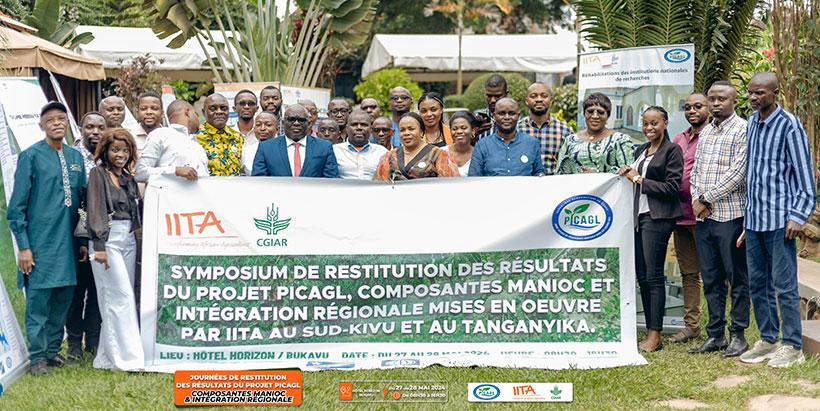
Participants after the PICAGL symposium in DRC.
The symposium was held over two days in Bukavu, the capital of South Kivu, from 27 to 28 May. During the symposium, IITA reviewed the major achievements of this project, which has provided improved varieties of cassava and rice in the two provinces concerned.
According to IITA Deputy Director General, Research for Development (DDG-R4D), Bernard Vanlauwe, in addition to the improved seeds introduced by PICAGL, the project’s two components have also enabled the rehabilitation and equipping of laboratories at CRSN Lwiro and INERA Mulungu in Kabare territory, and the construction and equipping of the aflatoxin analysis laboratory.
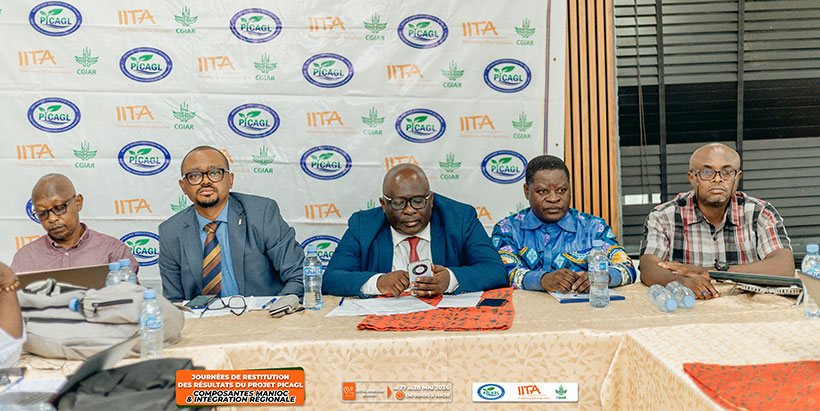
Facilitators at the symposium.
Thanks to PICAGL, Tanganyika now has outlets selling high-quality cassava flour (planifiable flours), making manufacturing cassava-based products such as Chikwange, bread, and cookies easier. The results show that the project has exceeded the planned target of 14 tonnes per hectare to over 20 tonnes per hectare for cassava yields in the field. Similarly, the household project has reached over 44,000 in Tanganyika out of a planned 52,000.
Regarding regional integration, the project’s achievements include scholarship holders who have obtained their Masters’ degrees and the introduction of fortified organic maize seeds.
Added to this are agroforestry and reforestation activities, including training for producers and the various players in the value chain.
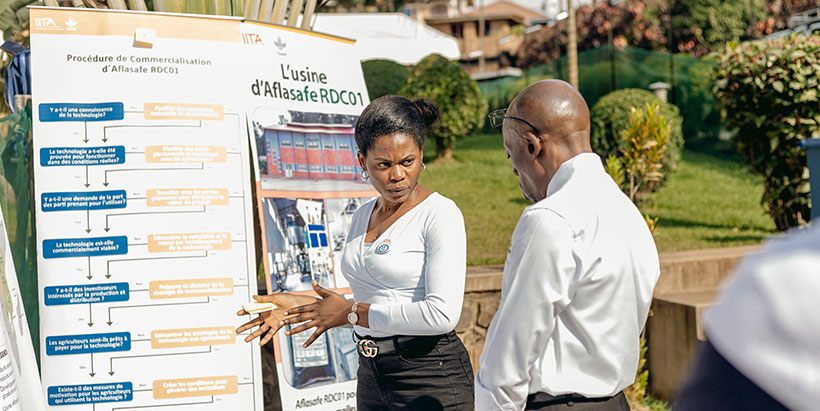
The project’s results include several studies, such as the food quality project, which has established a major innovation in South Kivu: an Aflasafe plant producing 5 tons per day. The plant helps to ensure healthy and toxin-free food.
Poster presentation during the PICAGL symposium.
The results presented over the two days revealed the significant progress made, notwithstanding some difficulties encountered during the implementation of the project’s activities.
In his presentation, the head of the PICAGL project at IITA, Leon Nabahungu, praised the Institute’s contribution to the success of this Congolese government project to improve agricultural production. He estimated that PICAGL’s cassava and regional integration components were more than 90% successful.
Nabahungu asserted, “For regional integration, the work was much more related to doing research that can help the rice, milk, and agroforestry value chains. So, we worked with government departments like INERA and SENASEM to research and find solutions. There was also the question of training INERA staff because we know that it’s the institution that will ensure the sustainability of this project, and to be a researcher, you have to study and have either a master’s degree or a doctorate.”
He explained further, “For cassava, the target was over 80,000 households (60% in South Kivu and 40% in Kalemie). We have invited our partners to show the results we have achieved and to discuss the lessons learned during the project’s implementation and sustainability. The success rate is 95%.”
He added, “In South Kivu and Tanganyika, we had a target of over 80,000 households, but we reached 20 million, and we think we have done a bit more. The donor is there and can easily see what has been planned and what has been done. In South Kivu, 64,000 households have benefited directly from our seeds and agricultural technologies for manioc.”
The provincial coordinator of PICAGL in Tanganyika participated in this feedback symposium and praised the results. For Jean Paul Batibuha, the lessons and results will enable the central and provincial governments and development stakeholders to successfully implement future development projects in the two provinces (South Kivu and Tanganyika).
He reminded participants to capitalize on the results presented and perpetuate PICAGL’s achievements.
Contributed by Isabelle Buhoro
Contributed by
Recent stories
No items found
Scroll to Top
Olaosebikan, Olamide
Olamide Deborah Nwanze is a Senior Research Associate specializing in gender mainstreaming research to inform participatory and inclusive breeding, variety development, and seed systems policies regarding root, tuber, and banana (RTB) crops in the International Institute of Tropical Agriculture Headquarters, Ibadan, Nigeria. She is a PhD candidate at the University of Ibadan and holds an MSc and B. Agric in Agricultural Extension and Rural Development. Olamide is a fellow of the African Women in Agricultural Research and Development – Gender Responsive Agricultural Systems Policy (AWARD-GRASP) and the Gender Responsive Researchers Equipped for Agricultural Transformation (GREAT). She seeks to apply her gender-mainstreaming learnings, gender-responsive research, and policy development, and review expertise to facilitate women, youth, children, and vulnerable social group’s access to and adoption of agricultural Innovations that guarantee food, nutrition, income, and livelihood security in Africa. Her current roles include mentoring research fellows, development of guides and training manuals, implementation and adaptation of gender frameworks and tools, value chain actors’ engagement as citizen science partners, policy review and redesign, data management, and analysis. Her current research explores mixed methods and participatory and interdisciplinary approaches to capture and highlight gender dynamics, needs, preferences, and challenges stakeholders face within the agricultural livelihood value chain to prioritize gender-inclusive strategies in breeding programs, policy design, and implementation.
de Sousa, K., van Etten, J., Manners, R. Bello, A., Teeken, B., Olaosebikan, O., et al. 2024. The tricot approach: an agile framework for decentralized on-farm testing supported by citizen science. A retrospective. Agron. Sustain. Dev. 44, 8. https://doi.org/10.1007/s13593-023-00937-1
Madu, T., Onwuka, S., Nwafor, S., Onyemauwa, N., Ejechi, M., Ofoeze, M., Ukeje, B., Eluagu, C., Olaosebikan, O., Okoye, B., 2024. Gender-Inclusive Consumer Studies Improve Cassava Breeding in Nigeria in: Frontiers in Sociology, volume 9, number: 1224504, doi: 10.3389/fsoc.2024.1224504
Olaosebikan, O.; Bello, A.; Utoblo, O.; Okoye, B.; Olutegbe, N.; Garner, E.; Teeken, B.; Bryan, E.; Forsythe, L.; Cole, S.; Madu, T. 2023. Stressors and Resilience within the Cassava Value Chain in Nigeria: Preferred Cassava Variety Traits and Response Strategies of Men and Women to Inform Breeding. Sustainability 15, 7837. https://doi.org/10.3390/su15107837
Okoye, B., Ofoeze, M., Ejechi, M., Onwuka, S., Nwafor, S., Onyemauwa, N., Ukeje, B., Eluagu, C., Obidiegwu, J.*, Olaosebikan, O., Madu, T.* 2023. Prioritizing preferred traits in the yam value chain in Nigeria: a gender situation analysis in: Frontiers in Sociology, volume 8, number: 1232626, pages 1 – 9, ISSN 2297-7775, 2023. https://www.frontiersin.org/articles/10.3389/fsoc.2023.1232626/full
Olaosebikan, O., Bello, A. A., de Sousa, K., Ndjouenkeu, R., Adesokan, M., Alamu, E. O., Agbona, A., van Etten, J., Kegah, F. N.*, Dufour, D., Bouniol, A., Teeken, B. 2023. Consumer acceptability of cassava gari-eba food products across cultural and environmental settings using the triadic comparison of technologies approach (tricot) in: Journal of the Science of Food and Agriculture,
Teeken, B., Olaosebikan, O., Bello, A. A., Madu, T.*, Cole, S. M. 2023. Qualitative assessment on the positionality and preferences of dyads in relation to cassava-related activities: working with tricot trial citizen scientists https://hdl.handle.net/10568/138326 Type: Manual
Bouniol, A., Ceballos, H., Bello, A. A., Teeken, B., Olaosebikan, O., Owoade, D., Agbona, A., Fotso Kuate, A., Madu, T.*, Okoye, B.*, Ofoeze, M.*, Nwafor, S.*, Onyemauwa, N.*, Adinsi, L.*, Forsythe, L., Dufour, D. 2023. Varietal impact on women’s labour, workload and related drudgery in processing root, tuber and banana crops: focus on cassava in sub-Saharan Africa in: Journal of the Science of Food and Agriculture, pages 1 – 25, ISSN 0022-5142,
Bello, A. A., Agbona, A., Olaosebikan, O., Edughaen, G., Dufour, D., Bouniol, A., Iluebbey, P., Ndjouenkeu, R.*, Rabbi, I. Y., Teeken, B. 2023. Genetic and environmental effects on processing productivity and food product yield: drudgery of women’s work in: Journal of the Science of Food and Agriculture, pages 1 – 32, ISSN 0022-5142, 5
Cavicchioli, M., Zimbiti, T., Teeken, B., Nwanze, D.O., Liani, M., Parkes, E. & Bello, A. 2023. IITA-Gender Responsive Breeding Training Report. Genetic Resources Center, IITA-HQ, Ibadan, 21-23 September, 2022. Ibadan, Nigeria: IITA, (34 p.).https://hdl.handle.net/10568/131368
Agbona, A. Peteti P., Teeken B., Olaosebikan O. Bello, A. A., Parkes, E., Rabbi, I. Y., Mueller, L., Egesi, C., Kulakow, P. 2022. Data Management in Multi-disciplinary African RTB Crop Breeding Programs. In: Williamson, H.F., Leonelli, S. (eds) Towards Responsible Plant Data Linkage: Data Challenges for Agricultural Research and Development. Springer, Cham. https://doi.org/10.1007/978-3-031-13276-6_5
Lora Forsythe, Pricilla Marimo, Sarah Mayanja, Olamide D. Olaosebikan, Esme Stuart, Bela Teeken, Benjamin Okoye, Tessy Madu, (2021). Cross-product Gender Analysis of RTBfoods Step 2 Gendered Food Mapping on RTB Products. Understanding the Drivers of Trait Preferences and the Development of Multi-user RTB Product Profiles, WP1. London, UK: RTBfoods Field Scientific Report, 30 p.
Teeken, B., Garner, E., Agbona, A., Balogun, I., Olaosebikan, O., Bello, A., Madu, T., Okoye, B., Egesi, C., Kulakow, P. and Tufan, H.A. 2021. Beyond “Women’s Traits”: Exploring How Gender, Social Difference, and Household Characteristics Influence Trait Preferences. Frontiers Sustainable Food Systems 5:740926. https://doi.org/10.3389/fsufs.2021.740926
Teeken, B., Agbona, A., Bello, A., Olaosebikan, O., Alamu, E., Adesokan, M., Awoyale, W., Madu, T., Okoye, B., Chijioke, U., Owoade, D., Okoro, M., Bouniol, A., Dufour, D., Hershey, C., Rabbi, I., Maziya‐Dixon, B., Egesi, C., Tufan, H. and Kulakow, P. (020. Understanding cassava varietal preferences through pairwise ranking of gari‐eba and fufu prepared by local farmer–processors. Int J Food Sci Technol.https://doi.org/10.1111/ijfs.14862
Bela Teeken, Olamide Olaosebikan, Ireti Balogun, Benjamin Okoye, Tessy Madu, Steven Cole, Abolore Bello, Elizabeth Parkes. (2020). Piloting the G+ customer and product profile tools for gender-responsive cassava breeding in Nigeria. Nigeria: International Institute of Tropical Agriculture (IITA). https://hdl.handle.net/20.500.11766/13000