
IITA NEWS

Transforming banana breeding in East Africa: IITA and NARS sign regional agreement
March 22, 2024

IITACGIAR and six national agricultural research centers have signed the Mchare and Matooke Regional Target Product Profiles to enhance banana breeding and breeding impact in East Africa to better serve smallholder farmers and their families. This agreement, signed during the recent East Africa Banana Network Meeting in Kampala Uganda, aims to develop and test new banana hybrids jointly in the highlands of Eastern Africa, following standardized breeding and testing procedures.
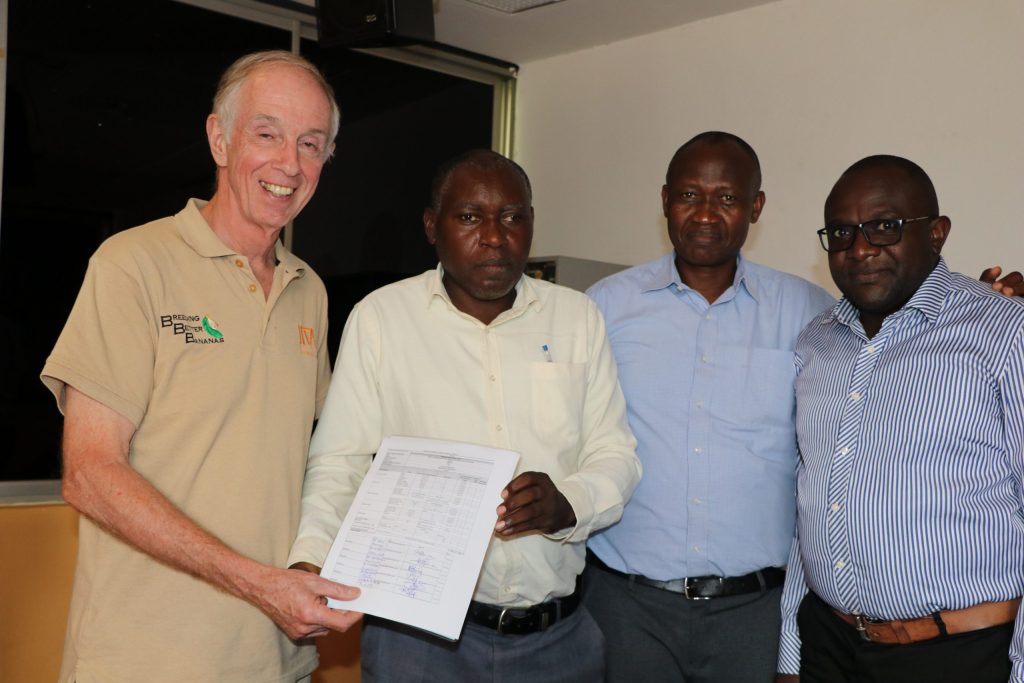
The agreement was signed by country banana research leads from Burundi, the Democratic Republic of Congo, Kenya, Rwanda, Uganda, and Tanzania in the presence of IITA Head of Breeding Hapson Mushoriwa and representatives of Genetic Innovation’s Accelerated Breeding Initiative. These countries represent about 40% of banana production in Africa, and this initiative marks the establishment and launch of the East African Banana Breeding Network, which aims to accelerate the delivery of improved banana varieties in the region.

IITA Banana Crop Lead Rony Swennen highlighted the significance of the network, noting that traditional banana breeding processes are time-consuming and costly. He emphasized that through the network, breeding and testing can be expedited, with a focus on meeting specific country needs rather than solely relying on what breeders can offer. In the end, farmers will benefit more quickly from the new varieties.

Just like the breeding of all RTB crops—banana, cassava, potato, sweet potato, and yam—is being tackled together instead of on an individual crop basis, through the Bill & Melinda Gates Foundation-funded project, RTB Breeding, it is important and practical for NARS to also work together despite the different countries and realities they represent, so all benefit from the shared learning and intellectual cross pollination.

The network aims to streamline the breeding process by sharing breeding data collected by a few breeders. This collaborative effort will focus on product profile and market segmentation, product design, on-farm testing, product registration, and product launch in their respective countries.

To ensure a standardized and systematic flow of information for decision-making, the network will follow stages and gates of communications throughout the breeding process using the RAPID (Recommend, Input, Agree, Decide, Perform) model. These stages involve product design, trait deployment, crossing and screening, early testing, pre-commercial testing, product registration, and product introduction. Breeders must pass through gate decisions, including crop strategy and product profile agreement, defining trait deployment strategy, selecting clones for preliminary yield trials, advancing candidates for on-farm trials, and advancing candidates for variety release to move to the next stage.

IITA Molecular Breeder Brigitte Uwimana advised, “NARS and breeders are encouraged to apply the stages and gates depending on what suits their work to adopt the framework of the communication flow.”

The banana network was well-received and commended by participants as a transformative initiative in accelerating regional banana improvement. NARS representative from Burundi Celestine Niyongere suggested, “I recommend we start by prioritizing the countries’ needs and demands and use the already available resources.”

Jules Bagula, the NARS representative from the Democratic Republic of Congo, expressed, “INERA is willing and ready to follow the Mchare and Matooke dissemination procedures. Moreover, the new network is an opportunity for DRC to improve its collaboration with CGIAR and other NARS involved in the region.”

Generose Nziguheba of VIB-IPBO emphasized that the participants should consider harmonization and data/protocol sharing by observing country policies and accepting the data from specific countries to enhance the efficiency of the network.

During the meeting, participants defined the network’s main activities and members’ responsibilities. All country representatives had the opportunity to nominate the network steering committee representative for their respective countries. The chair of the steering committee is Rony Swennen (IITA) and members are Alex Barekye (NARO-Uganda), Mpoki Shimwela (TARI-Tanzania), Benjamin Kivuva (KALRO-Kenya), Mary Mwanga (KU-Kenya), Immaculee Nishimwe (RAB-Rwanda), Celestin Niyongere (ISABU-Burundi), Jules Ntamwira  Bagula (INERA-DR Congo).

This collaboration marks a significant step towards enhancing banana breeding efforts in East Africa, focusing on meeting the specific needs of the region’s farmers and increasing food security and income through farming of improved cooking banana.


Scroll to Top
Olaosebikan, Olamide

Olamide Deborah Nwanze is a Senior Research Associate specializing in gender mainstreaming research to inform participatory and inclusive breeding, variety development, and seed systems policies regarding root, tuber, and banana (RTB) crops in the International Institute of Tropical Agriculture Headquarters, Ibadan, Nigeria. She is a PhD candidate at the University of Ibadan and holds an MSc and B. Agric in Agricultural Extension and Rural Development. Olamide is a fellow of the African Women in Agricultural Research and Development – Gender Responsive Agricultural Systems Policy (AWARD-GRASP) and the Gender Responsive Researchers Equipped for Agricultural Transformation (GREAT). She seeks to apply her gender-mainstreaming learnings, gender-responsive research, and policy development, and review expertise to facilitate women, youth, children, and vulnerable social group’s access to and adoption of agricultural Innovations that guarantee food, nutrition, income, and livelihood security in Africa. Her current roles include mentoring research fellows, development of guides and training manuals, implementation and adaptation of gender frameworks and tools, value chain actors’ engagement as citizen science partners, policy review and redesign, data management, and analysis. Her current research explores mixed methods and participatory and interdisciplinary approaches to capture and highlight gender dynamics, needs, preferences, and challenges stakeholders face within the agricultural livelihood value chain to prioritize gender-inclusive strategies in breeding programs, policy design, and implementation.

At IITA, she contributes to the implementation of the CGIAR Accelerated Breeding Initiative and Genetic Innovation Programs; participatory and gender research within the NextGen CassavaHarvestPlusRTBFoods, and Tricot-ClimMob 1000Farms Projects; and gender knowledge communication via the G-LENS webinar series, video documentary, policy briefspublications, and blogs.


Recent publications

de Sousa, K., van Etten, J., Manners, R. Bello, A., Teeken, B., Olaosebikan, O., et al. 2024. The tricot approach: an agile framework for decentralized on-farm testing supported by citizen science. A retrospective. Agron. Sustain. Dev. 44, 8. https://doi.org/10.1007/s13593-023-00937-1

Madu, T., Onwuka, S., Nwafor, S., Onyemauwa, N., Ejechi, M., Ofoeze, M., Ukeje, B., Eluagu, C., Olaosebikan, O., Okoye, B., 2024. Gender-Inclusive Consumer Studies Improve Cassava Breeding in Nigeria in: Frontiers in Sociology, volume 9, number: 1224504, doi: 10.3389/fsoc.2024.1224504

Olaosebikan, O.; Bello, A.; Utoblo, O.; Okoye, B.; Olutegbe, N.; Garner, E.; Teeken, B.; Bryan, E.; Forsythe, L.; Cole, S.; Madu, T. 2023.  Stressors and Resilience within the Cassava Value Chain in Nigeria: Preferred Cassava Variety Traits and Response Strategies of Men and Women to Inform Breeding. Sustainability 15, 7837. https://doi.org/10.3390/su15107837

Okoye, B., Ofoeze, M., Ejechi, M., Onwuka, S., Nwafor, S., Onyemauwa, N., Ukeje, B., Eluagu, C., Obidiegwu, J.*, Olaosebikan, O., Madu, T.* 2023. Prioritizing preferred traits in the yam value chain in Nigeria: a gender situation analysis in: Frontiers in Sociology, volume 8, number: 1232626, pages 1 – 9, ISSN 2297-7775, 2023. https://www.frontiersin.org/articles/10.3389/fsoc.2023.1232626/full

Olaosebikan, O., Bello, A. A., de Sousa, K., Ndjouenkeu, R., Adesokan, M., Alamu, E. O., Agbona, A., van Etten, J., Kegah, F. N.*, Dufour, D., Bouniol, A., Teeken, B. 2023. Consumer acceptability of cassava gari-eba food products across cultural and environmental settings using the triadic comparison of technologies approach (tricot) in: Journal of the Science of Food and Agriculture,

Teeken, B., Olaosebikan, O., Bello, A. A., Madu, T.*, Cole, S. M. 2023. Qualitative assessment on the positionality and preferences of dyads in relation to cassava-related activities: working with tricot trial citizen scientists https://hdl.handle.net/10568/138326 Type: Manual

Bouniol, A., Ceballos, H., Bello, A. A., Teeken, B., Olaosebikan, O., Owoade, D., Agbona, A., Fotso Kuate, A., Madu, T.*, Okoye, B.*, Ofoeze, M.*, Nwafor, S.*, Onyemauwa, N.*, Adinsi, L.*, Forsythe, L., Dufour, D. 2023. Varietal impact on women’s labour, workload and related drudgery in processing root, tuber and banana crops: focus on cassava in sub-Saharan Africa in: Journal of the Science of Food and Agriculture, pages 1 – 25, ISSN 0022-5142,

Bello, A. A., Agbona, A., Olaosebikan, O., Edughaen, G., Dufour, D., Bouniol, A., Iluebbey, P., Ndjouenkeu, R.*, Rabbi, I. Y., Teeken, B. 2023. Genetic and environmental effects on processing productivity and food product yield: drudgery of women’s work in: Journal of the Science of Food and Agriculture, pages 1 – 32, ISSN 0022-5142, 5

Cavicchioli, M., Zimbiti, T., Teeken, B., Nwanze, D.O., Liani, M., Parkes, E. & Bello, A. 2023. IITA-Gender Responsive Breeding Training Report. Genetic Resources Center, IITA-HQ, Ibadan, 21-23 September, 2022. Ibadan, Nigeria: IITA, (34 p.).https://hdl.handle.net/10568/131368

Agbona, A. Peteti P., Teeken B., Olaosebikan O. Bello, A. A., Parkes, E., Rabbi, I. Y., Mueller, L., Egesi, C., Kulakow, P. 2022. Data Management in Multi-disciplinary African RTB Crop Breeding Programs. In: Williamson, H.F., Leonelli, S. (eds) Towards Responsible Plant Data Linkage: Data Challenges for Agricultural Research and Development. Springer, Cham. https://doi.org/10.1007/978-3-031-13276-6_5

Lora Forsythe, Pricilla Marimo, Sarah Mayanja, Olamide D. Olaosebikan, Esme Stuart, Bela Teeken, Benjamin Okoye, Tessy Madu, (2021). Cross-product Gender Analysis of RTBfoods Step 2 Gendered Food Mapping on RTB Products. Understanding the Drivers of Trait Preferences and the Development of Multi-user RTB Product Profiles, WP1. London, UK: RTBfoods Field Scientific Report, 30 p.

Teeken, B., Garner, E., Agbona, A., Balogun, I., Olaosebikan, O., Bello, A., Madu, T., Okoye, B., Egesi, C., Kulakow, P. and Tufan, H.A. 2021. Beyond “Women’s Traits”: Exploring How Gender, Social Difference, and Household Characteristics Influence Trait Preferences. Frontiers Sustainable Food Systems 5:740926. https://doi.org/10.3389/fsufs.2021.740926

Teeken, B., Agbona, A., Bello, A., Olaosebikan, O., Alamu, E., Adesokan, M., Awoyale, W., Madu, T., Okoye, B., Chijioke, U., Owoade, D., Okoro, M., Bouniol, A., Dufour, D., Hershey, C., Rabbi, I., Maziya‐Dixon, B., Egesi, C., Tufan, H. and Kulakow, P. (020. Understanding cassava varietal preferences through pairwise ranking of gari‐eba and fufu prepared by local farmer–processors. Int J Food Sci Technol. https://doi.org/10.1111/ijfs.14862

Bela Teeken, Olamide Olaosebikan, Ireti Balogun, Benjamin Okoye, Tessy Madu, Steven Cole, Abolore Bello, Elizabeth Parkes. (2020). Piloting the G+ customer and product profile tools for gender-responsive cassava breeding in Nigeria. Nigeria: International Institute of Tropical Agriculture (IITA). https://hdl.handle.net/20.500.11766/13000