
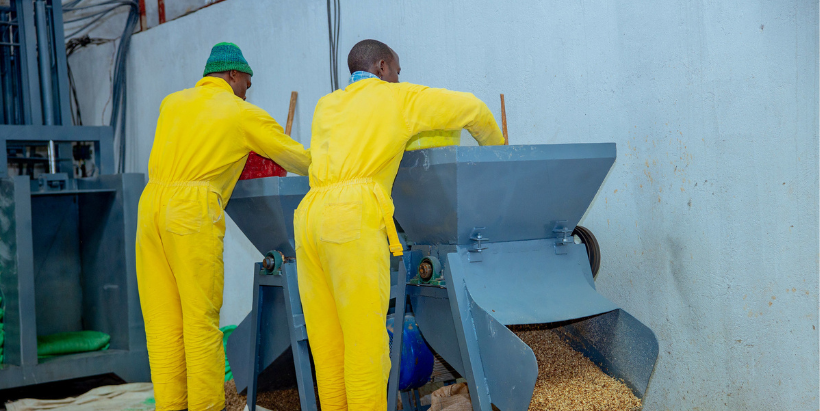
Every year, cassava processing generates large quantities of cassava peels that are often discarded, leading to environmental pollution and representing a missed economic opportunity. At the same time, livestock producers continue to face high animal feed costs, driven by rising prices of conventional feed ingredients. Addressing these two challenges simultaneously requires innovative solutions that transform agricultural waste into valuable products.
For Bizumuremyi Christian, Founder and Managing Director of Kabizu Business Group Ltd (an agro-processing company), the answer lies in converting cassava peels into High-Quality Cassava Peels (HQCP), a nutritious and affordable ingredient for animal feed. With support from the Rural-Urban Nexus (RUNRES) project by IITA Rwanda, Kabizu Business Group has demonstrated that what was once considered waste can become a profitable business while contributing to environmental sustainability.
“Our biggest challenge was convincing people that cassava peels are not waste but a valuable resource. We also faced limited processing technology, financial constraints, and the challenge of meeting strict quality standards. Many people could not imagine that cassava waste could become a high-quality commercial product,” Christian recalls.
With technical support from IITA Rwanda through the RUNRES Project, the company established a modern cassava peel processing facility. It improved its production systems to produce High-Quality Cassava Peels that meet market requirements. The project also strengthened partnerships with researchers, farmers, and other stakeholders, enabling Kabizu Business Group to transform an environmental challenge into a sustainable business opportunity.
“The project has completely changed my perspective as an entrepreneur. It has given me the confidence to invest in innovation and sustainability. I have learned that a business can generate profit while creating positive environmental and social impact,” Christian says.
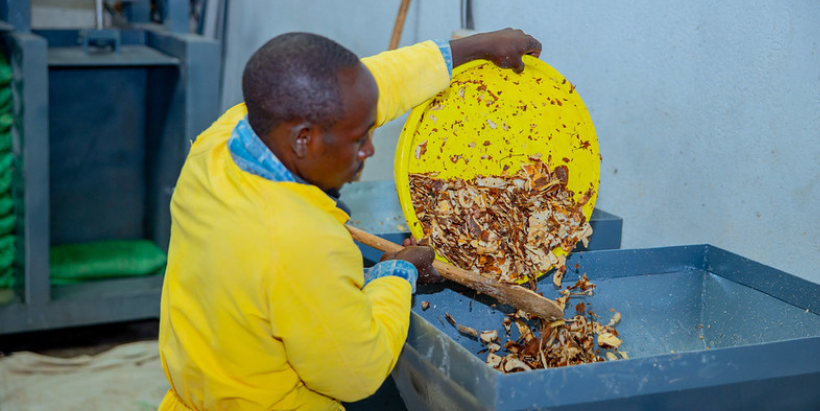
But transforming cassava peels into a reliable animal feed ingredient requires more than simply finding a new use for the waste. The peels must undergo appropriate processing to ensure they are safe, stable, and suitable for use in animal feed.
“Cassava peels are rich in fermentable carbohydrates, but in their raw form, they carry anti-nutritional compounds and moisture levels that make them unsafe and unstable as feed. The processing protocols we introduced through RUNRES address both issues — reducing cyanogenic compounds to safe levels while stabilizing the product for storage and transport,” explains Emmanuel Rukundo, Research Associate at IITA Rwanda, providing technical support and following up on the RUNRES innovations in Rwanda.
He notes that Kabizu Business Group’s success illustrates a broader principle behind the RUNRES approach: pairing farmers, processors, and researchers around a shared technical standard enables a waste stream to become a reliable commercial input. “It’s not enough to have an idea. You need consistent quality control, proper drying and grating systems, and a feed product that livestock producers can trust batch after batch. That’s where the technical partnership made the difference.”
Beyond strengthening the business, the innovation has created employment opportunities, enhanced the company’s reputation as a pioneer in Rwanda’s agro-processing sector, and opened new income opportunities for cassava farmers. Instead of being discarded, cassava peels now generate additional value along the agricultural value chain while providing livestock producers with a more affordable feed ingredient.
For Christian, one of the most rewarding aspects of the journey has been witnessing the power of collaboration. “The most inspiring part has been seeing researchers, farmers, development partners, and private companies working together to solve a common problem. Watching cassava peels that once polluted the environment become a nutritious ingredient for animal feed is proof that innovation and partnerships can transform communities,” he explains.
The experience has also reinforced an important lesson: waste only remains waste when its potential is overlooked. “The greatest lesson I have learned is that waste becomes a resource when innovation is applied. Success in the circular economy requires vision, persistence, strong partnerships, and an unwavering commitment to quality. Real transformation takes time, but the long-term benefits are worth the effort.”
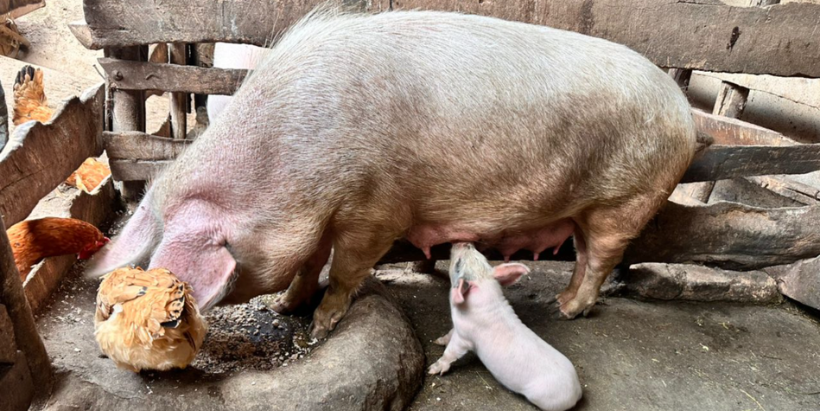
Looking ahead, Kabizu Business Group plans to expand HQCP production to supply feed manufacturers across Rwanda and neighboring countries. The company also aims to develop additional value-added products from cassava processing residues, creating a complete zero-waste processing system.
Christian believes this innovation has benefits far beyond his business. By creating new markets for cassava farmers, reducing environmental pollution, generating employment for young people and women, and making animal feed more affordable, the initiative is helping strengthen Rwanda’s circular economy.
The journey of Kabizu Business Group demonstrates how innovation, a technical standpoint, and collaboration can transform an agricultural waste stream into a source of economic and environmental value, such as High-Quality Cassava Peels. What was once discarded to decompose and pollute the environment is not being turned into a marketable product, creating opportunities across the cassava value chain while contributing to a more circular and sustainable agricultural economy in Rwanda.
Contributed by
Ritha Bumwe and Emmanuel Rukundo