
Genetic Resources Center
As an institution, IITA has made a long-term commitment to conserve Africa’s plant and animal genetic resources for future generations. At IITA we keep expansive collections of both crops and noncrops, in (in situ) or out (ex situ) of their natural environment.
The Genetic Resources Center (GRC) - Ibadan, Nigeria
IITA’s genebank holds the plant material (germplasm) of major food crops of Africa. This germplasm is held in trust on behalf of humanity under the auspices of the United Nations. It is distributed without restriction for use in research for food and agriculture.IITA’s conservation activities started in the mid-seventies with the establishment of a genebank. Depending on species, collections are either stored in field-, seed-, or in vitro genebanks.
Scope and collections
-
Crop
Preserving biodiversity outside of its natural environment is done in the Genebank. IITA’s Genebank holds over 36,000 accessions of plant material or germplasm, of major African food crops. This germplasm is held in trust on behalf of humanity under the sponsorship of the United Nations. It is distributed without restriction for use in research for food and agriculture.
Started in the mid-seventies the Genebank helps in crop improvement and also provides “seeds of hope” for people affected by flood, fire, wars, and other disasters.
Major crops in the IITA Genebank
The main crops stored in the Genebank are cowpea, cassava, plantain and banana, yam, soybean, bambara groundnut, and maize. In addition, substantial collections of wild cowpea relatives and miscellaneous legumes have been collated over the past 30 years. More recently a small collection of African yam bean, an underused legume, has been put together.
By far the most important crop in the Genebank is the cowpea. The IITA Genebank holds the world’s largest and most diverse collection of cowpeas with 15,000 unique samples from 88 countries, representing 70% of African cultivars and nearly half of the global diversity. This incredible collection makes IITA integral in the protection of the cowpea species.
The Genebank facilities
Depending on the species and its reproductive and dissemination biology, collections are either stored in the field, or in the seed or in-vitro genebanks.
All crops producing orthodox seeds are maintained at optimal water content in medium-term (5 ºC, 30–35% relative humidity) or long-term (-20 ºC, under vacuum) storage conditions.
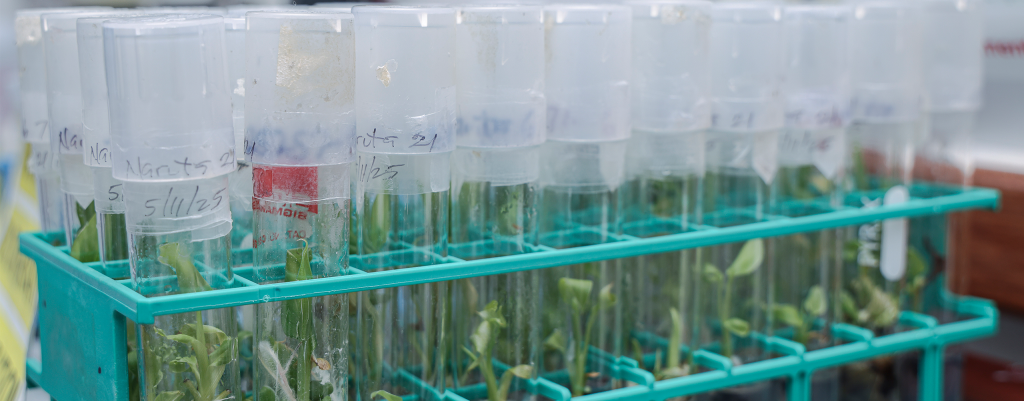
Clonal crops, those that are propagated through cuttings, are either maintained in the field or the in-vitro genebank. Sometimes they are kept in both to maintain the collection.
How the genebank operates
Types of conservation
- Seed bank: Seeds are dried and stored under controlled conditions — typically medium-term (about 5 °C) and long-term (about –20 °C) cold storage — to prolong viability and preserve genetic integrity.
- Field genebank: For crops that cannot be stored as seeds (like cassava and banana), living plants are maintained in field collections.
- In Vitro and cryopreservation: Tissue cultures are used for medium-term conservation of clonal crops, and advanced cryopreservation techniques (liquid nitrogen storage) help ensure long-term viability.
Global collaboration and safety
- The GRC operates within the CGIAR genebank network and under the provisions of the International Treaty on Plant Genetic Resources for Food and Agriculture (ITPGRFA) — meaning the genetic material is held “in trust” and made broadly available for research, breeding, and agricultural development.
- To protect against loss, safety duplicates of many accessions are stored at international facilities such as the Svalbard Global Seed Vault and other genebanks abroad.
Activities beyond storage
The genebank’s work isn’t just about holding seeds — it also involves:
- Collection and acquisition of genetic materials from farmers’ fields and national programs across Africa.
- Characterization and documentation of accessions using morphological and molecular methods to capture genetic diversity.
- Regeneration of materials when seed viability drops below thresholds, ensuring long-term usability.
- Distribution of germplasm to breeders, researchers, universities, and national research systems around the world.
Why it matters
- Food security: Conserving crop genetic diversity ensures breeders have access to traits for disease resistance, climate adaptability, improved nutrition, and yield stability.
- Climate resilience: Indigenous African legumes like Bambara groundnut and African yam bean — conserved in the genebank — hold valuable genes for drought tolerance and nutritional quality.
- Sustainable agriculture: The genebank supports crop improvement programs that strengthen smallholder farming systems across sub-Saharan Africa.