
IITA NEWS

Scientists to detail progress and challenges regarding global cassava threats at meetings in Nigeria
March 9, 2017

Gathering in Ibadan, cassava experts will report progress on efforts to shorten the cassava breeding cycle, enhance flowering and seed set, educate and train African plant breeders, and implement gender-responsive variety selection

IBADAN, NIGERIA: The world’s top cassava experts will gather in Nigeria to report progress on developing new varieties of cassava with higher yield and nutritional content. The meeting will take place on March 14-16, at the International Institute of Tropical Agriculture (IITA), in Ibadan.
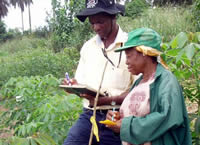
Picture of Field scientist  and woman farmer in the field
Field scientist and woman farmer in the field

“Africa produces more than half of the world’s cassava — about 86 million tons from over 10 million hectares,” said Chiedozie Egesi, IITA-based project manager of the Next Generation Cassava Breeding (NextGen Cassava) project, who also works to biofortify cassava with essential micronutrients. “But disease pathogens and climate change threaten cassava production and jeopardize the income and food security of smallholder farmers. Since 2012, scientists on the NextGen Cassava project have been working to significantly increase the rate of genetic improvement in cassava breeding and unlock cassava’s full potential.”

Cassava is a clonally propagated crop and seed set is difficult. New varieties with enhanced productivity and nutritional traits typically take up to 10 years to develop.

Scientists on the NextGen project are focused on giving breeders in Africa access to the most advanced plant breeding technologies to deliver improved varieties to farmers more rapidly.

“Partners of NextGen Cassava are using a state-of-the-art plant breeding approach known as genomic selection to improve cassava productivity for the 21st century,” said Ronnie Coffman, Cornell professor of plant breeding and genetics, director of International Programs, who is the principal investigator on the multi-partner grant.

Genomic selection shortens breeding cycles, provides more accurate evaluation at the seedling stage, and gives plant breeders the ability to evaluate a much larger number of clones without the need to plant them in the target environment. Using genomic selection, new releases of cassava are ready in as little as six years.

“The best clones from NextGen Cassava genomic selection efforts are in Uniform Yield Trials this year and are due to be released to farmers in the next two years,” said Egesi.

Cassava is predicted to be one of the few crops that will benefit from climate change because it requires few inputs and can withst and drought, marginal soils and long-term underground storage. A cash and subsistence crop, the storage roots of this perennial woody shrub are processed, consumed freshly boiled or raw, and eaten by people as well as animals as a low-cost source of carbohydrates. No other continent depends on cassava to feed as many people as does Africa, where 500 million people consume it daily. “The purpose of NextGen Cassava project is to improve the cassava breeding process making it faster and more efficient to produce the varieties farmers need,” said Peter Kulakow, cassava breeder at IITA, Ibadan.

In 2012, the Bill & Melinda Gates Foundation and the Department for International Development of the United Kingdom (DFID) under its UK Aid program invested $25.2M to improve the staple crop’s productivity and build human and technical capacity for plant breeding in sub-Saharan Africa.

The five-year project, led by Cornell University, works with 10 institutional partners across six countries on three continents: Boyce Thompson Institute (BTI/USA), Embrapa (Brazil), International Center for Tropical Agriculture (CIAT/Colombia), International Institute of Tropical Agriculture (IITA/Nigeria), National Crops Resources Research Institute (NaCRRI/Ug anda), National Root Crops Research Institute (NRCRI/Nigeria), University of Hawaii (USA), U.S. Department of Agriculture-Agricultural Research Service, and U.S. Department of Energy Joint Genome Institute. Most recently, NextGen Cassava has exp anded to include Tanzania, partnering with the Lake Zone Agricultural Research and Development Institute (LZARDI).

The partners share cassava data, expertise, and information on a publicly available website (www.cassavabase.org ).

In addition to reporting on the latest genomic information from cassava sequencing to improve productivity and yield, project partners will discuss progress on incorporating cassava germplasm diversity from South America into African breeding programs, training the next generation of plant breeders, and improving infrastructure at African institutions.

For more information see www.nextgencassava.org

Follow live: #NGcassava17 | @NEXTGENCassava


Contributed by

Recent stories

No items found

Leave a Reply

Your email address will not be published. Required fields are marked *

Scroll to Top
Olaosebikan, Olamide

Olamide Deborah Nwanze is a Senior Research Associate specializing in gender mainstreaming research to inform participatory and inclusive breeding, variety development, and seed systems policies regarding root, tuber, and banana (RTB) crops in the International Institute of Tropical Agriculture Headquarters, Ibadan, Nigeria. She is a PhD candidate at the University of Ibadan and holds an MSc and B. Agric in Agricultural Extension and Rural Development. Olamide is a fellow of the African Women in Agricultural Research and Development – Gender Responsive Agricultural Systems Policy (AWARD-GRASP) and the Gender Responsive Researchers Equipped for Agricultural Transformation (GREAT). She seeks to apply her gender-mainstreaming learnings, gender-responsive research, and policy development, and review expertise to facilitate women, youth, children, and vulnerable social group’s access to and adoption of agricultural Innovations that guarantee food, nutrition, income, and livelihood security in Africa. Her current roles include mentoring research fellows, development of guides and training manuals, implementation and adaptation of gender frameworks and tools, value chain actors’ engagement as citizen science partners, policy review and redesign, data management, and analysis. Her current research explores mixed methods and participatory and interdisciplinary approaches to capture and highlight gender dynamics, needs, preferences, and challenges stakeholders face within the agricultural livelihood value chain to prioritize gender-inclusive strategies in breeding programs, policy design, and implementation.

At IITA, she contributes to the implementation of the CGIAR Accelerated Breeding Initiative and Genetic Innovation Programs; participatory and gender research within the NextGen CassavaHarvestPlusRTBFoods, and Tricot-ClimMob 1000Farms Projects; and gender knowledge communication via the G-LENS webinar series, video documentary, policy briefspublications, and blogs.


Recent publications

de Sousa, K., van Etten, J., Manners, R. Bello, A., Teeken, B., Olaosebikan, O., et al. 2024. The tricot approach: an agile framework for decentralized on-farm testing supported by citizen science. A retrospective. Agron. Sustain. Dev. 44, 8. https://doi.org/10.1007/s13593-023-00937-1

Madu, T., Onwuka, S., Nwafor, S., Onyemauwa, N., Ejechi, M., Ofoeze, M., Ukeje, B., Eluagu, C., Olaosebikan, O., Okoye, B., 2024. Gender-Inclusive Consumer Studies Improve Cassava Breeding in Nigeria in: Frontiers in Sociology, volume 9, number: 1224504, doi: 10.3389/fsoc.2024.1224504

Olaosebikan, O.; Bello, A.; Utoblo, O.; Okoye, B.; Olutegbe, N.; Garner, E.; Teeken, B.; Bryan, E.; Forsythe, L.; Cole, S.; Madu, T. 2023.  Stressors and Resilience within the Cassava Value Chain in Nigeria: Preferred Cassava Variety Traits and Response Strategies of Men and Women to Inform Breeding. Sustainability 15, 7837. https://doi.org/10.3390/su15107837

Okoye, B., Ofoeze, M., Ejechi, M., Onwuka, S., Nwafor, S., Onyemauwa, N., Ukeje, B., Eluagu, C., Obidiegwu, J.*, Olaosebikan, O., Madu, T.* 2023. Prioritizing preferred traits in the yam value chain in Nigeria: a gender situation analysis in: Frontiers in Sociology, volume 8, number: 1232626, pages 1 – 9, ISSN 2297-7775, 2023. https://www.frontiersin.org/articles/10.3389/fsoc.2023.1232626/full

Olaosebikan, O., Bello, A. A., de Sousa, K., Ndjouenkeu, R., Adesokan, M., Alamu, E. O., Agbona, A., van Etten, J., Kegah, F. N.*, Dufour, D., Bouniol, A., Teeken, B. 2023. Consumer acceptability of cassava gari-eba food products across cultural and environmental settings using the triadic comparison of technologies approach (tricot) in: Journal of the Science of Food and Agriculture,

Teeken, B., Olaosebikan, O., Bello, A. A., Madu, T.*, Cole, S. M. 2023. Qualitative assessment on the positionality and preferences of dyads in relation to cassava-related activities: working with tricot trial citizen scientists https://hdl.handle.net/10568/138326 Type: Manual

Bouniol, A., Ceballos, H., Bello, A. A., Teeken, B., Olaosebikan, O., Owoade, D., Agbona, A., Fotso Kuate, A., Madu, T.*, Okoye, B.*, Ofoeze, M.*, Nwafor, S.*, Onyemauwa, N.*, Adinsi, L.*, Forsythe, L., Dufour, D. 2023. Varietal impact on women’s labour, workload and related drudgery in processing root, tuber and banana crops: focus on cassava in sub-Saharan Africa in: Journal of the Science of Food and Agriculture, pages 1 – 25, ISSN 0022-5142,

Bello, A. A., Agbona, A., Olaosebikan, O., Edughaen, G., Dufour, D., Bouniol, A., Iluebbey, P., Ndjouenkeu, R.*, Rabbi, I. Y., Teeken, B. 2023. Genetic and environmental effects on processing productivity and food product yield: drudgery of women’s work in: Journal of the Science of Food and Agriculture, pages 1 – 32, ISSN 0022-5142, 5

Cavicchioli, M., Zimbiti, T., Teeken, B., Nwanze, D.O., Liani, M., Parkes, E. & Bello, A. 2023. IITA-Gender Responsive Breeding Training Report. Genetic Resources Center, IITA-HQ, Ibadan, 21-23 September, 2022. Ibadan, Nigeria: IITA, (34 p.).https://hdl.handle.net/10568/131368

Agbona, A. Peteti P., Teeken B., Olaosebikan O. Bello, A. A., Parkes, E., Rabbi, I. Y., Mueller, L., Egesi, C., Kulakow, P. 2022. Data Management in Multi-disciplinary African RTB Crop Breeding Programs. In: Williamson, H.F., Leonelli, S. (eds) Towards Responsible Plant Data Linkage: Data Challenges for Agricultural Research and Development. Springer, Cham. https://doi.org/10.1007/978-3-031-13276-6_5

Lora Forsythe, Pricilla Marimo, Sarah Mayanja, Olamide D. Olaosebikan, Esme Stuart, Bela Teeken, Benjamin Okoye, Tessy Madu, (2021). Cross-product Gender Analysis of RTBfoods Step 2 Gendered Food Mapping on RTB Products. Understanding the Drivers of Trait Preferences and the Development of Multi-user RTB Product Profiles, WP1. London, UK: RTBfoods Field Scientific Report, 30 p.

Teeken, B., Garner, E., Agbona, A., Balogun, I., Olaosebikan, O., Bello, A., Madu, T., Okoye, B., Egesi, C., Kulakow, P. and Tufan, H.A. 2021. Beyond “Women’s Traits”: Exploring How Gender, Social Difference, and Household Characteristics Influence Trait Preferences. Frontiers Sustainable Food Systems 5:740926. https://doi.org/10.3389/fsufs.2021.740926

Teeken, B., Agbona, A., Bello, A., Olaosebikan, O., Alamu, E., Adesokan, M., Awoyale, W., Madu, T., Okoye, B., Chijioke, U., Owoade, D., Okoro, M., Bouniol, A., Dufour, D., Hershey, C., Rabbi, I., Maziya‐Dixon, B., Egesi, C., Tufan, H. and Kulakow, P. (020. Understanding cassava varietal preferences through pairwise ranking of gari‐eba and fufu prepared by local farmer–processors. Int J Food Sci Technol. https://doi.org/10.1111/ijfs.14862

Bela Teeken, Olamide Olaosebikan, Ireti Balogun, Benjamin Okoye, Tessy Madu, Steven Cole, Abolore Bello, Elizabeth Parkes. (2020). Piloting the G+ customer and product profile tools for gender-responsive cassava breeding in Nigeria. Nigeria: International Institute of Tropical Agriculture (IITA). https://hdl.handle.net/20.500.11766/13000