IITA to partner in global efforts to contain serious disease threat to the world’s bananas
November 2, 2017
FAO and partners Bioversity International, IITA, and the World Banana Forum have launched a global program requiring $98 million to contain and manage a new Fusarium Wilt strain—Tropical Race 4 (TR4) that is jeopardizing livelihoods that rely on banana—the world’s most traded fruit.
Banana is a staple food in most of East Africa.
IITA will lead efforts in deploying existing knowledge, human resources, and capabilities to breed for resistant bananas against TR4 based on its extensive experience in banana breeding in the continent.
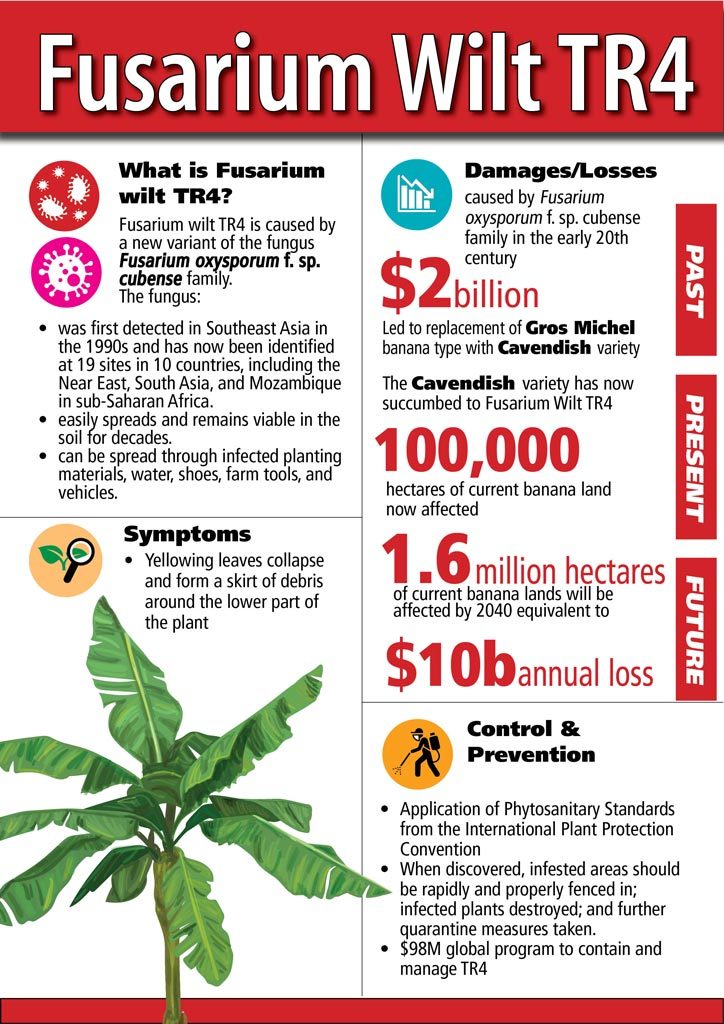
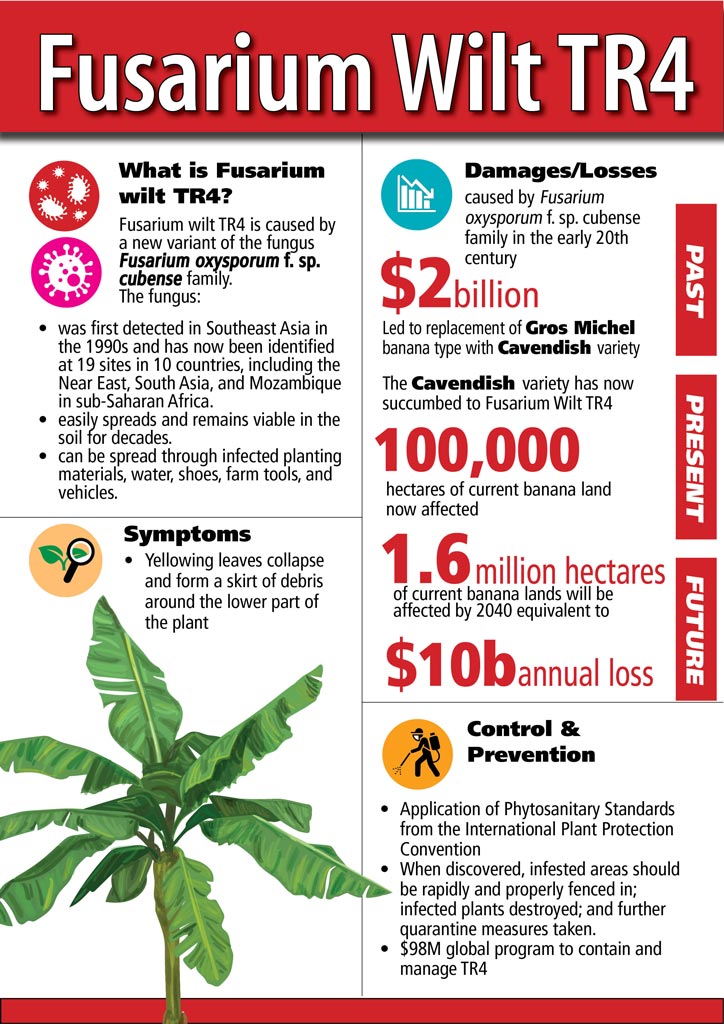
Fusarium wilt (TR4) was first detected in Southeast Asia in the 1990s and has now been identified at 19 sites in 10 countries, including the Near East, South Asia, and Mozambique in sub-Saharan Africa. This insidious disease can last for years in soils and can hitchhike to new fields and destinations through several means such as infected planting materials, water, shoes, farm tools, and vehicles.
“This is a major threat to banana production in several regions of the world. We need to move quickly to prevent its further spread from where it is right now and to support already affected countries in their efforts to cope with the disease,” said Hans Dreyer, Director of FAO’s Plant Production and Protection Division.
“The long-term resilience of banana production systems can only be improved through continuous monitoring, robust containment strategies, strengthening national capacities, and enhancing international collaboration to deploy integrated disease management approaches,” he added.
The global program is initially targeting 67 countries in a bid to prevent its spread and management. Without a coordinated intervention, scientists estimate that the disease could affect up to 1.6 million hectares of current banana l ands by 2040, representing one-sixth of current global production with an estimated annual value of $10 billion. The program aims to reduce the potentially affected area by up to 60%.
“There is also an important knowledge gap regarding the biology and management of the fungus and we aim to address these through this collaborative initiative, also promoting introduction of more biodiversity and improved agronomic practices into banana production systems,” said Ann Tutwiler, Director General of Bioversity International, speaking on her behalf and that of IITA.
The five-year program is designed to build on existing initiatives tackling the disease and focuses on strengthening local technical capacities and supporting the development of science-based technologies and tools through research on biology and epidemiology of the fungus, its detection, surveillance, rapid containment actions, soil health, and the development of resistant cultivars.
IITA is currently partnering with renowned worldwide research teams in an ongoing regional banana breeding program in the Great Lakes Region (http://breedingbetterbananas.org/).
For areas where the disease is not present or first appears, inspection, surveillance and rapid response measures will be developed. Where it already occurs, improved and integrated disease management techniques will be developed along with the search for and deployment of resistant varieties.
If effectively rolled out, it is estimated that every $1 invested in the program today will produce benefits of between $98 and $196 in 20 years’ time.
What is Fusarium wilt TR4?
Part of the Fusarium oxysporum f.sp. cubense family, the disease is caused by a new variant of the fungus that had decimated banana plantations in the early 20th century, ultimately causing more than $2 billion in damages and leading to the replacement of the Gros Michel banana type with the Cavendish variety. The Cavendish proved resistant to the earlier strain of the fungus but has now succumbed to the new race TR4.
Fusarium wilt TR4
The TR4—which so far has impacted nearly 100,000 hectares according to estimations of scientists—particularly affects the Cavendish banana, which accounts for around half the bananas grown today, but also other cultivars that constitute key nutritional staples. Despite banana’s large role in global trade, around 85% of annual production is consumed locally.
Affected plants show yellowing leaves, which then collapse and form a skirt of debris around the lower part of the plant. The fungus can easily spread and remain viable in the soil for decades. This is why the phytosanitary st andards provided by the International Plant Protection Convention are essential as the best approach by far in preventing the fungus from arriving in a new country or region.
When discovered, infested areas should be rapidly and properly fenced in, infected plants destroyed and further quarantine measures were taken. Implementation of such measures will vary widely according to whether production systems are based on smallholder farming, mixed-cropping systems or monoculture plantations.
More information is available here: Global programme on Fusarium wilt disease of banana: Engaging stakeholders in combatting TR4: Side event at World Banana forum, 7-10 November: http://www.fao.org/world-banana-forum/wbf3/wbf3/en/New banana disease to Africa found in MozambiqueBad news for Fusarium wilt: “Breeding Better Bananas” means business
Olamide Deborah Nwanze is a Senior Research Associate specializing in gender mainstreaming research to inform participatory and inclusive breeding, variety development, and seed systems policies regarding root, tuber, and banana (RTB) crops in the International Institute of Tropical Agriculture Headquarters, Ibadan, Nigeria. She is a PhD candidate at the University of Ibadan and holds an MSc and B. Agric in Agricultural Extension and Rural Development. Olamide is a fellow of the African Women in Agricultural Research and Development – Gender Responsive Agricultural Systems Policy (AWARD-GRASP) and the Gender Responsive Researchers Equipped for Agricultural Transformation (GREAT). She seeks to apply her gender-mainstreaming learnings, gender-responsive research, and policy development, and review expertise to facilitate women, youth, children, and vulnerable social group’s access to and adoption of agricultural Innovations that guarantee food, nutrition, income, and livelihood security in Africa. Her current roles include mentoring research fellows, development of guides and training manuals, implementation and adaptation of gender frameworks and tools, value chain actors’ engagement as citizen science partners, policy review and redesign, data management, and analysis. Her current research explores mixed methods and participatory and interdisciplinary approaches to capture and highlight gender dynamics, needs, preferences, and challenges stakeholders face within the agricultural livelihood value chain to prioritize gender-inclusive strategies in breeding programs, policy design, and implementation.
de Sousa, K., van Etten, J., Manners, R. Bello, A., Teeken, B., Olaosebikan, O., et al. 2024. The tricot approach: an agile framework for decentralized on-farm testing supported by citizen science. A retrospective. Agron. Sustain. Dev. 44, 8. https://doi.org/10.1007/s13593-023-00937-1
Madu, T., Onwuka, S., Nwafor, S., Onyemauwa, N., Ejechi, M., Ofoeze, M., Ukeje, B., Eluagu, C., Olaosebikan, O., Okoye, B., 2024. Gender-Inclusive Consumer Studies Improve Cassava Breeding in Nigeria in: Frontiers in Sociology, volume 9, number: 1224504, doi: 10.3389/fsoc.2024.1224504
Olaosebikan, O.; Bello, A.; Utoblo, O.; Okoye, B.; Olutegbe, N.; Garner, E.; Teeken, B.; Bryan, E.; Forsythe, L.; Cole, S.; Madu, T. 2023. Stressors and Resilience within the Cassava Value Chain in Nigeria: Preferred Cassava Variety Traits and Response Strategies of Men and Women to Inform Breeding. Sustainability 15, 7837. https://doi.org/10.3390/su15107837
Okoye, B., Ofoeze, M., Ejechi, M., Onwuka, S., Nwafor, S., Onyemauwa, N., Ukeje, B., Eluagu, C., Obidiegwu, J.*, Olaosebikan, O., Madu, T.* 2023. Prioritizing preferred traits in the yam value chain in Nigeria: a gender situation analysis in: Frontiers in Sociology, volume 8, number: 1232626, pages 1 – 9, ISSN 2297-7775, 2023. https://www.frontiersin.org/articles/10.3389/fsoc.2023.1232626/full
Olaosebikan, O., Bello, A. A., de Sousa, K., Ndjouenkeu, R., Adesokan, M., Alamu, E. O., Agbona, A., van Etten, J., Kegah, F. N.*, Dufour, D., Bouniol, A., Teeken, B. 2023. Consumer acceptability of cassava gari-eba food products across cultural and environmental settings using the triadic comparison of technologies approach (tricot) in: Journal of the Science of Food and Agriculture,
Teeken, B., Olaosebikan, O., Bello, A. A., Madu, T.*, Cole, S. M. 2023. Qualitative assessment on the positionality and preferences of dyads in relation to cassava-related activities: working with tricot trial citizen scientists https://hdl.handle.net/10568/138326 Type: Manual
Bouniol, A., Ceballos, H., Bello, A. A., Teeken, B., Olaosebikan, O., Owoade, D., Agbona, A., Fotso Kuate, A., Madu, T.*, Okoye, B.*, Ofoeze, M.*, Nwafor, S.*, Onyemauwa, N.*, Adinsi, L.*, Forsythe, L., Dufour, D. 2023. Varietal impact on women’s labour, workload and related drudgery in processing root, tuber and banana crops: focus on cassava in sub-Saharan Africa in: Journal of the Science of Food and Agriculture, pages 1 – 25, ISSN 0022-5142,
Bello, A. A., Agbona, A., Olaosebikan, O., Edughaen, G., Dufour, D., Bouniol, A., Iluebbey, P., Ndjouenkeu, R.*, Rabbi, I. Y., Teeken, B. 2023. Genetic and environmental effects on processing productivity and food product yield: drudgery of women’s work in: Journal of the Science of Food and Agriculture, pages 1 – 32, ISSN 0022-5142, 5
Cavicchioli, M., Zimbiti, T., Teeken, B., Nwanze, D.O., Liani, M., Parkes, E. & Bello, A. 2023. IITA-Gender Responsive Breeding Training Report. Genetic Resources Center, IITA-HQ, Ibadan, 21-23 September, 2022. Ibadan, Nigeria: IITA, (34 p.).https://hdl.handle.net/10568/131368
Agbona, A. Peteti P., Teeken B., Olaosebikan O. Bello, A. A., Parkes, E., Rabbi, I. Y., Mueller, L., Egesi, C., Kulakow, P. 2022. Data Management in Multi-disciplinary African RTB Crop Breeding Programs. In: Williamson, H.F., Leonelli, S. (eds) Towards Responsible Plant Data Linkage: Data Challenges for Agricultural Research and Development. Springer, Cham. https://doi.org/10.1007/978-3-031-13276-6_5
Lora Forsythe, Pricilla Marimo, Sarah Mayanja, Olamide D. Olaosebikan, Esme Stuart, Bela Teeken, Benjamin Okoye, Tessy Madu, (2021). Cross-product Gender Analysis of RTBfoods Step 2 Gendered Food Mapping on RTB Products. Understanding the Drivers of Trait Preferences and the Development of Multi-user RTB Product Profiles, WP1. London, UK: RTBfoods Field Scientific Report, 30 p.
Teeken, B., Garner, E., Agbona, A., Balogun, I., Olaosebikan, O., Bello, A., Madu, T., Okoye, B., Egesi, C., Kulakow, P. and Tufan, H.A. 2021. Beyond “Women’s Traits”: Exploring How Gender, Social Difference, and Household Characteristics Influence Trait Preferences. Frontiers Sustainable Food Systems 5:740926. https://doi.org/10.3389/fsufs.2021.740926
Teeken, B., Agbona, A., Bello, A., Olaosebikan, O., Alamu, E., Adesokan, M., Awoyale, W., Madu, T., Okoye, B., Chijioke, U., Owoade, D., Okoro, M., Bouniol, A., Dufour, D., Hershey, C., Rabbi, I., Maziya‐Dixon, B., Egesi, C., Tufan, H. and Kulakow, P. (020. Understanding cassava varietal preferences through pairwise ranking of gari‐eba and fufu prepared by local farmer–processors. Int J Food Sci Technol.https://doi.org/10.1111/ijfs.14862
Bela Teeken, Olamide Olaosebikan, Ireti Balogun, Benjamin Okoye, Tessy Madu, Steven Cole, Abolore Bello, Elizabeth Parkes. (2020). Piloting the G+ customer and product profile tools for gender-responsive cassava breeding in Nigeria. Nigeria: International Institute of Tropical Agriculture (IITA). https://hdl.handle.net/20.500.11766/13000