Early adopter of YIIFSWA-promoted improved yam varieties enjoys “fantastic” yield
August 28, 2020
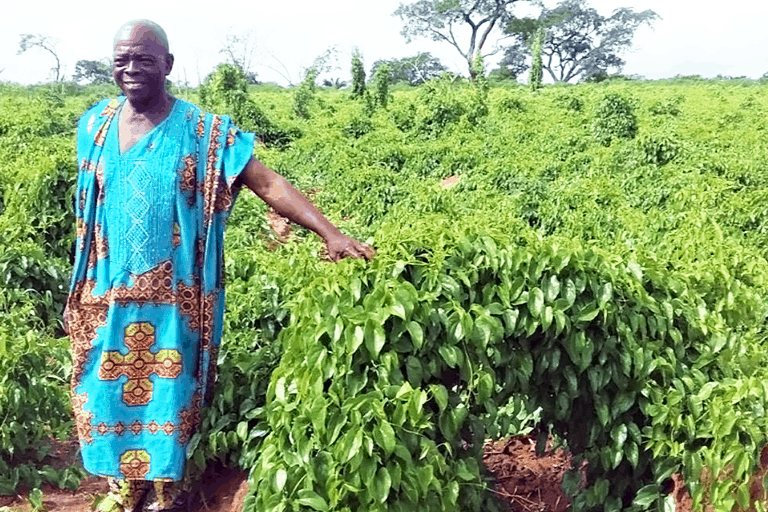
Beaming with pride, Chief Joshua Ojedele showed off his 2-hectare yam field cultivated from improved varieties that he got from the Yam Improvement for Income and Food Security in West Africa (YIIFSWA) project. His farm was lush green with healthy foliage, promising a good harvest. All the mounds had at least one yam plant with tubers. “This has never happened before. See–no mound is missing a plant,” Chief Ojedele said while he led the YIIFSWA-II monitoring team through his field.
Chief Joshua Ojedele in his Agunrege farm.
Chief Ojedele lives in a community where yam is the preferred crop for cultivation, but farmers stopped growing it due to reduced yields and subsequent crop failures of the traditional varieties. He said farmers in Agunrege, Atisbo local government in Oyo State, were finding it difficult to make ends meet with the local yam varieties in their barns. After each cropping season, they neither had enough to eat nor sell in the market. Consequently, they had no benefit from cropping yam. “We thought the problem was the land, so we abandoned yam production and started cultivating cassava and maize. But with these IITA yam varieties, no matter how small the planting materials are, they produce something. Now I know it is not the land. The local varieties we were planting were old and had poor seed quality,” Chief Ojedele said.
According to Beatrice Aighewi, YIIFSWA-II’s Seed System Specialist, “In the traditional system, farmers recycle their seed yam year after year. As a result, the seed tubers of local varieties lose their quality after years of accumulation of pests and diseases such as nematodes, viruses, fungi, and bacterial infections. Consequently, yam farmers in Nigeria lose up to 50% due to the use of poor-quality seed tubers.”
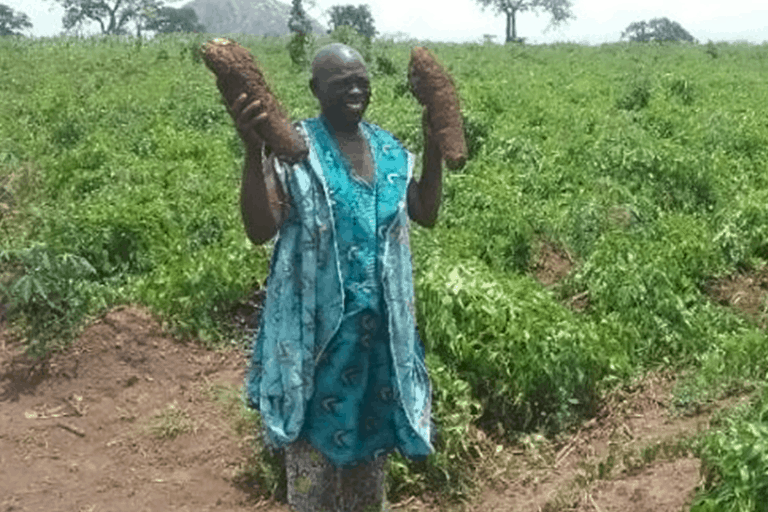
Early adopter showcasing harvests from his farm.
She also stated that the current average yields of local yam varieties are less than 25% of the yield of released improved varieties, which range from 30 to 40 t/ha. New agricultural technologies, such as high-yielding improved varieties coupled with good agronomic practices offer the promise of improving productivity and farmers’ livelihoods. However, the adoption of these enhanced yam varieties has been slow because of the absence of a formal seed system that can sustainably produce and distribute large quantities of quality seed at affordable prices.
The adequate supply and distribution of these improved varieties are critical to the intensification of yam production in Nigeria. The current high level of production is due to farmers’ practice of periodic relocation of yam fields in more fertile soils, rather than input intensification. Agricultural intensification is critical for agricultural productivity growth.
YIIFSWA-II’s intervention
In the initial years of implementation, the project successfully demonstrated to farmers the high performance of the three improved and released varieties, namely Asiedu (TDr 89/02665), Kpamyo (TDr 95/19177), and Swaswa (TDa 98/01176), as well as the value and better performance of quality seed vs. farmer-saved seed.
YIIFSWA-II is working to establish a formal seed system that is commercially viable and sustainable to boost yam productivity in Ghana and Nigeria. The project seeks to ensure that farmers like Chief Ojedele have access to quality seed tubers that have the consistent characteristics of the varieties, are free from pests and diseases, and have a high percentage of sprouting for good field establishment.
Reaping the benefits
Chief Ojedele, who participated in three types of demonstrations, is already reaping the benefits of early adoption of these technologies. According to him, since he participated in the YIIFSWA-II project, he spent the first two years multiplying the few seed tubers he acquired from the field trials using the Adapted Yam Minisett Technology (AYMT).
In 2019, he planted clean seed tubers he amassed from the AYMT, which resulted in “fantastic” yield. Data collected in his field showed yields of 32.6 t/ha (Asiedu), 30.0 t/ha (Kpamyo), and 37.5 t/ha (Swaswa).
“These yam varieties have been good to me. The yam produces big tubers and in multiples. It is what I used for my son’s wedding. In Nigeria, you cannot marry without presenting yam to the bride’s family. My yields have been so good that I had more than enough for my son to give to his bride’s family as part of the bride price. I can’t thank YIIFSWA-II enough. The yam has taken me to places I have never been in my own country. I was so excited when I crossed the Onitsha Bridge to go to the National Root Crops Research Institute (NRCRI, Umudike) and participate in the naming ceremony of these improved varieties. YIIFSWA-II makes me feel like I am part of a greater farmers’ community outside of Agunrege,” Chief Ojedele said.
Olamide Deborah Nwanze is a Senior Research Associate specializing in gender mainstreaming research to inform participatory and inclusive breeding, variety development, and seed systems policies regarding root, tuber, and banana (RTB) crops in the International Institute of Tropical Agriculture Headquarters, Ibadan, Nigeria. She is a PhD candidate at the University of Ibadan and holds an MSc and B. Agric in Agricultural Extension and Rural Development. Olamide is a fellow of the African Women in Agricultural Research and Development – Gender Responsive Agricultural Systems Policy (AWARD-GRASP) and the Gender Responsive Researchers Equipped for Agricultural Transformation (GREAT). She seeks to apply her gender-mainstreaming learnings, gender-responsive research, and policy development, and review expertise to facilitate women, youth, children, and vulnerable social group’s access to and adoption of agricultural Innovations that guarantee food, nutrition, income, and livelihood security in Africa. Her current roles include mentoring research fellows, development of guides and training manuals, implementation and adaptation of gender frameworks and tools, value chain actors’ engagement as citizen science partners, policy review and redesign, data management, and analysis. Her current research explores mixed methods and participatory and interdisciplinary approaches to capture and highlight gender dynamics, needs, preferences, and challenges stakeholders face within the agricultural livelihood value chain to prioritize gender-inclusive strategies in breeding programs, policy design, and implementation.
de Sousa, K., van Etten, J., Manners, R. Bello, A., Teeken, B., Olaosebikan, O., et al. 2024. The tricot approach: an agile framework for decentralized on-farm testing supported by citizen science. A retrospective. Agron. Sustain. Dev. 44, 8. https://doi.org/10.1007/s13593-023-00937-1
Madu, T., Onwuka, S., Nwafor, S., Onyemauwa, N., Ejechi, M., Ofoeze, M., Ukeje, B., Eluagu, C., Olaosebikan, O., Okoye, B., 2024. Gender-Inclusive Consumer Studies Improve Cassava Breeding in Nigeria in: Frontiers in Sociology, volume 9, number: 1224504, doi: 10.3389/fsoc.2024.1224504
Olaosebikan, O.; Bello, A.; Utoblo, O.; Okoye, B.; Olutegbe, N.; Garner, E.; Teeken, B.; Bryan, E.; Forsythe, L.; Cole, S.; Madu, T. 2023. Stressors and Resilience within the Cassava Value Chain in Nigeria: Preferred Cassava Variety Traits and Response Strategies of Men and Women to Inform Breeding. Sustainability 15, 7837. https://doi.org/10.3390/su15107837
Okoye, B., Ofoeze, M., Ejechi, M., Onwuka, S., Nwafor, S., Onyemauwa, N., Ukeje, B., Eluagu, C., Obidiegwu, J.*, Olaosebikan, O., Madu, T.* 2023. Prioritizing preferred traits in the yam value chain in Nigeria: a gender situation analysis in: Frontiers in Sociology, volume 8, number: 1232626, pages 1 – 9, ISSN 2297-7775, 2023. https://www.frontiersin.org/articles/10.3389/fsoc.2023.1232626/full
Olaosebikan, O., Bello, A. A., de Sousa, K., Ndjouenkeu, R., Adesokan, M., Alamu, E. O., Agbona, A., van Etten, J., Kegah, F. N.*, Dufour, D., Bouniol, A., Teeken, B. 2023. Consumer acceptability of cassava gari-eba food products across cultural and environmental settings using the triadic comparison of technologies approach (tricot) in: Journal of the Science of Food and Agriculture,
Teeken, B., Olaosebikan, O., Bello, A. A., Madu, T.*, Cole, S. M. 2023. Qualitative assessment on the positionality and preferences of dyads in relation to cassava-related activities: working with tricot trial citizen scientists https://hdl.handle.net/10568/138326 Type: Manual
Bouniol, A., Ceballos, H., Bello, A. A., Teeken, B., Olaosebikan, O., Owoade, D., Agbona, A., Fotso Kuate, A., Madu, T.*, Okoye, B.*, Ofoeze, M.*, Nwafor, S.*, Onyemauwa, N.*, Adinsi, L.*, Forsythe, L., Dufour, D. 2023. Varietal impact on women’s labour, workload and related drudgery in processing root, tuber and banana crops: focus on cassava in sub-Saharan Africa in: Journal of the Science of Food and Agriculture, pages 1 – 25, ISSN 0022-5142,
Bello, A. A., Agbona, A., Olaosebikan, O., Edughaen, G., Dufour, D., Bouniol, A., Iluebbey, P., Ndjouenkeu, R.*, Rabbi, I. Y., Teeken, B. 2023. Genetic and environmental effects on processing productivity and food product yield: drudgery of women’s work in: Journal of the Science of Food and Agriculture, pages 1 – 32, ISSN 0022-5142, 5
Cavicchioli, M., Zimbiti, T., Teeken, B., Nwanze, D.O., Liani, M., Parkes, E. & Bello, A. 2023. IITA-Gender Responsive Breeding Training Report. Genetic Resources Center, IITA-HQ, Ibadan, 21-23 September, 2022. Ibadan, Nigeria: IITA, (34 p.).https://hdl.handle.net/10568/131368
Agbona, A. Peteti P., Teeken B., Olaosebikan O. Bello, A. A., Parkes, E., Rabbi, I. Y., Mueller, L., Egesi, C., Kulakow, P. 2022. Data Management in Multi-disciplinary African RTB Crop Breeding Programs. In: Williamson, H.F., Leonelli, S. (eds) Towards Responsible Plant Data Linkage: Data Challenges for Agricultural Research and Development. Springer, Cham. https://doi.org/10.1007/978-3-031-13276-6_5
Lora Forsythe, Pricilla Marimo, Sarah Mayanja, Olamide D. Olaosebikan, Esme Stuart, Bela Teeken, Benjamin Okoye, Tessy Madu, (2021). Cross-product Gender Analysis of RTBfoods Step 2 Gendered Food Mapping on RTB Products. Understanding the Drivers of Trait Preferences and the Development of Multi-user RTB Product Profiles, WP1. London, UK: RTBfoods Field Scientific Report, 30 p.
Teeken, B., Garner, E., Agbona, A., Balogun, I., Olaosebikan, O., Bello, A., Madu, T., Okoye, B., Egesi, C., Kulakow, P. and Tufan, H.A. 2021. Beyond “Women’s Traits”: Exploring How Gender, Social Difference, and Household Characteristics Influence Trait Preferences. Frontiers Sustainable Food Systems 5:740926. https://doi.org/10.3389/fsufs.2021.740926
Teeken, B., Agbona, A., Bello, A., Olaosebikan, O., Alamu, E., Adesokan, M., Awoyale, W., Madu, T., Okoye, B., Chijioke, U., Owoade, D., Okoro, M., Bouniol, A., Dufour, D., Hershey, C., Rabbi, I., Maziya‐Dixon, B., Egesi, C., Tufan, H. and Kulakow, P. (020. Understanding cassava varietal preferences through pairwise ranking of gari‐eba and fufu prepared by local farmer–processors. Int J Food Sci Technol.https://doi.org/10.1111/ijfs.14862
Bela Teeken, Olamide Olaosebikan, Ireti Balogun, Benjamin Okoye, Tessy Madu, Steven Cole, Abolore Bello, Elizabeth Parkes. (2020). Piloting the G+ customer and product profile tools for gender-responsive cassava breeding in Nigeria. Nigeria: International Institute of Tropical Agriculture (IITA). https://hdl.handle.net/20.500.11766/13000