
IITA NEWS

IITA and EAGC agree to work towards producing aflatoxin-free grains for health and trade
August 26, 2020

Ibadan, Nigeria/Nairobi, Kenya – The International Institute of Tropical Agriculture (IITA) and the Eastern Africa Grain Council (EAGC) today signed an agreement to work together to tackle aflatoxin contamination of grains in the region to help ensure that they are safe for human and livestock consumption and meet export standards.
Aflatoxin is a highly poisonous chemical produced by a naturally occurring fungus known as Aspergillus flavus. The fungus is found in soils and attacks important crops such as maize and groundnut while in the field and in storage when they are not dried and stored properly.

Aflatoxin poses a serious health threat to both human beings and animals. Acute poisoning as a result of consuming foods with extremely high levels of aflatoxin can lead to instant death. Chronic exposure, on the other hand, as a result of consuming foods with above-the-allowable safe levels, for many years, can result in lowered immunity, low birth weight, and irreversible stunting in children and liver cancer.
Aflatoxin also causes loss in trade revenues due to contamination of products that do not meet the required standards. According to Partnership for Aflatoxin Control in Africa (PACA), Africa loses an estimated US$670 million in rejected export trade annually due to contamination by aflatoxin.
In the partnership agreement, IITA, a not-for-profit research institution that generates innovations to address major agricultural challenges in Africa, and EAGC, a membership organization that brings together key players across the grain value chain in Eastern and Southern Africa, will, among others, promote best practices and proven technologies to manage aflatoxin.
This will include promoting the use of Aflasafe™, an innovative, safe, and natural product that drastically reduces aflatoxin contamination in maize and groundnuts as part of an integrated aflatoxin management strategy.
The technology was originally developed by the United States Department of Agriculture – Agricultural Research Service (USDA-ARS) and is widely used in the US. IITA, in partnership with the USDA, has successfully adapted this technology for use in many countries in Africa.
“Aflatoxin contamination is a serious food safety issue in sub-Saharan Africa and also a major impediment to trade. We are therefore excited about this partnership with EACG that will, among others, support efforts to create awareness on aflatoxin and mitigation strategies. This includes the use of the very effective, safe, affordable and easy-to-use aflasafe technology. This will help towards the realization of our vision for an aflatoxin-free, food-secure Africa,” said Kenton Dashiell, IITA Deputy Director General for Partnerships for Delivery at the virtual signing of the memorandum of understanding (MoU).
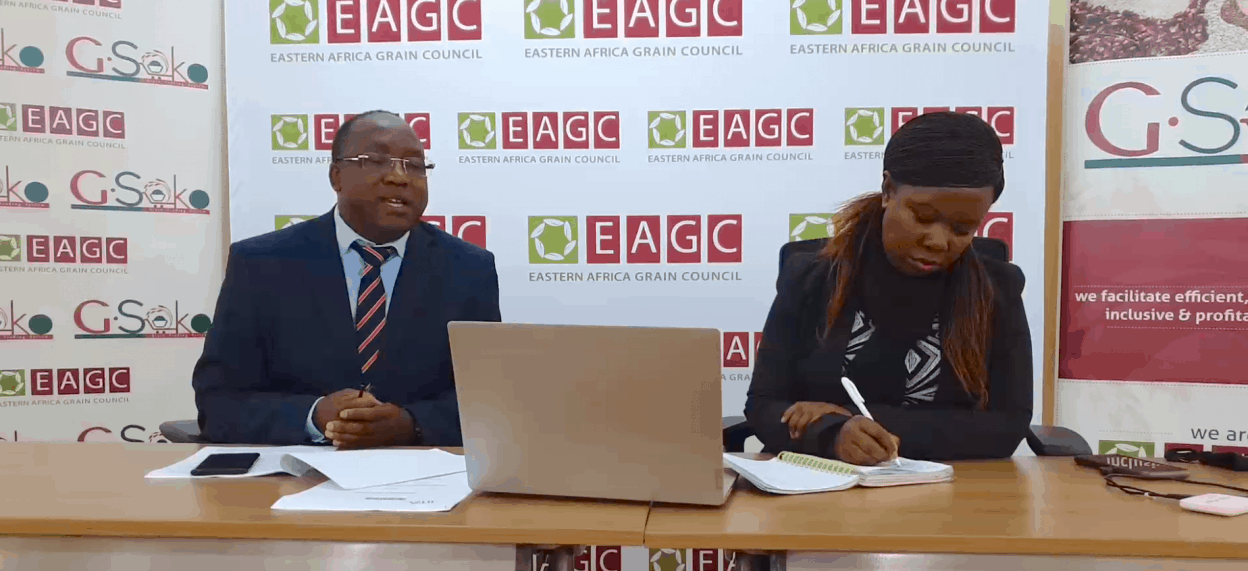
EAGC, on the other hand, seeks to identify best practices in food safety and quality control among grain value chain actors to increase their potential in intra- and inter-African grain trade. The EAGC Executive Director, Gerald Masila, stated that “By reducing aflatoxin contamination in grains to safe levels, Africa could meet international food safety standards, thereby creating a huge opportunity for increase in grain exports potential.”
The MoU will leverage each organization’s comparative advantage to promote mutually beneficial cooperation in the areas of advocacy, research, capacity development, and awareness creation. EAGC and IITA will work together to shape quality grain production, support market linkages for increased regional grain trade, promote the implementation of EAC staple foods standards and aflatoxin control, and mobilize resources to attain and manage aflatoxin standards. The MoU is intended to increase cooperation through knowledge and experience sharing as well as mobilization of resources to maximize desired outcomes.
The Aflasafe technology had been registered for commercial use and transferred to the private sector for scale-up. To date, 14 products have been registered in 10 countries (Nigeria, Kenya, Senegal, The Gambia, Burkina Faso, Ghana, Zambia, Tanzania, Malawi, and Mozambique) with more under development in 12 countries.


Contributed by

Related news

No items found

Leave a Reply

Your email address will not be published. Required fields are marked *

Scroll to Top
Olaosebikan, Olamide

Olamide Deborah Nwanze is a Senior Research Associate specializing in gender mainstreaming research to inform participatory and inclusive breeding, variety development, and seed systems policies regarding root, tuber, and banana (RTB) crops in the International Institute of Tropical Agriculture Headquarters, Ibadan, Nigeria. She is a PhD candidate at the University of Ibadan and holds an MSc and B. Agric in Agricultural Extension and Rural Development. Olamide is a fellow of the African Women in Agricultural Research and Development – Gender Responsive Agricultural Systems Policy (AWARD-GRASP) and the Gender Responsive Researchers Equipped for Agricultural Transformation (GREAT). She seeks to apply her gender-mainstreaming learnings, gender-responsive research, and policy development, and review expertise to facilitate women, youth, children, and vulnerable social group’s access to and adoption of agricultural Innovations that guarantee food, nutrition, income, and livelihood security in Africa. Her current roles include mentoring research fellows, development of guides and training manuals, implementation and adaptation of gender frameworks and tools, value chain actors’ engagement as citizen science partners, policy review and redesign, data management, and analysis. Her current research explores mixed methods and participatory and interdisciplinary approaches to capture and highlight gender dynamics, needs, preferences, and challenges stakeholders face within the agricultural livelihood value chain to prioritize gender-inclusive strategies in breeding programs, policy design, and implementation.

At IITA, she contributes to the implementation of the CGIAR Accelerated Breeding Initiative and Genetic Innovation Programs; participatory and gender research within the NextGen CassavaHarvestPlusRTBFoods, and Tricot-ClimMob 1000Farms Projects; and gender knowledge communication via the G-LENS webinar series, video documentary, policy briefspublications, and blogs.


Recent publications

de Sousa, K., van Etten, J., Manners, R. Bello, A., Teeken, B., Olaosebikan, O., et al. 2024. The tricot approach: an agile framework for decentralized on-farm testing supported by citizen science. A retrospective. Agron. Sustain. Dev. 44, 8. https://doi.org/10.1007/s13593-023-00937-1

Madu, T., Onwuka, S., Nwafor, S., Onyemauwa, N., Ejechi, M., Ofoeze, M., Ukeje, B., Eluagu, C., Olaosebikan, O., Okoye, B., 2024. Gender-Inclusive Consumer Studies Improve Cassava Breeding in Nigeria in: Frontiers in Sociology, volume 9, number: 1224504, doi: 10.3389/fsoc.2024.1224504

Olaosebikan, O.; Bello, A.; Utoblo, O.; Okoye, B.; Olutegbe, N.; Garner, E.; Teeken, B.; Bryan, E.; Forsythe, L.; Cole, S.; Madu, T. 2023.  Stressors and Resilience within the Cassava Value Chain in Nigeria: Preferred Cassava Variety Traits and Response Strategies of Men and Women to Inform Breeding. Sustainability 15, 7837. https://doi.org/10.3390/su15107837

Okoye, B., Ofoeze, M., Ejechi, M., Onwuka, S., Nwafor, S., Onyemauwa, N., Ukeje, B., Eluagu, C., Obidiegwu, J.*, Olaosebikan, O., Madu, T.* 2023. Prioritizing preferred traits in the yam value chain in Nigeria: a gender situation analysis in: Frontiers in Sociology, volume 8, number: 1232626, pages 1 – 9, ISSN 2297-7775, 2023. https://www.frontiersin.org/articles/10.3389/fsoc.2023.1232626/full

Olaosebikan, O., Bello, A. A., de Sousa, K., Ndjouenkeu, R., Adesokan, M., Alamu, E. O., Agbona, A., van Etten, J., Kegah, F. N.*, Dufour, D., Bouniol, A., Teeken, B. 2023. Consumer acceptability of cassava gari-eba food products across cultural and environmental settings using the triadic comparison of technologies approach (tricot) in: Journal of the Science of Food and Agriculture,

Teeken, B., Olaosebikan, O., Bello, A. A., Madu, T.*, Cole, S. M. 2023. Qualitative assessment on the positionality and preferences of dyads in relation to cassava-related activities: working with tricot trial citizen scientists https://hdl.handle.net/10568/138326 Type: Manual

Bouniol, A., Ceballos, H., Bello, A. A., Teeken, B., Olaosebikan, O., Owoade, D., Agbona, A., Fotso Kuate, A., Madu, T.*, Okoye, B.*, Ofoeze, M.*, Nwafor, S.*, Onyemauwa, N.*, Adinsi, L.*, Forsythe, L., Dufour, D. 2023. Varietal impact on women’s labour, workload and related drudgery in processing root, tuber and banana crops: focus on cassava in sub-Saharan Africa in: Journal of the Science of Food and Agriculture, pages 1 – 25, ISSN 0022-5142,

Bello, A. A., Agbona, A., Olaosebikan, O., Edughaen, G., Dufour, D., Bouniol, A., Iluebbey, P., Ndjouenkeu, R.*, Rabbi, I. Y., Teeken, B. 2023. Genetic and environmental effects on processing productivity and food product yield: drudgery of women’s work in: Journal of the Science of Food and Agriculture, pages 1 – 32, ISSN 0022-5142, 5

Cavicchioli, M., Zimbiti, T., Teeken, B., Nwanze, D.O., Liani, M., Parkes, E. & Bello, A. 2023. IITA-Gender Responsive Breeding Training Report. Genetic Resources Center, IITA-HQ, Ibadan, 21-23 September, 2022. Ibadan, Nigeria: IITA, (34 p.).https://hdl.handle.net/10568/131368

Agbona, A. Peteti P., Teeken B., Olaosebikan O. Bello, A. A., Parkes, E., Rabbi, I. Y., Mueller, L., Egesi, C., Kulakow, P. 2022. Data Management in Multi-disciplinary African RTB Crop Breeding Programs. In: Williamson, H.F., Leonelli, S. (eds) Towards Responsible Plant Data Linkage: Data Challenges for Agricultural Research and Development. Springer, Cham. https://doi.org/10.1007/978-3-031-13276-6_5

Lora Forsythe, Pricilla Marimo, Sarah Mayanja, Olamide D. Olaosebikan, Esme Stuart, Bela Teeken, Benjamin Okoye, Tessy Madu, (2021). Cross-product Gender Analysis of RTBfoods Step 2 Gendered Food Mapping on RTB Products. Understanding the Drivers of Trait Preferences and the Development of Multi-user RTB Product Profiles, WP1. London, UK: RTBfoods Field Scientific Report, 30 p.

Teeken, B., Garner, E., Agbona, A., Balogun, I., Olaosebikan, O., Bello, A., Madu, T., Okoye, B., Egesi, C., Kulakow, P. and Tufan, H.A. 2021. Beyond “Women’s Traits”: Exploring How Gender, Social Difference, and Household Characteristics Influence Trait Preferences. Frontiers Sustainable Food Systems 5:740926. https://doi.org/10.3389/fsufs.2021.740926

Teeken, B., Agbona, A., Bello, A., Olaosebikan, O., Alamu, E., Adesokan, M., Awoyale, W., Madu, T., Okoye, B., Chijioke, U., Owoade, D., Okoro, M., Bouniol, A., Dufour, D., Hershey, C., Rabbi, I., Maziya‐Dixon, B., Egesi, C., Tufan, H. and Kulakow, P. (020. Understanding cassava varietal preferences through pairwise ranking of gari‐eba and fufu prepared by local farmer–processors. Int J Food Sci Technol. https://doi.org/10.1111/ijfs.14862

Bela Teeken, Olamide Olaosebikan, Ireti Balogun, Benjamin Okoye, Tessy Madu, Steven Cole, Abolore Bello, Elizabeth Parkes. (2020). Piloting the G+ customer and product profile tools for gender-responsive cassava breeding in Nigeria. Nigeria: International Institute of Tropical Agriculture (IITA). https://hdl.handle.net/20.500.11766/13000