
NEWS

IITA boss receives prestigious award for championing youth in agriculture programs
September 3, 2021

The Association of Deans of Agriculture in Nigeria Universities (ADAN) has honored the Director-General of the International Institute of Tropical Agriculture (IITA), Dr Nteranya Sanginga, with an Award of Excellence for successfully pioneering the IITA Youth in Agribusiness program.

The award was presented to the IITA boss during the 64th annual general meeting of ADAN held recently in Nasarawa State, north-central Nigeria.
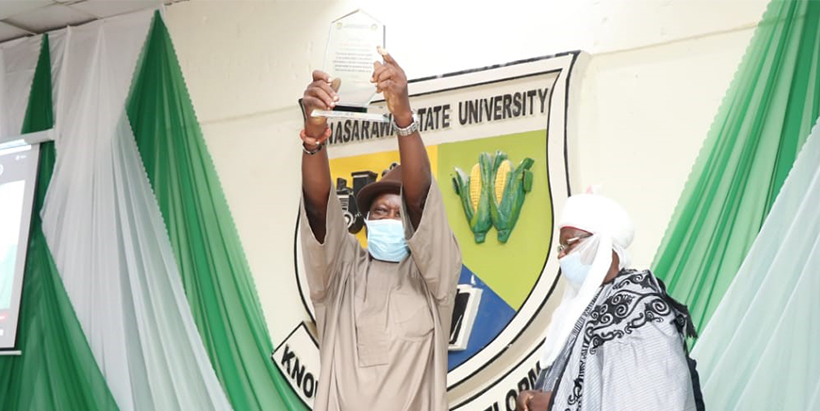
IITA boss receives prestigious award for championing youth in agriculture programs
Dr Alfred Dixon receiving the award on behalf of DG Sanginga.

“We are proud of the impact of the work that IITA has been doing, particularly among the youth, and it is worthy of recognition,” Chair of the Local Organizing Committee of ADAN, Prof. Olumuyiwa James Jayeoba, said.

The IITA youth program, which initially started with less than 50 youths on IITA Campus, Ibadan, has blossomed with hundreds of young people across Africa benefiting from the program. Most of the program’s beneficiaries are now managers of their own farms, while others have picked up other vocations within the agriculture space.

“ADAN intends to emulate the IITA Youth program and replicate the model across Nigerian universities,” Prof. Jayeoba disclosed.

Receiving the award on behalf of Dr Sanginga, Dr Alfred Dixon, the Director of the Development and Delivery Office of IITA, said the recognition was an encouragement for IITA and the DG to do more for the growth of youth in Africa.

“The youth program in IITA has demonstrated that the rising youth population is a huge capital that we need to harness for wealth creation and the prosperity of Africa,” Dr Dixon added.

Widely referred to as the “father of youth in agripreneurship”, Dr Sanginga successfully pioneered the youth-in-agriculture initiative that has been adopted in many African countries.

Prior to becoming the Director-General of IITA, Dr Sanginga served as the Director of the Nairobi-based Tropical Soil Biology and Fertility Institute (TBSF) of the Centro Internacional de Agricultura Tropical (CIAT-TBSF). Before transferring to CIAT-TBSF, Dr Sanginga served for 14 years in IITA in various capacities, including Principal Scientist and Head of the Soil Microbiology Unit. Other positions he held include Assistant Coordinator of the Alley Farming Network for Tropical Africa (AFNETA); Project Coordinator of Improvement of High-Intensity Food and Forage Crop Systems and Short Fallow Systems to Arrest Land Degradation due to Land Use Intensification; Leader of the multidisciplinary program Improving and Intensifying Cereal-Legume Systems in the Moist and Dry Savannas of West and Central Africa, and collaborating with many scientists in national and international institutions.

Dr Sanginga has more than 30 years of experience with the University of Zimbabwe, International Atomic Energy Agency (IAEA) in Austria, CIAT-TSBF, and IITA in agricultural research and development, particularly in the fields of applied microbial ecology, plant nutrition, and integrated natural resources management in Africa, Latin America, and Southeast Asia.

Born and bred in the Democratic Republic of Congo (DRC), Dr Sanginga did most of his postgraduate training at IITA and his PhD in Agronomy/Soil Microbiology under a joint program between IITA and the Institut Facultaire des Sciences Agronomiques, Yangambi, DRC.

He has extensive skills in research management, developing partnerships and institutional linkages, and institution building. Under his leadership, the CIAT-TSBF portfolio rose from $1.2 million in 2003 to over $14.5 million in 2010. Its research-for-development agenda expanded from focusing on Western Kenya to covering the major agroecosystems of East, Central, and Southern Africa. In IITA, he has more than tripled the institute’s budget since assumption into office.

Dr Sanginga played a major role in the creation of the Consortium for Improving Agriculture-based Livelihood in Central Africa (CIALCA) that included three international research centers (IITA, CIAT-TSBF, and Bioversity), university partners in Belgium, national research and development partners in DRC, Burundi, and Rwanda.

His career has also focused on building the capacity of young scientists in Africa. He has trained more than 30 PhD candidates at the National University of Congo, School of Agriculture and the University of Zimbabwe, who now hold leadership positions in their countries.

Dr Sanginga has to his credit more than 150 publications in international journals and book chapters.

Under his leadership, IITA received the Al-Sumait Award for Food Security in 2016 and the Africa Food Prize in 2018.

At the award ceremony were: Dr Chrys Akem, Technologies for TAAT Coordinator: Prof. Lateef Sanni, Project Leader for BASICS-II; Ezinne Igbokwe Ibe , Project Administrator, BASICS-II: Godwin Atser, Advocacy, Promotion & Outreach Lead, BASICS-II and the youth agriprenuers in IITA.


Contributed by

Recent stories

No items found

Leave a Reply

Your email address will not be published. Required fields are marked *

Scroll to Top
Olaosebikan, Olamide

Olamide Deborah Nwanze is a Senior Research Associate specializing in gender mainstreaming research to inform participatory and inclusive breeding, variety development, and seed systems policies regarding root, tuber, and banana (RTB) crops in the International Institute of Tropical Agriculture Headquarters, Ibadan, Nigeria. She is a PhD candidate at the University of Ibadan and holds an MSc and B. Agric in Agricultural Extension and Rural Development. Olamide is a fellow of the African Women in Agricultural Research and Development – Gender Responsive Agricultural Systems Policy (AWARD-GRASP) and the Gender Responsive Researchers Equipped for Agricultural Transformation (GREAT). She seeks to apply her gender-mainstreaming learnings, gender-responsive research, and policy development, and review expertise to facilitate women, youth, children, and vulnerable social group’s access to and adoption of agricultural Innovations that guarantee food, nutrition, income, and livelihood security in Africa. Her current roles include mentoring research fellows, development of guides and training manuals, implementation and adaptation of gender frameworks and tools, value chain actors’ engagement as citizen science partners, policy review and redesign, data management, and analysis. Her current research explores mixed methods and participatory and interdisciplinary approaches to capture and highlight gender dynamics, needs, preferences, and challenges stakeholders face within the agricultural livelihood value chain to prioritize gender-inclusive strategies in breeding programs, policy design, and implementation.

At IITA, she contributes to the implementation of the CGIAR Accelerated Breeding Initiative and Genetic Innovation Programs; participatory and gender research within the NextGen CassavaHarvestPlusRTBFoods, and Tricot-ClimMob 1000Farms Projects; and gender knowledge communication via the G-LENS webinar series, video documentary, policy briefspublications, and blogs.


Recent publications

de Sousa, K., van Etten, J., Manners, R. Bello, A., Teeken, B., Olaosebikan, O., et al. 2024. The tricot approach: an agile framework for decentralized on-farm testing supported by citizen science. A retrospective. Agron. Sustain. Dev. 44, 8. https://doi.org/10.1007/s13593-023-00937-1

Madu, T., Onwuka, S., Nwafor, S., Onyemauwa, N., Ejechi, M., Ofoeze, M., Ukeje, B., Eluagu, C., Olaosebikan, O., Okoye, B., 2024. Gender-Inclusive Consumer Studies Improve Cassava Breeding in Nigeria in: Frontiers in Sociology, volume 9, number: 1224504, doi: 10.3389/fsoc.2024.1224504

Olaosebikan, O.; Bello, A.; Utoblo, O.; Okoye, B.; Olutegbe, N.; Garner, E.; Teeken, B.; Bryan, E.; Forsythe, L.; Cole, S.; Madu, T. 2023.  Stressors and Resilience within the Cassava Value Chain in Nigeria: Preferred Cassava Variety Traits and Response Strategies of Men and Women to Inform Breeding. Sustainability 15, 7837. https://doi.org/10.3390/su15107837

Okoye, B., Ofoeze, M., Ejechi, M., Onwuka, S., Nwafor, S., Onyemauwa, N., Ukeje, B., Eluagu, C., Obidiegwu, J.*, Olaosebikan, O., Madu, T.* 2023. Prioritizing preferred traits in the yam value chain in Nigeria: a gender situation analysis in: Frontiers in Sociology, volume 8, number: 1232626, pages 1 – 9, ISSN 2297-7775, 2023. https://www.frontiersin.org/articles/10.3389/fsoc.2023.1232626/full

Olaosebikan, O., Bello, A. A., de Sousa, K., Ndjouenkeu, R., Adesokan, M., Alamu, E. O., Agbona, A., van Etten, J., Kegah, F. N.*, Dufour, D., Bouniol, A., Teeken, B. 2023. Consumer acceptability of cassava gari-eba food products across cultural and environmental settings using the triadic comparison of technologies approach (tricot) in: Journal of the Science of Food and Agriculture,

Teeken, B., Olaosebikan, O., Bello, A. A., Madu, T.*, Cole, S. M. 2023. Qualitative assessment on the positionality and preferences of dyads in relation to cassava-related activities: working with tricot trial citizen scientists https://hdl.handle.net/10568/138326 Type: Manual

Bouniol, A., Ceballos, H., Bello, A. A., Teeken, B., Olaosebikan, O., Owoade, D., Agbona, A., Fotso Kuate, A., Madu, T.*, Okoye, B.*, Ofoeze, M.*, Nwafor, S.*, Onyemauwa, N.*, Adinsi, L.*, Forsythe, L., Dufour, D. 2023. Varietal impact on women’s labour, workload and related drudgery in processing root, tuber and banana crops: focus on cassava in sub-Saharan Africa in: Journal of the Science of Food and Agriculture, pages 1 – 25, ISSN 0022-5142,

Bello, A. A., Agbona, A., Olaosebikan, O., Edughaen, G., Dufour, D., Bouniol, A., Iluebbey, P., Ndjouenkeu, R.*, Rabbi, I. Y., Teeken, B. 2023. Genetic and environmental effects on processing productivity and food product yield: drudgery of women’s work in: Journal of the Science of Food and Agriculture, pages 1 – 32, ISSN 0022-5142, 5

Cavicchioli, M., Zimbiti, T., Teeken, B., Nwanze, D.O., Liani, M., Parkes, E. & Bello, A. 2023. IITA-Gender Responsive Breeding Training Report. Genetic Resources Center, IITA-HQ, Ibadan, 21-23 September, 2022. Ibadan, Nigeria: IITA, (34 p.).https://hdl.handle.net/10568/131368

Agbona, A. Peteti P., Teeken B., Olaosebikan O. Bello, A. A., Parkes, E., Rabbi, I. Y., Mueller, L., Egesi, C., Kulakow, P. 2022. Data Management in Multi-disciplinary African RTB Crop Breeding Programs. In: Williamson, H.F., Leonelli, S. (eds) Towards Responsible Plant Data Linkage: Data Challenges for Agricultural Research and Development. Springer, Cham. https://doi.org/10.1007/978-3-031-13276-6_5

Lora Forsythe, Pricilla Marimo, Sarah Mayanja, Olamide D. Olaosebikan, Esme Stuart, Bela Teeken, Benjamin Okoye, Tessy Madu, (2021). Cross-product Gender Analysis of RTBfoods Step 2 Gendered Food Mapping on RTB Products. Understanding the Drivers of Trait Preferences and the Development of Multi-user RTB Product Profiles, WP1. London, UK: RTBfoods Field Scientific Report, 30 p.

Teeken, B., Garner, E., Agbona, A., Balogun, I., Olaosebikan, O., Bello, A., Madu, T., Okoye, B., Egesi, C., Kulakow, P. and Tufan, H.A. 2021. Beyond “Women’s Traits”: Exploring How Gender, Social Difference, and Household Characteristics Influence Trait Preferences. Frontiers Sustainable Food Systems 5:740926. https://doi.org/10.3389/fsufs.2021.740926

Teeken, B., Agbona, A., Bello, A., Olaosebikan, O., Alamu, E., Adesokan, M., Awoyale, W., Madu, T., Okoye, B., Chijioke, U., Owoade, D., Okoro, M., Bouniol, A., Dufour, D., Hershey, C., Rabbi, I., Maziya‐Dixon, B., Egesi, C., Tufan, H. and Kulakow, P. (020. Understanding cassava varietal preferences through pairwise ranking of gari‐eba and fufu prepared by local farmer–processors. Int J Food Sci Technol. https://doi.org/10.1111/ijfs.14862

Bela Teeken, Olamide Olaosebikan, Ireti Balogun, Benjamin Okoye, Tessy Madu, Steven Cole, Abolore Bello, Elizabeth Parkes. (2020). Piloting the G+ customer and product profile tools for gender-responsive cassava breeding in Nigeria. Nigeria: International Institute of Tropical Agriculture (IITA). https://hdl.handle.net/20.500.11766/13000