
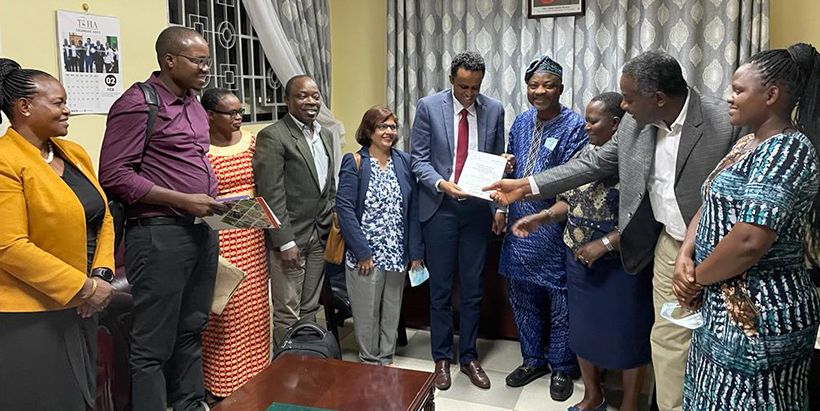
Tanzanian Minister of Agriculture, Honorable Hussein Mohamed Bashe, wants IITA to support the East African region in cassava, soybean, and banana transformation for economic prosperity. In a meeting with IITA researchers, including those working under the Building an Economically Sustainable Integrated Cassava Seed System, Phase 2 (BASICS-II), Hon. Bashe acknowledged that agriculture was crucial to the country’s economic prosperity but observed its potential is yet to be realized.
“Take cassava, for instance. During Ramadan, my meal is incomplete if there is no cassava. The crop is still a food security crop. My question is: how can we turn this crop into a cash crop?” he asked.
Data from the Food and Agriculture Organization (FAO) show that the average yield per ha of cassava is still below 10 tons per hectare, making it difficult for countries like Tanzania to compete globally in exports.
The Chinese authorities have offered to buy Tanzanian cassava chips, but farmers are yet to take advantage of such offers as yields remain low.
Like cassava, soybean is another crop whose potential is yet to be tapped owing to a lack of improved and industry preferred varieties.
Hon. Bashe said, “I just signed a contract for the importation of soybean because industries can’t get soybean seeds with desired traits.” He added that banana in the Western part of the country was also threatened by a new disease known as Banana Bunchy Top Virus (BBTV).
IITA Hub Director for Eastern Africa, Leena Tripathi, pledged IITA’s commitment to work with Tanzania to tackle agriculture challenges.
“Tanzania is strategic for us, and we are ready to work with you,” Tripathi assured the Minister, adding that a lot of technologies were available in IITA to advance the transformation of banana and plantain, soybean, and cassava.
On cassava, Lateef Sanni, Project Manager of BASICS-II, harped on the need for Tanzania to learn from Nigeria, especially the Presidential Initiative on Cassava (1999–2007) that drove cassava by linking productivity to markets. “Understanding the market demand for cassava and cassava products and responding to market demands will help create a sustainable cassava transformation,” Sanni said.
Apart from the local market, Sanni identified starch and High-Quality Cassava Flour as areas that Tanzania could tap for economic growth.
BASICS-II Advocacy, Promotion, and Outreach Lead Godwin Atser said Tanzania should invest in a cassava seed system to boost the yield per ha of cassava and make growers in the country globally competitive. He noted that the BASICS model had become a tool helping countries transform their seed system and urged them to adopt it for food security and economic development.
On the request for support on soybean, Frederick Baijukya said there were breeding efforts by IITA to offer farmers soybean varieties that are in demand by processors and consumers.
The high point of the meeting was the agreement in principle between both parties to do a market analysis for cassava and soybean. The market analysis will, among other things, determine the demand and the preferred varieties by processors and end-users. Furthermore, IITA and Tanzania will work on ways to halt the spread of banana disease in the country.
The issue of youth employment through agricultural businesses is critical, so the Ministry will also follow up with IITA on scaling the existing model of youth agripreneurship.
IITA Head of Advocacy and Resource Mobilization Regina Kapinga commended the Minister for the time given the team and promised that the Institute, in collaboration with other partners, would continue to collaborate with the government to address the priorities set in the national agricultural agenda.
Contributed by Gloriana Ndibalema
Contributed by
Recent stories