
IITA NEWS

IFAD-funded Zero Hunger Project makes progress in achieving its objective in Nigeria
March 23, 2022

As part of efforts to realize IITA’s Zero Hunger initiative (ZHI) partnership with FGN/IFAD-VCDP on cassava value chain development in Benue State, the IITA Zero Hunger Project team were in Benue State in February on an assessment and training visit. FGN/IFAD-VCDP Benue State Programme Coordinator, Emmanuel Igbaukum, led the Zero Hunger Project team comprising the Project Monitoring, Evaluation and Learning Manager Oyewale Abioye, Project Training Manager Bolanle Olorode, and IITA Post-Harvest Specialist Peter Kolawole on a courtesy visit to the Benue State Commissioner for Agriculture and Natural Resources, Hon. Kester Kyenge to familiarize and brief him on the Project and its collaborations with FGN/IFAD-VCDP.
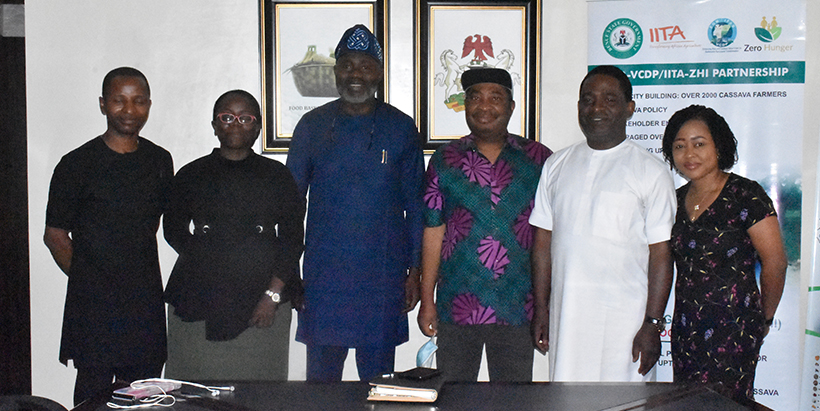
During the visit: (L-R) Zero Hunger Project MEL Manager Oyewale Abioye, Zero Hunger Training Manager Bolanle Olorode, Hon. Commissioner of Agriculture and Natural Resources Dr Kester Kyenge, VCDP State Project Coordinator Emmanuel Igbaukum, and the Secretary to the VCDP SPC.

Speaking on behalf of Project Lead Debo Akande, Abioye congratulated Hon. Kyenge on his appointment and thanked him for receiving them on short notice. He briefed the Commissioner on programs and the team’s efforts to achieve zero hunger in Benue in close collaboration with VCDP. The implementation will align with the initiative’s three components: Policy Assessment, Productivity Enhancement, and Capacity Development, with a strong focus on women and youth inclusion. He applauded Benue State’s relationship with IITA, which he described as “fantastic and productive” based on the number of IITA interventions and projects in the State. He also commended the State’s Policy Assessment with IITA Zero Hunger Project, evident in a meeting with the then Commissioner of Agriculture, VCDP, and other stakeholders last year.

Abioye highlighted several IITA Zero Hunger Project capacity development interventions in the State, particularly sourcing for seed funding and training some seed entrepreneurs in partnership with FGN/IFAD-VCDP. He also noted that, in collaboration with FGN/IFAD-VCDP, the program has trained some extension agents on Good Agronomic Practices (GAP) and introduced them to digital agriculture tools, such as the Herbicide Calculator and Akilimo. These extension agents also learned to build and collect correct data using Open Data Kit (ODK) software.

According to Abioye, the program has designed, developed, and remolded some agricultural production machinery that they are introducing to farmers and agripreneurs in the State to enhance production. The IITA team would train seed entrepreneurs on best practices on this visit. Some metal fabricators would learn how to produce a wet hammer mill that can process fresh cassava tubers and dry cassava chips for food and cassava peels for animal feed. He disclosed that this model would be installed at the FGN/IFAD-VCDP Assisted Cassava Processing Centre in Kwande Local Government, in Benue State.

In his address, Kolawole reiterated the need for mechanization in agriculture production and processing to maximize output and profit. He noted that the referenced mechanization does not necessarily mean tractorization but rather basic handheld tools and light machinery, one of which is the wet hammer mill.

Training Manager Olorode emphasized the potential along the cassava value chain, hoping that embracing it would significantly reduce insecurity, unemployment, and youth restiveness. She added that the focus of this visit was to train extension workers and seed entrepreneurs on the production of high-yielding National Agricultural Seed Council (NASC) certifiable seed.

The Project team members charged the Benue State Government to absorb some of the trained extension workers and employ more to increase the chances of achieving zero hunger in the State.

In his remarks, Hon. Kyenge counted the State privileged to be a beneficiary of both the FGN/IFAD-VCDP and the Zero Hunger Initiative, focusing on enhancing the cassava value chain. He noted that Nigeria is prioritizing agriculture to make it the country’s mainstay, and Benue, as its food basket, has a major role in the agricultural transformation plan.

The Commissioner promised the State’s support to assist VCDP and IITA scale up their intervention in the State while assuring the team that the issue of engaging extension workers was being looked into with the urgency it requires. He also commended the program’s focus on youth and women, charging IITA to sustain their partnership with IFAD-VCDP to achieve zero hunger in the State in light of the imminent global population explosion for improved and sustainable agriculture.

Contributed by Oyewale Abioye


Contributed by

Recent stories

No items found

Leave a Reply

Your email address will not be published. Required fields are marked *

Scroll to Top
Olaosebikan, Olamide

Olamide Deborah Nwanze is a Senior Research Associate specializing in gender mainstreaming research to inform participatory and inclusive breeding, variety development, and seed systems policies regarding root, tuber, and banana (RTB) crops in the International Institute of Tropical Agriculture Headquarters, Ibadan, Nigeria. She is a PhD candidate at the University of Ibadan and holds an MSc and B. Agric in Agricultural Extension and Rural Development. Olamide is a fellow of the African Women in Agricultural Research and Development – Gender Responsive Agricultural Systems Policy (AWARD-GRASP) and the Gender Responsive Researchers Equipped for Agricultural Transformation (GREAT). She seeks to apply her gender-mainstreaming learnings, gender-responsive research, and policy development, and review expertise to facilitate women, youth, children, and vulnerable social group’s access to and adoption of agricultural Innovations that guarantee food, nutrition, income, and livelihood security in Africa. Her current roles include mentoring research fellows, development of guides and training manuals, implementation and adaptation of gender frameworks and tools, value chain actors’ engagement as citizen science partners, policy review and redesign, data management, and analysis. Her current research explores mixed methods and participatory and interdisciplinary approaches to capture and highlight gender dynamics, needs, preferences, and challenges stakeholders face within the agricultural livelihood value chain to prioritize gender-inclusive strategies in breeding programs, policy design, and implementation.

At IITA, she contributes to the implementation of the CGIAR Accelerated Breeding Initiative and Genetic Innovation Programs; participatory and gender research within the NextGen CassavaHarvestPlusRTBFoods, and Tricot-ClimMob 1000Farms Projects; and gender knowledge communication via the G-LENS webinar series, video documentary, policy briefspublications, and blogs.


Recent publications

de Sousa, K., van Etten, J., Manners, R. Bello, A., Teeken, B., Olaosebikan, O., et al. 2024. The tricot approach: an agile framework for decentralized on-farm testing supported by citizen science. A retrospective. Agron. Sustain. Dev. 44, 8. https://doi.org/10.1007/s13593-023-00937-1

Madu, T., Onwuka, S., Nwafor, S., Onyemauwa, N., Ejechi, M., Ofoeze, M., Ukeje, B., Eluagu, C., Olaosebikan, O., Okoye, B., 2024. Gender-Inclusive Consumer Studies Improve Cassava Breeding in Nigeria in: Frontiers in Sociology, volume 9, number: 1224504, doi: 10.3389/fsoc.2024.1224504

Olaosebikan, O.; Bello, A.; Utoblo, O.; Okoye, B.; Olutegbe, N.; Garner, E.; Teeken, B.; Bryan, E.; Forsythe, L.; Cole, S.; Madu, T. 2023.  Stressors and Resilience within the Cassava Value Chain in Nigeria: Preferred Cassava Variety Traits and Response Strategies of Men and Women to Inform Breeding. Sustainability 15, 7837. https://doi.org/10.3390/su15107837

Okoye, B., Ofoeze, M., Ejechi, M., Onwuka, S., Nwafor, S., Onyemauwa, N., Ukeje, B., Eluagu, C., Obidiegwu, J.*, Olaosebikan, O., Madu, T.* 2023. Prioritizing preferred traits in the yam value chain in Nigeria: a gender situation analysis in: Frontiers in Sociology, volume 8, number: 1232626, pages 1 – 9, ISSN 2297-7775, 2023. https://www.frontiersin.org/articles/10.3389/fsoc.2023.1232626/full

Olaosebikan, O., Bello, A. A., de Sousa, K., Ndjouenkeu, R., Adesokan, M., Alamu, E. O., Agbona, A., van Etten, J., Kegah, F. N.*, Dufour, D., Bouniol, A., Teeken, B. 2023. Consumer acceptability of cassava gari-eba food products across cultural and environmental settings using the triadic comparison of technologies approach (tricot) in: Journal of the Science of Food and Agriculture,

Teeken, B., Olaosebikan, O., Bello, A. A., Madu, T.*, Cole, S. M. 2023. Qualitative assessment on the positionality and preferences of dyads in relation to cassava-related activities: working with tricot trial citizen scientists https://hdl.handle.net/10568/138326 Type: Manual

Bouniol, A., Ceballos, H., Bello, A. A., Teeken, B., Olaosebikan, O., Owoade, D., Agbona, A., Fotso Kuate, A., Madu, T.*, Okoye, B.*, Ofoeze, M.*, Nwafor, S.*, Onyemauwa, N.*, Adinsi, L.*, Forsythe, L., Dufour, D. 2023. Varietal impact on women’s labour, workload and related drudgery in processing root, tuber and banana crops: focus on cassava in sub-Saharan Africa in: Journal of the Science of Food and Agriculture, pages 1 – 25, ISSN 0022-5142,

Bello, A. A., Agbona, A., Olaosebikan, O., Edughaen, G., Dufour, D., Bouniol, A., Iluebbey, P., Ndjouenkeu, R.*, Rabbi, I. Y., Teeken, B. 2023. Genetic and environmental effects on processing productivity and food product yield: drudgery of women’s work in: Journal of the Science of Food and Agriculture, pages 1 – 32, ISSN 0022-5142, 5

Cavicchioli, M., Zimbiti, T., Teeken, B., Nwanze, D.O., Liani, M., Parkes, E. & Bello, A. 2023. IITA-Gender Responsive Breeding Training Report. Genetic Resources Center, IITA-HQ, Ibadan, 21-23 September, 2022. Ibadan, Nigeria: IITA, (34 p.).https://hdl.handle.net/10568/131368

Agbona, A. Peteti P., Teeken B., Olaosebikan O. Bello, A. A., Parkes, E., Rabbi, I. Y., Mueller, L., Egesi, C., Kulakow, P. 2022. Data Management in Multi-disciplinary African RTB Crop Breeding Programs. In: Williamson, H.F., Leonelli, S. (eds) Towards Responsible Plant Data Linkage: Data Challenges for Agricultural Research and Development. Springer, Cham. https://doi.org/10.1007/978-3-031-13276-6_5

Lora Forsythe, Pricilla Marimo, Sarah Mayanja, Olamide D. Olaosebikan, Esme Stuart, Bela Teeken, Benjamin Okoye, Tessy Madu, (2021). Cross-product Gender Analysis of RTBfoods Step 2 Gendered Food Mapping on RTB Products. Understanding the Drivers of Trait Preferences and the Development of Multi-user RTB Product Profiles, WP1. London, UK: RTBfoods Field Scientific Report, 30 p.

Teeken, B., Garner, E., Agbona, A., Balogun, I., Olaosebikan, O., Bello, A., Madu, T., Okoye, B., Egesi, C., Kulakow, P. and Tufan, H.A. 2021. Beyond “Women’s Traits”: Exploring How Gender, Social Difference, and Household Characteristics Influence Trait Preferences. Frontiers Sustainable Food Systems 5:740926. https://doi.org/10.3389/fsufs.2021.740926

Teeken, B., Agbona, A., Bello, A., Olaosebikan, O., Alamu, E., Adesokan, M., Awoyale, W., Madu, T., Okoye, B., Chijioke, U., Owoade, D., Okoro, M., Bouniol, A., Dufour, D., Hershey, C., Rabbi, I., Maziya‐Dixon, B., Egesi, C., Tufan, H. and Kulakow, P. (020. Understanding cassava varietal preferences through pairwise ranking of gari‐eba and fufu prepared by local farmer–processors. Int J Food Sci Technol. https://doi.org/10.1111/ijfs.14862

Bela Teeken, Olamide Olaosebikan, Ireti Balogun, Benjamin Okoye, Tessy Madu, Steven Cole, Abolore Bello, Elizabeth Parkes. (2020). Piloting the G+ customer and product profile tools for gender-responsive cassava breeding in Nigeria. Nigeria: International Institute of Tropical Agriculture (IITA). https://hdl.handle.net/20.500.11766/13000