
IITA, in collaboration with the Nelson Mandela African Institution of Science and Technology (NM-AIST) and Tanzania Agricultural Research Institute (TARI), participated in the 2023 national agricultural exhibition, famously known as Nanenane, which was conducted in Mbeya and Arusha regions.
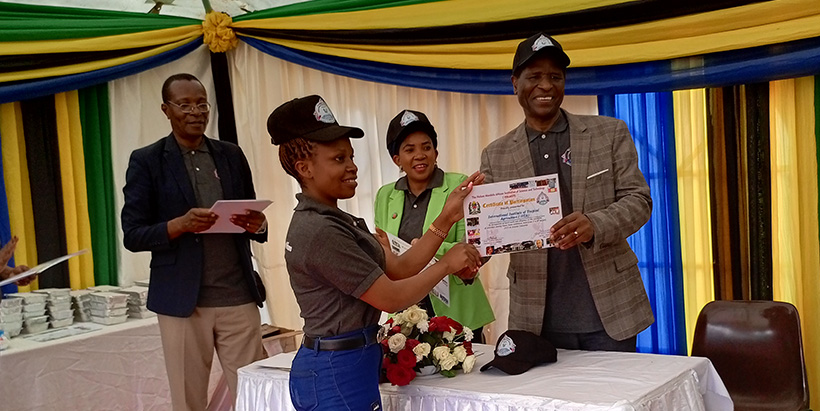
Their participation at the exhibition aimed at showcasing, among other things, the progress of banana breeding implemented by the partnership of institutes aiming to improve the cooking banana varieties—Matooke and Mchare. The IITA team received the certificate of participation from the hosting partner (NM-AIST) in recognition of their hard work and diligence in executing activities that contributed to winning the NM-AIST Higher Learning Institutes award category.
Nanenane is an agricultural exhibition taking place annually in various Tanzanian regions from 1 to 8 August, where different organizations, institutions, and stakeholders within the agricultural sector showcase various technologies, providing insights, knowledge, and skills that largely focus on transforming the agricultural sector in the country. This year’s theme—Youth and Women are the Firm Foundation of Sustainable Food Systems—aimed to attract more youth and women to engage in agriculture to create employment, improve livelihood, generate income, and ensure food security.
The IITA team in Mbeya, consisting of Hassam Mduma and Jackline Ulotu, and in Arusha, consisting of Kennedy Jomanga and Rosemary Simba, provided classroom training on how conventional banana breeding is carried out, disease identification and management, and banana best agronomic practices to farmer groups and leaders from different areas, village executives, and agricultural extension officers. The knowledge was shared with the farmers and exhibition visitors at the IITA booths in both regions.
According to Hassan Mduma, 3070 plants of newly released Matooke hybrid varieties (TARIBAN) were distributed to farmers for free by TARI. “Every farmer who showed interest in growing Matooke after seeing them from the demo plot was given 1-10 plants for free, depending on the size of the farmer’s field. TARIBAN 4 was the most requested by the farmers, perhaps because it had the biggest bunches in the demo plot,” said Mduma.
Moreover, the team highlighted the progress made by IITA in improving Mchare bananas with four high-yielding, good quality, and Fusarium wilt-resistant hybrids. These Mchare hybrids were developed in Arusha under the leadership of Allan Brown, who stated that the hybrids are now part of a multi-locational trial managed by TARI.
Farmers had a valuable chance to engage with the team, gaining hands-on experience by observing practical activities on the demo plot of TARIBAN established by TARI inside the Nanenane grounds. This allowed them to witness field processes such as seeing bunches from the field, asking questions, and receiving guidance on various aspects of banana cultivation, including spacing, hole digging, manure application, mulching, and sucker management.
Contributed Gloriana NdibalemaContributed by
Recent stories