
From 24 to 31 August, IITA accommodated four representatives from the Tokyo University of Agriculture (Tokyo NODAI) at the institute’s headquarters. The visit was an opportunity to strengthen the existing partnership between IITA and Tokyo NODAI and conduct research under the joint project titled “Utilization of plant-promoting bacteria isolated from yam to enhance crop production in Africa.”
IITA Deputy Director General, Partnerships for Delivery (DDG-P4D), Kenton Dashiell, welcomed the team and showed gratitude as he acknowledged the pivotal role that the university has played in advancing yam research in Africa.
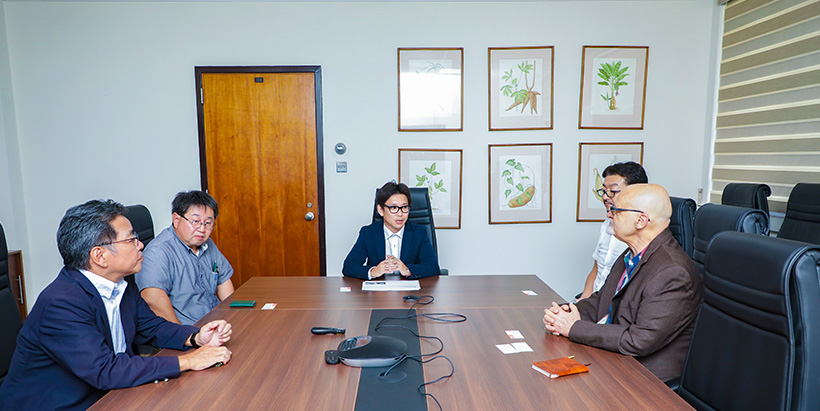
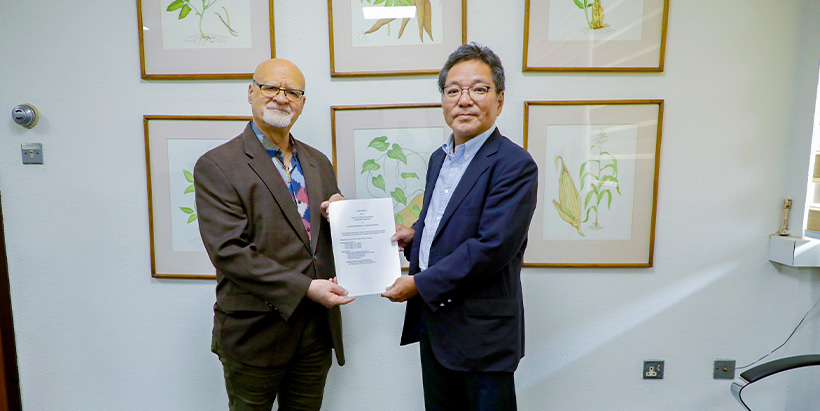
IITA and Tokyo NODAI have collaborated since 2012 under a Memorandum of Understanding (MoU). In January 2023, they renewed their commitment for another five years. Since their initial collaboration, they have completed three projects and continued with new collaborative projects slated from January 2023 to March 2026.
The collaboration was not limited to the exchange of ideas alone. Over the years, more than ten Japanese students have found their way to IITA as research fellows and postdoc students, while IITA staff have ventured to Tokyo NODAI as MSc students.
During a meeting, the representatives and the IITA team discussed ways to deepen their collaboration and leverage their longstanding research efforts to address pressing agricultural issues. Professors Hironobu Shiwachi and Hidehiko Kikuno were among the delegates, former yam researchers at IITA. While at IITA, they were instrumental in developing mass propagation techniques for water yam and white Guinea yam, concepts that have since transformed IITA’s yam breeding program.
As the discussions continued, Professor Shiwachi shared Tokyo NODAI’s research on the nitrogen-fixing ability of water yam and the bacterial communities in the rhizosphere soil of this crop. Their focus was now on harnessing this knowledge to enhance the productivity of White Guinea yam, a crop of vital importance in West Africa.
“Supporting young scientists and students through collaboration is mutually beneficial,” Professor Shiwachi emphasized, recognizing the critical role education played in their partnership’s success.
Their visit also included an insightful tour of the IITA Yam Breeding Unit with Molecular Breeder Paterne Agre. Yam Agronomist Asrat Amele presented a comprehensive report on the ongoing collaborative research project. The Tokyo NODAI team also shared their yam research activities and findings in Japan at a Knowledge Café in IITA.
In closing, Dashiell highlighted the importance of their continued collaboration to improve yam productivity in West Africa through the sharing of knowledge and talent exchange.
“I hope the results of the basic research will lead to improved productivity of yams in West Africa in the future,” he said.
Contributed by Favour Ochuwa Daramola
Contributed by
Recent stories