
NEWS

CGIAR and partner create guidelines to enhance gender transformative change
October 13, 2023

In the food security, nutrition, and sustainable agriculture space, the Joint Programme on Gender Transformative Approaches for Food Security and Nutrition (JP GTA) and the CGIAR GENDER Impact Platform achieved a significant milestone with the development of the “Guidelines for measuring gender transformative change.” The guidelines’ purpose is to enhance the capacity of research and development partners from the United Nations Rome-based Agencies—Food and Agriculture Organization of the United Nations (FAO), International Fund for Agricultural Development (IFAD), and World Food Programme (WFP)—the European Union, CGIAR, and other organizations in designing, implementing, monitoring and evaluating gender-transformative interventions.
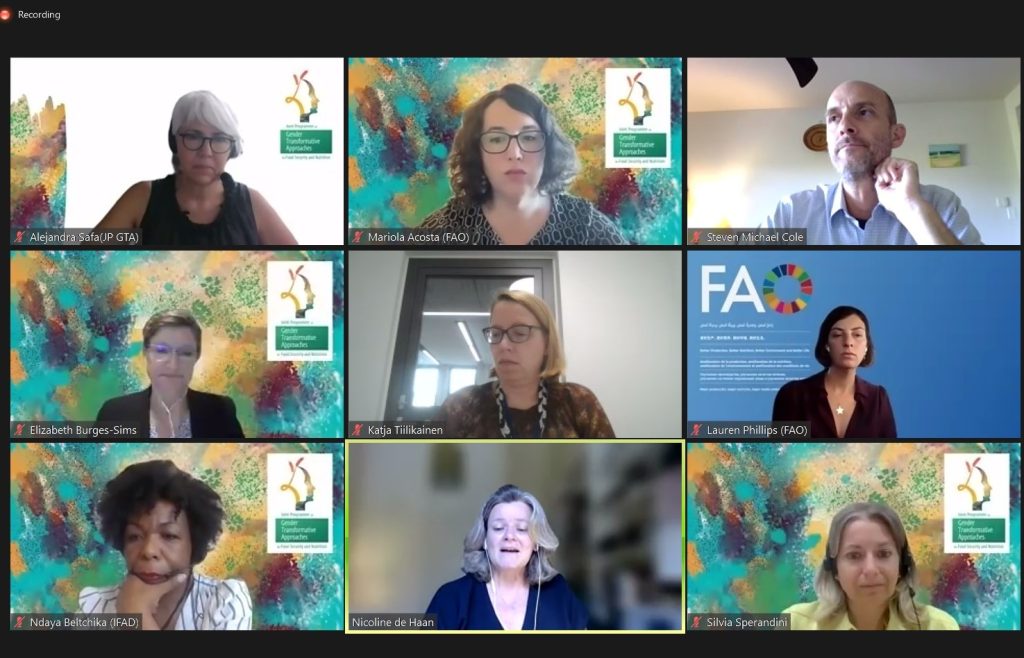
Some of the participants during the webinar.

The official unveiling of the guidelines occurred during a virtual launch event held on 26 September. The authors and thematic experts emphasized the importance of incorporating indicators capable of measuring gender transformative change into the monitoring and evaluation frameworks of food security, nutrition, and sustainable agriculture initiatives. The Deputy Director of the WFP Gender Equality Office, Elizabeth Burges-Sims, moderated the event.

Deputy Director of the Inclusive Rural Transformation and Gender Equality Division at FAO, Lauren Phillips, highlighted the persistent gender-based disparities in agriculture, particularly regarding women’s empowerment. She noted that women faced more intense challenges than men and underlined the significance of gender equality in fulfilling sustainable development objectives. “We have ongoing programs doing their best to ensure women are being empowered in agriculture,” she said.
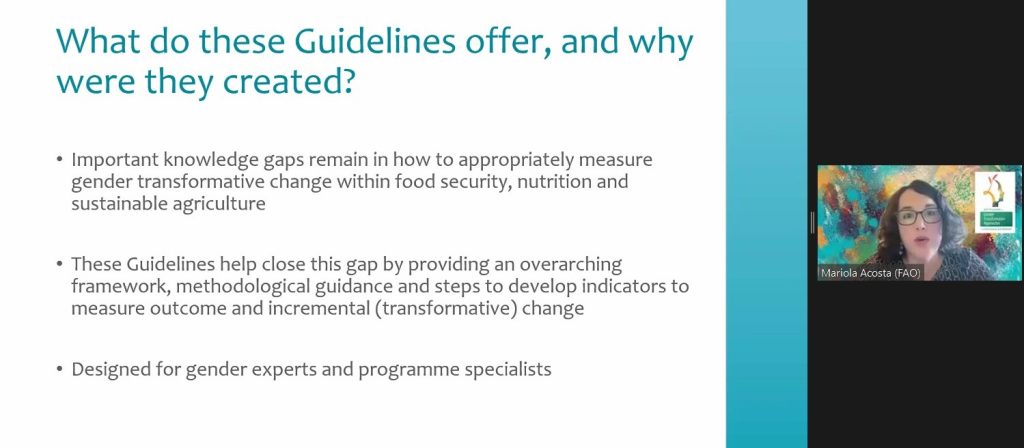
 FAO Rural Women's Empowerment Specialist Mariola Acosta during her presentation.
FAO Rural Women’s Empowerment Specialist Mariola Acosta during her presentation.

Deputy Head of the Social Sustainability Unit at the General Directorate for Agriculture and Rural Development of the European Commission, María Gafo Gómez-Zamalloa, echoed Philips’s view. She emphasized that gender equality was not merely a moral ideal but a substantial driving force behind economic development. She argued that without equality for women and girls, ensuring agricultural sustainability and eradicating hunger and poverty would be a mirage. She declared that the European Union is deeply committed to gender equality, with the primary goal of improving the livelihoods of rural female farmers. “Raising the awareness of women’s equality is key for gender equality. It is impossible to achieve food security without the contribution of women,” she said.

The Director of the CGIAR GENDER Impact Platform, Nicoline de Haan, delivered the welcome remarks, in which she shared the platform’s journey, revealing how they transitioned from merely focusing on empowering women to striving for transformative change. This ignited the spark of gender transformative research, ultimately leading to the creation of these ground-breaking guidelines.

The core of the event was the presentation of the guidelines by two experts in the field: IITA Senior Scientist and Gender Specialist Steven Michael Cole and FAO Rural Women Empowerment Specialist Mariola Acosta. Acosta delved into the structural aspects of the guidelines, while Cole tackled the practical application of the framework for gender-specific transformation. Cole introduced a comprehensive five-step process for developing gender transformative change indicators and announced the forthcoming availability of a concise “at a glance” version of the guidelines.
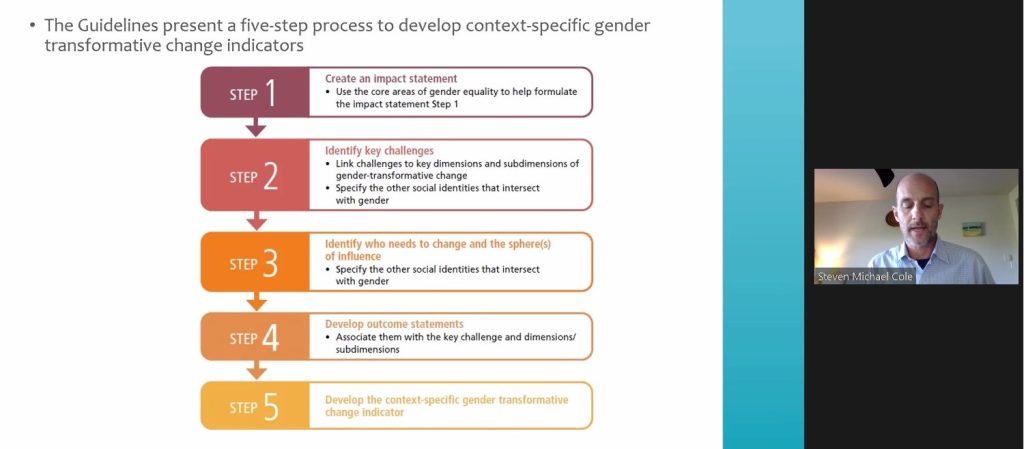
IITA-CGIAR Gender Specialist Steven Cole during his presentation.

A panel featuring CGIAR GENDER Impact Platform Science Officer and the HER+ Gender Equality Initiative Lead, Els Lecoutere, and IFAD Gender, Targeting, and Social Inclusion Specialist Silvia Sperandini discussed the opportunities and challenges associated with assessing normative constraints in agrifood systems. This was followed by a question-and-answer session moderated by FAO Senior Gender Officer and Team Leader Clara Park.

In her closing remarks, Senior Adviser for Gender Equality at the Ministry for Foreign Affairs of Finland and Lead of the EU Member States Working Group on the Gender Transformative Approach, Katja Tiilikainen, summarized the discussions, emphasizing that the guidelines had been developed to address the existing knowledge gaps in measuring gender transformative approaches, signaling a clear path forward in the journey towards gender equality in food security, nutrition, and sustainable agriculture. These guidelines were not just documents; they were inspirations guiding the way toward a more equitable and sustainable future for all.

Contributed by Ochuwa Favour Daramola

Contributed by

Recent stories

No items found

Leave a Reply

Your email address will not be published. Required fields are marked *

Scroll to Top
Olaosebikan, Olamide

Olamide Deborah Nwanze is a Senior Research Associate specializing in gender mainstreaming research to inform participatory and inclusive breeding, variety development, and seed systems policies regarding root, tuber, and banana (RTB) crops in the International Institute of Tropical Agriculture Headquarters, Ibadan, Nigeria. She is a PhD candidate at the University of Ibadan and holds an MSc and B. Agric in Agricultural Extension and Rural Development. Olamide is a fellow of the African Women in Agricultural Research and Development – Gender Responsive Agricultural Systems Policy (AWARD-GRASP) and the Gender Responsive Researchers Equipped for Agricultural Transformation (GREAT). She seeks to apply her gender-mainstreaming learnings, gender-responsive research, and policy development, and review expertise to facilitate women, youth, children, and vulnerable social group’s access to and adoption of agricultural Innovations that guarantee food, nutrition, income, and livelihood security in Africa. Her current roles include mentoring research fellows, development of guides and training manuals, implementation and adaptation of gender frameworks and tools, value chain actors’ engagement as citizen science partners, policy review and redesign, data management, and analysis. Her current research explores mixed methods and participatory and interdisciplinary approaches to capture and highlight gender dynamics, needs, preferences, and challenges stakeholders face within the agricultural livelihood value chain to prioritize gender-inclusive strategies in breeding programs, policy design, and implementation.

At IITA, she contributes to the implementation of the CGIAR Accelerated Breeding Initiative and Genetic Innovation Programs; participatory and gender research within the NextGen CassavaHarvestPlusRTBFoods, and Tricot-ClimMob 1000Farms Projects; and gender knowledge communication via the G-LENS webinar series, video documentary, policy briefspublications, and blogs.


Recent publications

de Sousa, K., van Etten, J., Manners, R. Bello, A., Teeken, B., Olaosebikan, O., et al. 2024. The tricot approach: an agile framework for decentralized on-farm testing supported by citizen science. A retrospective. Agron. Sustain. Dev. 44, 8. https://doi.org/10.1007/s13593-023-00937-1

Madu, T., Onwuka, S., Nwafor, S., Onyemauwa, N., Ejechi, M., Ofoeze, M., Ukeje, B., Eluagu, C., Olaosebikan, O., Okoye, B., 2024. Gender-Inclusive Consumer Studies Improve Cassava Breeding in Nigeria in: Frontiers in Sociology, volume 9, number: 1224504, doi: 10.3389/fsoc.2024.1224504

Olaosebikan, O.; Bello, A.; Utoblo, O.; Okoye, B.; Olutegbe, N.; Garner, E.; Teeken, B.; Bryan, E.; Forsythe, L.; Cole, S.; Madu, T. 2023.  Stressors and Resilience within the Cassava Value Chain in Nigeria: Preferred Cassava Variety Traits and Response Strategies of Men and Women to Inform Breeding. Sustainability 15, 7837. https://doi.org/10.3390/su15107837

Okoye, B., Ofoeze, M., Ejechi, M., Onwuka, S., Nwafor, S., Onyemauwa, N., Ukeje, B., Eluagu, C., Obidiegwu, J.*, Olaosebikan, O., Madu, T.* 2023. Prioritizing preferred traits in the yam value chain in Nigeria: a gender situation analysis in: Frontiers in Sociology, volume 8, number: 1232626, pages 1 – 9, ISSN 2297-7775, 2023. https://www.frontiersin.org/articles/10.3389/fsoc.2023.1232626/full

Olaosebikan, O., Bello, A. A., de Sousa, K., Ndjouenkeu, R., Adesokan, M., Alamu, E. O., Agbona, A., van Etten, J., Kegah, F. N.*, Dufour, D., Bouniol, A., Teeken, B. 2023. Consumer acceptability of cassava gari-eba food products across cultural and environmental settings using the triadic comparison of technologies approach (tricot) in: Journal of the Science of Food and Agriculture,

Teeken, B., Olaosebikan, O., Bello, A. A., Madu, T.*, Cole, S. M. 2023. Qualitative assessment on the positionality and preferences of dyads in relation to cassava-related activities: working with tricot trial citizen scientists https://hdl.handle.net/10568/138326 Type: Manual

Bouniol, A., Ceballos, H., Bello, A. A., Teeken, B., Olaosebikan, O., Owoade, D., Agbona, A., Fotso Kuate, A., Madu, T.*, Okoye, B.*, Ofoeze, M.*, Nwafor, S.*, Onyemauwa, N.*, Adinsi, L.*, Forsythe, L., Dufour, D. 2023. Varietal impact on women’s labour, workload and related drudgery in processing root, tuber and banana crops: focus on cassava in sub-Saharan Africa in: Journal of the Science of Food and Agriculture, pages 1 – 25, ISSN 0022-5142,

Bello, A. A., Agbona, A., Olaosebikan, O., Edughaen, G., Dufour, D., Bouniol, A., Iluebbey, P., Ndjouenkeu, R.*, Rabbi, I. Y., Teeken, B. 2023. Genetic and environmental effects on processing productivity and food product yield: drudgery of women’s work in: Journal of the Science of Food and Agriculture, pages 1 – 32, ISSN 0022-5142, 5

Cavicchioli, M., Zimbiti, T., Teeken, B., Nwanze, D.O., Liani, M., Parkes, E. & Bello, A. 2023. IITA-Gender Responsive Breeding Training Report. Genetic Resources Center, IITA-HQ, Ibadan, 21-23 September, 2022. Ibadan, Nigeria: IITA, (34 p.).https://hdl.handle.net/10568/131368

Agbona, A. Peteti P., Teeken B., Olaosebikan O. Bello, A. A., Parkes, E., Rabbi, I. Y., Mueller, L., Egesi, C., Kulakow, P. 2022. Data Management in Multi-disciplinary African RTB Crop Breeding Programs. In: Williamson, H.F., Leonelli, S. (eds) Towards Responsible Plant Data Linkage: Data Challenges for Agricultural Research and Development. Springer, Cham. https://doi.org/10.1007/978-3-031-13276-6_5

Lora Forsythe, Pricilla Marimo, Sarah Mayanja, Olamide D. Olaosebikan, Esme Stuart, Bela Teeken, Benjamin Okoye, Tessy Madu, (2021). Cross-product Gender Analysis of RTBfoods Step 2 Gendered Food Mapping on RTB Products. Understanding the Drivers of Trait Preferences and the Development of Multi-user RTB Product Profiles, WP1. London, UK: RTBfoods Field Scientific Report, 30 p.

Teeken, B., Garner, E., Agbona, A., Balogun, I., Olaosebikan, O., Bello, A., Madu, T., Okoye, B., Egesi, C., Kulakow, P. and Tufan, H.A. 2021. Beyond “Women’s Traits”: Exploring How Gender, Social Difference, and Household Characteristics Influence Trait Preferences. Frontiers Sustainable Food Systems 5:740926. https://doi.org/10.3389/fsufs.2021.740926

Teeken, B., Agbona, A., Bello, A., Olaosebikan, O., Alamu, E., Adesokan, M., Awoyale, W., Madu, T., Okoye, B., Chijioke, U., Owoade, D., Okoro, M., Bouniol, A., Dufour, D., Hershey, C., Rabbi, I., Maziya‐Dixon, B., Egesi, C., Tufan, H. and Kulakow, P. (020. Understanding cassava varietal preferences through pairwise ranking of gari‐eba and fufu prepared by local farmer–processors. Int J Food Sci Technol. https://doi.org/10.1111/ijfs.14862

Bela Teeken, Olamide Olaosebikan, Ireti Balogun, Benjamin Okoye, Tessy Madu, Steven Cole, Abolore Bello, Elizabeth Parkes. (2020). Piloting the G+ customer and product profile tools for gender-responsive cassava breeding in Nigeria. Nigeria: International Institute of Tropical Agriculture (IITA). https://hdl.handle.net/20.500.11766/13000