
IITA NEWS

Monitoring the bird species of southwest Nigeria
December 1, 2023

Nigeria is an ornithologically diverse country with various species of birds. According to the African Bird Club, over 900 bird species have been recorded in Nigeria, ranking it the 7th most ornithologically diverse country on the African continent.

However, Nigeria’s human population currently (mid-2023) stands at 223 million, with a projected annual growth rate of 2.4%. As the country’s total landmass is fixed at 923,768 km2, the available natural areas face continuing threats from anthropogenic activities like unsustainable farming practices, exploitation, and urbanization. The crucial question is, “How do we conserve Nigeria’s dwindling biodiversity caused by habitat degradation?”
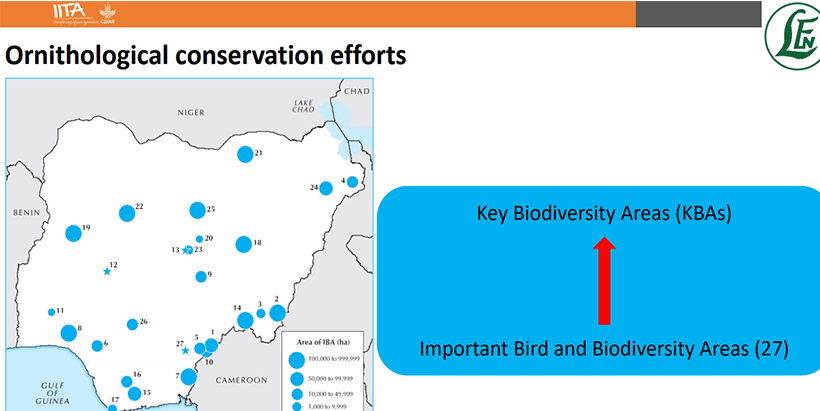
 
 Designated Key Biodiversity Areas in Nigeria.
Designated Key Biodiversity Areas in Nigeria. (Credit: Ezealor, 2001).
IITA Forest Center Manager Adewale Awoyemi answered part of this question during a webinar organized by the group “Fridays4Birds” on 27 October. He focused on bird conservation in southwest Nigeria. He noted, “Birds can be used to assess the health of the environment.”

There are 27 designated Key Biodiversity Areas (KBAs) in Nigeria, of which only two are found in the southwest region—the IITA Forest Reserve in Ibadan and Omo Forest Reserve in Ogun State. “Perhaps the most ambitious action targeted at conserving Nigeria’s vast bird diversity was the designation of the KBA sites,” Awoyemi said. He quickly added, “The 27 KBAs in Nigeria account for merely 3% of the country’s total landmass, suggesting that we need to do more work.”
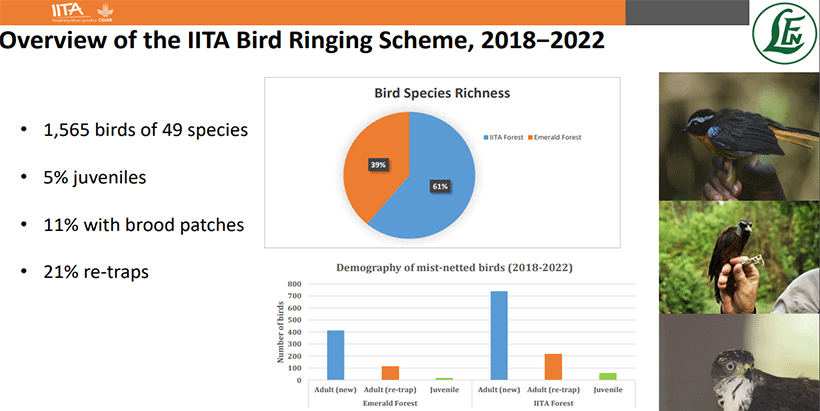
Age, sex, mass, breeding and molt are part of the data experts quantify from captured birds. (Credit: IITA Forest Center).

Awoyemi highlighted the various ornithological activities of the IITA Forest Center, particularly the quarterly monitoring of birds in the IITA and Emerald (in Osun State, southwest Nigeria) Forest Reserves that equally capture the wet and dry seasons in the area. These activities mainly involve using the line transect and mist-netting census techniques. While the first method involves walking along forest trails and recording birds seen and heard, the latter involves setting up special nets to capture live birds.

Forest staff record data from the birds before releasing them safe and sound back into the forest. Awoyemi said only licensed experts are permitted to buy and use the specialized nets to trap birds. Awoyemi is a licensed bird ringer who trains staff and students how to deploy the technique at IITA.

Thanks to the A.G Leventis Foundation sponsorship, IITA Forest Center continues making remarkable feats in the bird conservation space. Previously trapped birds are retrapped, showing that birds find the forest safe for living, breeding, and roosting. Likewise, new species are recorded. Since IITA premise is highly protected, birds and other fauna are often found lounging without fear of harm around the campus. Results from the regular bird surveys serve valuable resource materials for researchers.

Another resounding success of IITA Forest Center’s bird surveys is the identification of a potential KBA—the Emerald Forest Reserve. This forest is not part of Nigeria’s 27 designated KBAs. However, it hosts 31% of the total number of important bird species restricted to the Guinea-Congo forest belt of Nigeria (187). Despite its small size (120 ha) compared to IITA Forest Reserve (360 ha), the Emerald Forest Reserve boasts a total 128 bird species.

The IITA Forest Center has recorded the endemic and endangered Ibadan Malimbe Malimbus Ibadanensis and its only available song in the Emerald Forest Reserve. This has since contributed useful data to the RedList assessment conducted by the International Union for Conservation of Nature.

IITA Forest Center has taken the bold step of recommending the Emerald Forest Reserve as a KBA. This nomination was made to the KBA Secretariat through the Nigerian Conservation Foundation, the BirdLife International partner in Nigeria. A favorable response to this will strengthen southwest Nigeria’s ornithological relevance, especially as it is the only host to the Ibadan Malimbe.

Contributed by Folake Oduntan

Contributed by

Recent stories

No items found

Leave a Reply

Your email address will not be published. Required fields are marked *

Scroll to Top
Olaosebikan, Olamide

Olamide Deborah Nwanze is a Senior Research Associate specializing in gender mainstreaming research to inform participatory and inclusive breeding, variety development, and seed systems policies regarding root, tuber, and banana (RTB) crops in the International Institute of Tropical Agriculture Headquarters, Ibadan, Nigeria. She is a PhD candidate at the University of Ibadan and holds an MSc and B. Agric in Agricultural Extension and Rural Development. Olamide is a fellow of the African Women in Agricultural Research and Development – Gender Responsive Agricultural Systems Policy (AWARD-GRASP) and the Gender Responsive Researchers Equipped for Agricultural Transformation (GREAT). She seeks to apply her gender-mainstreaming learnings, gender-responsive research, and policy development, and review expertise to facilitate women, youth, children, and vulnerable social group’s access to and adoption of agricultural Innovations that guarantee food, nutrition, income, and livelihood security in Africa. Her current roles include mentoring research fellows, development of guides and training manuals, implementation and adaptation of gender frameworks and tools, value chain actors’ engagement as citizen science partners, policy review and redesign, data management, and analysis. Her current research explores mixed methods and participatory and interdisciplinary approaches to capture and highlight gender dynamics, needs, preferences, and challenges stakeholders face within the agricultural livelihood value chain to prioritize gender-inclusive strategies in breeding programs, policy design, and implementation.

At IITA, she contributes to the implementation of the CGIAR Accelerated Breeding Initiative and Genetic Innovation Programs; participatory and gender research within the NextGen CassavaHarvestPlusRTBFoods, and Tricot-ClimMob 1000Farms Projects; and gender knowledge communication via the G-LENS webinar series, video documentary, policy briefspublications, and blogs.


Recent publications

de Sousa, K., van Etten, J., Manners, R. Bello, A., Teeken, B., Olaosebikan, O., et al. 2024. The tricot approach: an agile framework for decentralized on-farm testing supported by citizen science. A retrospective. Agron. Sustain. Dev. 44, 8. https://doi.org/10.1007/s13593-023-00937-1

Madu, T., Onwuka, S., Nwafor, S., Onyemauwa, N., Ejechi, M., Ofoeze, M., Ukeje, B., Eluagu, C., Olaosebikan, O., Okoye, B., 2024. Gender-Inclusive Consumer Studies Improve Cassava Breeding in Nigeria in: Frontiers in Sociology, volume 9, number: 1224504, doi: 10.3389/fsoc.2024.1224504

Olaosebikan, O.; Bello, A.; Utoblo, O.; Okoye, B.; Olutegbe, N.; Garner, E.; Teeken, B.; Bryan, E.; Forsythe, L.; Cole, S.; Madu, T. 2023.  Stressors and Resilience within the Cassava Value Chain in Nigeria: Preferred Cassava Variety Traits and Response Strategies of Men and Women to Inform Breeding. Sustainability 15, 7837. https://doi.org/10.3390/su15107837

Okoye, B., Ofoeze, M., Ejechi, M., Onwuka, S., Nwafor, S., Onyemauwa, N., Ukeje, B., Eluagu, C., Obidiegwu, J.*, Olaosebikan, O., Madu, T.* 2023. Prioritizing preferred traits in the yam value chain in Nigeria: a gender situation analysis in: Frontiers in Sociology, volume 8, number: 1232626, pages 1 – 9, ISSN 2297-7775, 2023. https://www.frontiersin.org/articles/10.3389/fsoc.2023.1232626/full

Olaosebikan, O., Bello, A. A., de Sousa, K., Ndjouenkeu, R., Adesokan, M., Alamu, E. O., Agbona, A., van Etten, J., Kegah, F. N.*, Dufour, D., Bouniol, A., Teeken, B. 2023. Consumer acceptability of cassava gari-eba food products across cultural and environmental settings using the triadic comparison of technologies approach (tricot) in: Journal of the Science of Food and Agriculture,

Teeken, B., Olaosebikan, O., Bello, A. A., Madu, T.*, Cole, S. M. 2023. Qualitative assessment on the positionality and preferences of dyads in relation to cassava-related activities: working with tricot trial citizen scientists https://hdl.handle.net/10568/138326 Type: Manual

Bouniol, A., Ceballos, H., Bello, A. A., Teeken, B., Olaosebikan, O., Owoade, D., Agbona, A., Fotso Kuate, A., Madu, T.*, Okoye, B.*, Ofoeze, M.*, Nwafor, S.*, Onyemauwa, N.*, Adinsi, L.*, Forsythe, L., Dufour, D. 2023. Varietal impact on women’s labour, workload and related drudgery in processing root, tuber and banana crops: focus on cassava in sub-Saharan Africa in: Journal of the Science of Food and Agriculture, pages 1 – 25, ISSN 0022-5142,

Bello, A. A., Agbona, A., Olaosebikan, O., Edughaen, G., Dufour, D., Bouniol, A., Iluebbey, P., Ndjouenkeu, R.*, Rabbi, I. Y., Teeken, B. 2023. Genetic and environmental effects on processing productivity and food product yield: drudgery of women’s work in: Journal of the Science of Food and Agriculture, pages 1 – 32, ISSN 0022-5142, 5

Cavicchioli, M., Zimbiti, T., Teeken, B., Nwanze, D.O., Liani, M., Parkes, E. & Bello, A. 2023. IITA-Gender Responsive Breeding Training Report. Genetic Resources Center, IITA-HQ, Ibadan, 21-23 September, 2022. Ibadan, Nigeria: IITA, (34 p.).https://hdl.handle.net/10568/131368

Agbona, A. Peteti P., Teeken B., Olaosebikan O. Bello, A. A., Parkes, E., Rabbi, I. Y., Mueller, L., Egesi, C., Kulakow, P. 2022. Data Management in Multi-disciplinary African RTB Crop Breeding Programs. In: Williamson, H.F., Leonelli, S. (eds) Towards Responsible Plant Data Linkage: Data Challenges for Agricultural Research and Development. Springer, Cham. https://doi.org/10.1007/978-3-031-13276-6_5

Lora Forsythe, Pricilla Marimo, Sarah Mayanja, Olamide D. Olaosebikan, Esme Stuart, Bela Teeken, Benjamin Okoye, Tessy Madu, (2021). Cross-product Gender Analysis of RTBfoods Step 2 Gendered Food Mapping on RTB Products. Understanding the Drivers of Trait Preferences and the Development of Multi-user RTB Product Profiles, WP1. London, UK: RTBfoods Field Scientific Report, 30 p.

Teeken, B., Garner, E., Agbona, A., Balogun, I., Olaosebikan, O., Bello, A., Madu, T., Okoye, B., Egesi, C., Kulakow, P. and Tufan, H.A. 2021. Beyond “Women’s Traits”: Exploring How Gender, Social Difference, and Household Characteristics Influence Trait Preferences. Frontiers Sustainable Food Systems 5:740926. https://doi.org/10.3389/fsufs.2021.740926

Teeken, B., Agbona, A., Bello, A., Olaosebikan, O., Alamu, E., Adesokan, M., Awoyale, W., Madu, T., Okoye, B., Chijioke, U., Owoade, D., Okoro, M., Bouniol, A., Dufour, D., Hershey, C., Rabbi, I., Maziya‐Dixon, B., Egesi, C., Tufan, H. and Kulakow, P. (020. Understanding cassava varietal preferences through pairwise ranking of gari‐eba and fufu prepared by local farmer–processors. Int J Food Sci Technol. https://doi.org/10.1111/ijfs.14862

Bela Teeken, Olamide Olaosebikan, Ireti Balogun, Benjamin Okoye, Tessy Madu, Steven Cole, Abolore Bello, Elizabeth Parkes. (2020). Piloting the G+ customer and product profile tools for gender-responsive cassava breeding in Nigeria. Nigeria: International Institute of Tropical Agriculture (IITA). https://hdl.handle.net/20.500.11766/13000