
IITA NEWS

A space for gender in baseline surveys
December 1, 2023

In agricultural development, there is a growing acknowledgment of the crucial role played by gender-focused approaches throughout the various phases of project implementation. This recognition originates from the realization that development actions have not yielded the widespread beneficial impacts envisioned. In light of this, there is a mounting understanding that, for projects or programs to be truly effective and inclusive, women and men must have equal opportunities to participate in interventions and reap the benefits.
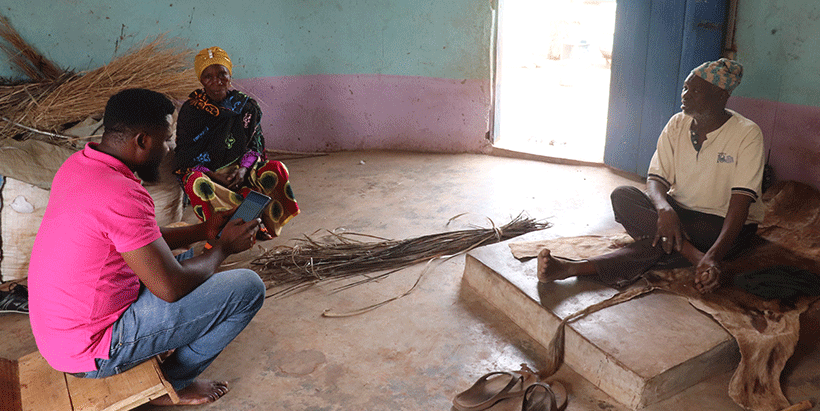
A couple responding to a questionnaire together from an enumerator during the MFS baseline survey in Ghana.
A couple responding to a questionnaire together from an enumerator during the MFS baseline survey in Ghana. (Credit: Dokurugu Fuseini/IITA).

This narrative digs into the experience and key lessons derived from an interdisciplinary research initiative that brought together Monitoring and Evaluation (M&E) and gender experts to comprehensively revise and implement a baseline survey, supplemented by qualitative data collection and support the execution of field activities.

The central argument emphasizes the significance of incorporating questions that capture gendered social dynamics in the design of baseline modules, sampling procedures, and questionnaire administration. This integrative approach, which brings gender considerations to the forefront of the research process, is posited as a crucial step toward achieving gender-responsive project implementation for sustainable development.

Wearing a gender lens in a baseline survey

In the initial quarter of 2023, the Monitoring, Evaluation, Learning, and Impact Assessment (MELIA) team of the CGIAR Initiative of Mixed Farming Systems (MFS) conducted a baseline survey in Ghana. Aligned with the initiative’s results framework, the baseline aimed to collect data on key challenges and opportunities faced by women and men farmers in mixed farming systems within the implementation countries. Its objectives included assessing the initiative’s impact on farmers’ livelihoods and identifying potential agricultural technologies and practices for scaling.
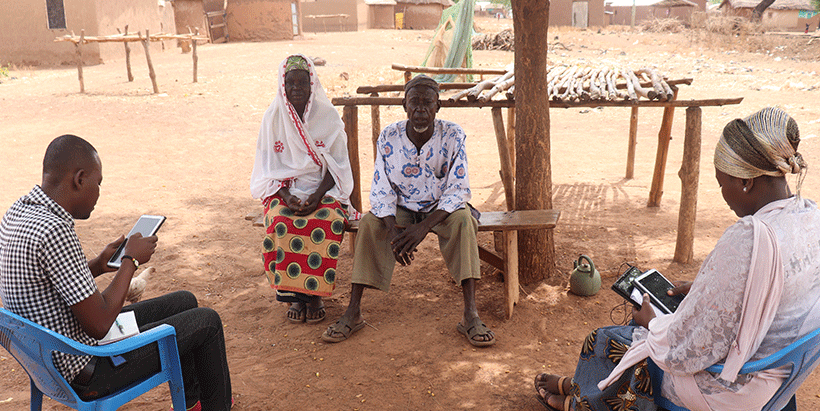
A field supervisor observing an enumerator administering a questionnaire to a couple during the MFS baseline survey in Ghana.
A field supervisor observing an enumerator administering a questionnaire to a couple during the MFS baseline survey in Ghana. (Credit: Dokurugu Fuseini/IITA).

To achieve these goals, the MELIA team developed a standard baseline survey, subject to review and adaptation by interdisciplinary teams at the country level. Survey results would be crosschecked with data from mid-line and end-line surveys to discern changes in outcomes on the ground.

The questionnaire’s initial version covered a module on participation in community-based associations and groups. The gender team added three modules designed to capture critical dimensions identified in empowerment measurement tools like the Women’s Empowerment in Agriculture Index (WEAI). One module focused on respondents’ perceptions of engagement in daily activities, ranking them from most to least time-consuming. Another module documented intra-household decision-making on land-related assets, and a third module aimed to capture participants’ views on gender norms influencing the adoption of technologies in mixed farming systems.

Drawing from the Guide to formulating gendered social norms indicators by FAO, IFAD, and WFP, the third module included participants’ agreements and disagreements on common gender norms affecting farmers’ technology adoption. The list of norms was developed through focus group discussions with farmers under the Africa RISING program in Ghana and later refined through follow-up interviews with various stakeholders involved in agricultural innovations.

From a gender perspective, ensuring inclusivity in the sampling strategy was a priority. This was considered despite challenges in accessing certain social categories. The household survey in Ghana took place from March to April across five regions in 54 communities, involving 1,320 households. The team included 20 enumerators (five women), six supervisors, and one coordinator, divided into three groups. Couples were requested to respond together, except for gender-related modules, which required separate responses from husband and wife/wives. This approach aimed to elicit responses based on individual lived experiences, free from inhibition by a spouse within listening range. However, during the survey’s administration, time constraints posed challenges to some respondents, especially women, whose busy schedules made some leave the survey prematurely with apologies, citing, “My husband will respond on my behalf.” This aspect suggests that some apparently unbiased ways to conduct research, such as a survey length, may still limit participation by the same groups whose inclusion is being fostered.

Key-learnings and recommendations

More attention must be paid to women and men as key actors in the agriculture sector. A renewed focus is for agriculture researchers to design and implement baselines to recognize and create a space for female heads of households and women in male-headed households to improve the availability of gender-responsive data suitable for gender analysis.

Addressing length in survey designs and administration resolves the limitation of women’s interest and participation, allowing a greater diversity of opinions from within the household to emerge and increase the inclusiveness and equal representation of women and men during survey exercises.

Gender analysis is an important step toward achieving and delivering gender-responsive programs and projects. However, applying a mixed methods design (quantitative and qualitative approaches) can provide researchers insights to understand women’s and men’s attitudes, experiences, and perceptions and to measure changes over time.

For a gender and mostly qualitative methods-oriented researcher, participating in a baseline survey design and administration can be a great opportunity to more effectively mainstream gender and social inclusion approaches and research questions in quantitative research. In our attempt as researchers to bridge disciplinary gaps and more accurately document the social implications of our activities, we will need to move toward approaches that seek to understand the smallholders’ physical and social contexts in which projects and interventions are designed and implemented.

Creating space for gender and social research into agriculture helps make interventions more mindful of the challenges and the opportunities that women and men see in agriculture and incorporating them into project frameworks that will likely result in increased benefits for all.

Contributed by Rashida Chantima Ziblila and Martina Cavicchioli

Contributed by

Recent stories

No items found

Leave a Reply

Your email address will not be published. Required fields are marked *

Scroll to Top
Olaosebikan, Olamide

Olamide Deborah Nwanze is a Senior Research Associate specializing in gender mainstreaming research to inform participatory and inclusive breeding, variety development, and seed systems policies regarding root, tuber, and banana (RTB) crops in the International Institute of Tropical Agriculture Headquarters, Ibadan, Nigeria. She is a PhD candidate at the University of Ibadan and holds an MSc and B. Agric in Agricultural Extension and Rural Development. Olamide is a fellow of the African Women in Agricultural Research and Development – Gender Responsive Agricultural Systems Policy (AWARD-GRASP) and the Gender Responsive Researchers Equipped for Agricultural Transformation (GREAT). She seeks to apply her gender-mainstreaming learnings, gender-responsive research, and policy development, and review expertise to facilitate women, youth, children, and vulnerable social group’s access to and adoption of agricultural Innovations that guarantee food, nutrition, income, and livelihood security in Africa. Her current roles include mentoring research fellows, development of guides and training manuals, implementation and adaptation of gender frameworks and tools, value chain actors’ engagement as citizen science partners, policy review and redesign, data management, and analysis. Her current research explores mixed methods and participatory and interdisciplinary approaches to capture and highlight gender dynamics, needs, preferences, and challenges stakeholders face within the agricultural livelihood value chain to prioritize gender-inclusive strategies in breeding programs, policy design, and implementation.

At IITA, she contributes to the implementation of the CGIAR Accelerated Breeding Initiative and Genetic Innovation Programs; participatory and gender research within the NextGen CassavaHarvestPlusRTBFoods, and Tricot-ClimMob 1000Farms Projects; and gender knowledge communication via the G-LENS webinar series, video documentary, policy briefspublications, and blogs.


Recent publications

de Sousa, K., van Etten, J., Manners, R. Bello, A., Teeken, B., Olaosebikan, O., et al. 2024. The tricot approach: an agile framework for decentralized on-farm testing supported by citizen science. A retrospective. Agron. Sustain. Dev. 44, 8. https://doi.org/10.1007/s13593-023-00937-1

Madu, T., Onwuka, S., Nwafor, S., Onyemauwa, N., Ejechi, M., Ofoeze, M., Ukeje, B., Eluagu, C., Olaosebikan, O., Okoye, B., 2024. Gender-Inclusive Consumer Studies Improve Cassava Breeding in Nigeria in: Frontiers in Sociology, volume 9, number: 1224504, doi: 10.3389/fsoc.2024.1224504

Olaosebikan, O.; Bello, A.; Utoblo, O.; Okoye, B.; Olutegbe, N.; Garner, E.; Teeken, B.; Bryan, E.; Forsythe, L.; Cole, S.; Madu, T. 2023.  Stressors and Resilience within the Cassava Value Chain in Nigeria: Preferred Cassava Variety Traits and Response Strategies of Men and Women to Inform Breeding. Sustainability 15, 7837. https://doi.org/10.3390/su15107837

Okoye, B., Ofoeze, M., Ejechi, M., Onwuka, S., Nwafor, S., Onyemauwa, N., Ukeje, B., Eluagu, C., Obidiegwu, J.*, Olaosebikan, O., Madu, T.* 2023. Prioritizing preferred traits in the yam value chain in Nigeria: a gender situation analysis in: Frontiers in Sociology, volume 8, number: 1232626, pages 1 – 9, ISSN 2297-7775, 2023. https://www.frontiersin.org/articles/10.3389/fsoc.2023.1232626/full

Olaosebikan, O., Bello, A. A., de Sousa, K., Ndjouenkeu, R., Adesokan, M., Alamu, E. O., Agbona, A., van Etten, J., Kegah, F. N.*, Dufour, D., Bouniol, A., Teeken, B. 2023. Consumer acceptability of cassava gari-eba food products across cultural and environmental settings using the triadic comparison of technologies approach (tricot) in: Journal of the Science of Food and Agriculture,

Teeken, B., Olaosebikan, O., Bello, A. A., Madu, T.*, Cole, S. M. 2023. Qualitative assessment on the positionality and preferences of dyads in relation to cassava-related activities: working with tricot trial citizen scientists https://hdl.handle.net/10568/138326 Type: Manual

Bouniol, A., Ceballos, H., Bello, A. A., Teeken, B., Olaosebikan, O., Owoade, D., Agbona, A., Fotso Kuate, A., Madu, T.*, Okoye, B.*, Ofoeze, M.*, Nwafor, S.*, Onyemauwa, N.*, Adinsi, L.*, Forsythe, L., Dufour, D. 2023. Varietal impact on women’s labour, workload and related drudgery in processing root, tuber and banana crops: focus on cassava in sub-Saharan Africa in: Journal of the Science of Food and Agriculture, pages 1 – 25, ISSN 0022-5142,

Bello, A. A., Agbona, A., Olaosebikan, O., Edughaen, G., Dufour, D., Bouniol, A., Iluebbey, P., Ndjouenkeu, R.*, Rabbi, I. Y., Teeken, B. 2023. Genetic and environmental effects on processing productivity and food product yield: drudgery of women’s work in: Journal of the Science of Food and Agriculture, pages 1 – 32, ISSN 0022-5142, 5

Cavicchioli, M., Zimbiti, T., Teeken, B., Nwanze, D.O., Liani, M., Parkes, E. & Bello, A. 2023. IITA-Gender Responsive Breeding Training Report. Genetic Resources Center, IITA-HQ, Ibadan, 21-23 September, 2022. Ibadan, Nigeria: IITA, (34 p.).https://hdl.handle.net/10568/131368

Agbona, A. Peteti P., Teeken B., Olaosebikan O. Bello, A. A., Parkes, E., Rabbi, I. Y., Mueller, L., Egesi, C., Kulakow, P. 2022. Data Management in Multi-disciplinary African RTB Crop Breeding Programs. In: Williamson, H.F., Leonelli, S. (eds) Towards Responsible Plant Data Linkage: Data Challenges for Agricultural Research and Development. Springer, Cham. https://doi.org/10.1007/978-3-031-13276-6_5

Lora Forsythe, Pricilla Marimo, Sarah Mayanja, Olamide D. Olaosebikan, Esme Stuart, Bela Teeken, Benjamin Okoye, Tessy Madu, (2021). Cross-product Gender Analysis of RTBfoods Step 2 Gendered Food Mapping on RTB Products. Understanding the Drivers of Trait Preferences and the Development of Multi-user RTB Product Profiles, WP1. London, UK: RTBfoods Field Scientific Report, 30 p.

Teeken, B., Garner, E., Agbona, A., Balogun, I., Olaosebikan, O., Bello, A., Madu, T., Okoye, B., Egesi, C., Kulakow, P. and Tufan, H.A. 2021. Beyond “Women’s Traits”: Exploring How Gender, Social Difference, and Household Characteristics Influence Trait Preferences. Frontiers Sustainable Food Systems 5:740926. https://doi.org/10.3389/fsufs.2021.740926

Teeken, B., Agbona, A., Bello, A., Olaosebikan, O., Alamu, E., Adesokan, M., Awoyale, W., Madu, T., Okoye, B., Chijioke, U., Owoade, D., Okoro, M., Bouniol, A., Dufour, D., Hershey, C., Rabbi, I., Maziya‐Dixon, B., Egesi, C., Tufan, H. and Kulakow, P. (020. Understanding cassava varietal preferences through pairwise ranking of gari‐eba and fufu prepared by local farmer–processors. Int J Food Sci Technol. https://doi.org/10.1111/ijfs.14862

Bela Teeken, Olamide Olaosebikan, Ireti Balogun, Benjamin Okoye, Tessy Madu, Steven Cole, Abolore Bello, Elizabeth Parkes. (2020). Piloting the G+ customer and product profile tools for gender-responsive cassava breeding in Nigeria. Nigeria: International Institute of Tropical Agriculture (IITA). https://hdl.handle.net/20.500.11766/13000