
Following the recent exhibition of innovations from CGIAR centers and partners and the Youth project launch in Abuja, Nigeria, a delegation from the Federal Government of Nigeria (FGN) embarked on a three-day visit to IITA headquarters in Ibadan from 26 to 28 November. The delegation included Marion Moon, Technical Advisor to the Vice-President on Agriculture and Food Security, and Heather-Ronke Akanni, Senior Technical Advisor on Agriculture and Food Security, Office of the President.

Moon explained the challenges faced by the important crops in Nigeria that have reduced the productivity of smallholder farmers in Nigeria. Expressing her mission, “I am here to acquire insights about IITA’s experiences to bridge the gaps between successful and unsuccessful activities and leverage on the Institute’s research output in crops that are important in Nigeria,” she stated.
Akanni highlighted the potential of High-Quality Cassava Flour (HQCF), stressing the need to expand its production and facilitate its incorporation into confectionary products. In addition, she advocated for exploring the potential of HQCF and various components of cassava plants for exportation, aiming to attract foreign direct investment.
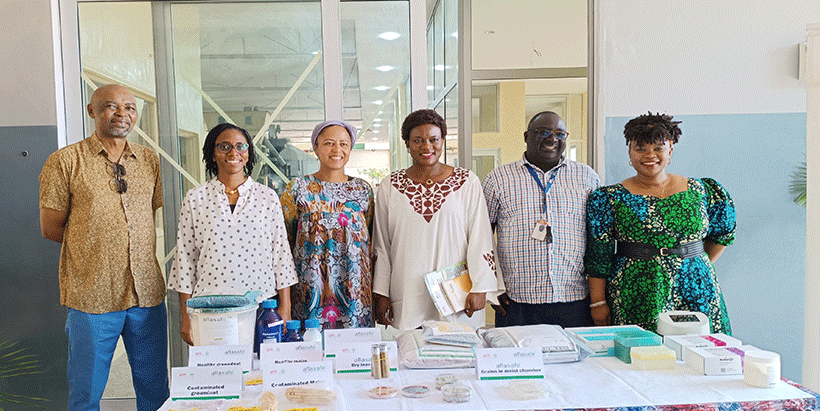
Furthermore, Akanni requested IITA’s technical support in rice production and youth empowerment, which will contribute to the scaling of youth-oriented programs in Nigeria.
In response, IITA Deputy Director General Partnerships for Delivery (DDG-P4D) Kenton Dashiell mentioned that the team would be linked with the required institutions with the skills required to address the challenges.
IITA Director General Simeon Ehui expressed his enthusiasm for the collaboration and support of the FGN, which would help explore the Institute’s technical expertise. “I want to reassure you of our harmonization with FGN to ensure that the Nigerian agricultural sector is significantly impacted by modern agriculture,” he said.
The discussion pivoted toward the challenges facing smallholder farmers, contributing to the issue of food insecurity. Therefore, the adoption of good agronomic practices will enhance agricultural output.
During the delegation’s visit to the Aflasafe unit and IITA Youth in Agribusiness (IYA), they were impressed by the Aflasafe technology—a natural solution to the challenge of aflatoxin in food crops—and the importance of young people in agriculture. In light of this, Akanni suggested that more advocacy be carried out on Aflasafe to extend its impact without neglecting the grassroots level and its critical role in ensuring consumer food safety.
“The IYA model presents significant opportunities for youth empowerment. I am interested in the Start Them Early Program, which is worth scaling. Implementing the program can enhance the school feeding program initiative led by the FGN,” Akanni stated.
Contributed by Anita AkinyomadeContributed by
Recent stories