
Banana project applauded for making record progress amidst the COVID-19 pandemic
June 25, 2021
IITA management and the Scientific Advisory Group (SAG) of the Accelerated Breeding Better Bananas (ABBB) project—the biggest banana breeding project—have praised the project for its solid achievements in improving the production and productivity of banana in Tanzania and Uganda, despite the challenges posed by COVID-19.
Notable achievements include the official release of new banana hybrids of the popular cooking banana ‘matooke’ in Tanzania—the first-ever hybrids locally bred, and the rolling out of the innovative Banana breeding Tracking Tool (BTracT) currently operational across all project breeding sites.
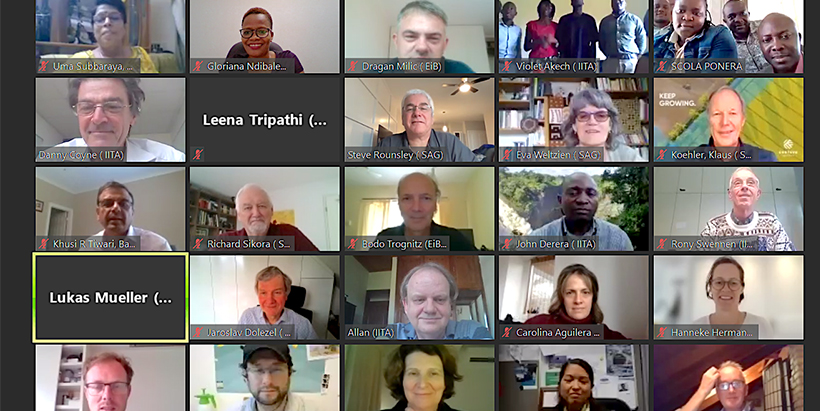
 The team reported their achievements during the project’s annual review and planning meeting held virtually on 17-20 May to review progress and results and discuss a way forward as the prject transitions into the Excellence in Breeding (EiB) platform under One CGIAR in 2022.
In her opening remarks, Leena Tripathi, IITA Director for Eastern Africa Hub, appreciated the hard work and commended the project on its achievements. These included good collaboration with national partners—the National Agricultural Research Organization (NARO) and Tanzania Agricultural Research Institute (TARI), which contributed towards improving banana breeding systems and changing the lives of banana farming communities.
The team reported their achievements during the project’s annual review and planning meeting held virtually on 17-20 May to review progress and results and discuss a way forward as the prject transitions into the Excellence in Breeding (EiB) platform under One CGIAR in 2022.
In her opening remarks, Leena Tripathi, IITA Director for Eastern Africa Hub, appreciated the hard work and commended the project on its achievements. These included good collaboration with national partners—the National Agricultural Research Organization (NARO) and Tanzania Agricultural Research Institute (TARI), which contributed towards improving banana breeding systems and changing the lives of banana farming communities.
 “Major achievements of the project include the official release of NARITA hybrids in Tanzania; development and deployment of the banana tracking tool, which is key for modern banana breeding programs, and efforts in training the next generation of banana breeders, including IITA and partner staff in Uganda and Tanzania as well as several PhD and masters’ students,” she said.
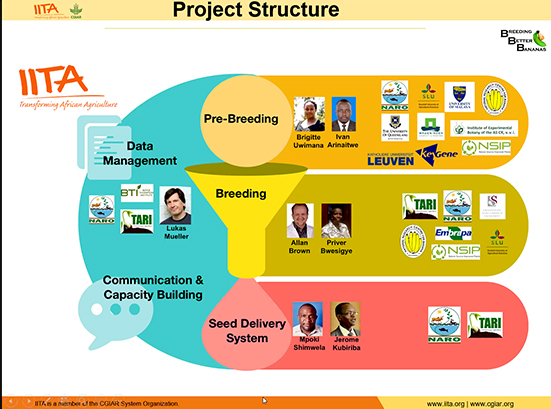
The project team and partners highlighted the results and challenges under the project’s research themes and future outlook. The themes are pre-breeding, breeding (divided into two subthemes: Matooke and Mchare), data management, communication and capacity building, and seed delivery/variety release systems.
Highlighting the project’s successes, Prof Rony Swennen, the project coordinator, noted that the project’s breeding was currently guided by the product profile for the parents and the final product to ensure it met the consumers’ demands.
“We developed the product profiles together with our colleagues at NARO; however, we still need to work on it further because what we have now was only done by breeders. We need to have the consumers and market intelligence to refine the elements,” Swennen said.
He further noted that the team is linking hybrids with sensory acceptability, an important element to start evaluating for quality. The bases are developed by NARO using the preferred traits with measurements in the laboratory. Furthermore, the first Mchare hybrids have been selected for preliminary yield trials.
Giving their feedback on progress and achievement, Eva Weltzien-Rattunde, SAG member, also commended the good and clear division of roles and responsibilities between the national research institutes and IITA.
“There is good integration of pathology work during pre-breeding and breeding work,” Weltzein-Rattunde said.
The ABBB project seeks to strengthen the banana breeding programs in the two countries towards developing new high-yielding hybrid banana varieties with resistance to key pests and diseases.
The project is led by IITA in cooperation with TARI and NARO and brings together other institutes and banana breeding programs across the globe. There were 125 participants, including other delegates from Excellence in Breeding, the private sector (Bayer, NSIP, KeyGene), and the NGO, MEDA. This work is part of the CGIAR Research Program on Roots, Tubers and Banana, flagship 2.
“Major achievements of the project include the official release of NARITA hybrids in Tanzania; development and deployment of the banana tracking tool, which is key for modern banana breeding programs, and efforts in training the next generation of banana breeders, including IITA and partner staff in Uganda and Tanzania as well as several PhD and masters’ students,” she said.
The project team and partners highlighted the results and challenges under the project’s research themes and future outlook. The themes are pre-breeding, breeding (divided into two subthemes: Matooke and Mchare), data management, communication and capacity building, and seed delivery/variety release systems.
Highlighting the project’s successes, Prof Rony Swennen, the project coordinator, noted that the project’s breeding was currently guided by the product profile for the parents and the final product to ensure it met the consumers’ demands.
“We developed the product profiles together with our colleagues at NARO; however, we still need to work on it further because what we have now was only done by breeders. We need to have the consumers and market intelligence to refine the elements,” Swennen said.
He further noted that the team is linking hybrids with sensory acceptability, an important element to start evaluating for quality. The bases are developed by NARO using the preferred traits with measurements in the laboratory. Furthermore, the first Mchare hybrids have been selected for preliminary yield trials.
Giving their feedback on progress and achievement, Eva Weltzien-Rattunde, SAG member, also commended the good and clear division of roles and responsibilities between the national research institutes and IITA.
“There is good integration of pathology work during pre-breeding and breeding work,” Weltzein-Rattunde said.
The ABBB project seeks to strengthen the banana breeding programs in the two countries towards developing new high-yielding hybrid banana varieties with resistance to key pests and diseases.
The project is led by IITA in cooperation with TARI and NARO and brings together other institutes and banana breeding programs across the globe. There were 125 participants, including other delegates from Excellence in Breeding, the private sector (Bayer, NSIP, KeyGene), and the NGO, MEDA. This work is part of the CGIAR Research Program on Roots, Tubers and Banana, flagship 2.
An overview of the research themes and partners under the ABBB project.
A group photo of the virtual annual meeting of the ABBB project.
Contributed by
Recent stories
No items found