
African Yam Bean (AYB): Rehabilitating a leguminous crop with many uses
May 21, 2021
To revitalize underutilized crops in Africa, the “Bean-preneur” team organized exploratory interviews with African Yam Bean (AYB) growers and non-AYB growers in Nigeria to identify its cultivation and utilization challenges. They also used the opportunity to create more awareness about AYB’s economic and nutritional benefits among farmers and other stakeholders.
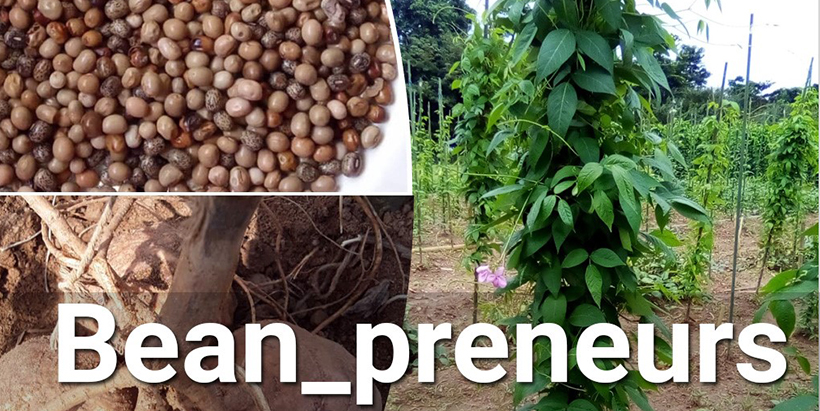 In the southwestern part of the country, particularly in Ekiti and Osun states, AYB attracts more patronage in terms of cultivation and consumption than other states in the region. The focus group discussion established that the cultivation of AYB in these states was still at the subsistence level with local processing for consumption. Ekiti farmers demonstrated this during the interview session through the displayed bean pods, shelled raw beans, and cooked AYB from their farms. The interview facilitator, Sarafat Tijani, acknowledged this, saying, “Ekiti growers are really into AYB cultivation and consumption.”
On the knowledge of AYB cultivation and processing, most farmers stated that AYB is planted as a side crop or intercropped with other crops like yam and sorghum. As a vine crop, AYB shares staking with these crops or uses them (e.g., sorghum) as stakes.
Farmers also shared their knowledge about planting AYB around April or latest May, but not delayed till June as this reduces yield obtainable from the crop. According to the farmers, AYB flowering stage starts in November; thus, a growing cycle from April to January yields a more remarkable harvest. The long growing cycle explains the reason for farmers’ limited interest in AYB cultivation and its intercropping mode with other crops.
In the southwestern part of the country, particularly in Ekiti and Osun states, AYB attracts more patronage in terms of cultivation and consumption than other states in the region. The focus group discussion established that the cultivation of AYB in these states was still at the subsistence level with local processing for consumption. Ekiti farmers demonstrated this during the interview session through the displayed bean pods, shelled raw beans, and cooked AYB from their farms. The interview facilitator, Sarafat Tijani, acknowledged this, saying, “Ekiti growers are really into AYB cultivation and consumption.”
On the knowledge of AYB cultivation and processing, most farmers stated that AYB is planted as a side crop or intercropped with other crops like yam and sorghum. As a vine crop, AYB shares staking with these crops or uses them (e.g., sorghum) as stakes.
Farmers also shared their knowledge about planting AYB around April or latest May, but not delayed till June as this reduces yield obtainable from the crop. According to the farmers, AYB flowering stage starts in November; thus, a growing cycle from April to January yields a more remarkable harvest. The long growing cycle explains the reason for farmers’ limited interest in AYB cultivation and its intercropping mode with other crops.
 Besides the long growing process, cooking AYB for consumption was also reported to take so long that it has to be cooked over the night to soften. Farmers identified other uses to which AYB can be put, such as processing and grinding into a paste with pepper and onion to make bean cake and moin-moin and other food delicacies made from other beans.
The challenges notwithstanding, farmers agreed that the crop’s economic and nutritional benefits could not be over-emphasized. Its cultivation enhances soil fertility through nodulation as a leguminous crop, and it increases the yield of other crops. However, the Project Supervisor Ademola Aina’s observation on the simultaneous production of tubers in underground and bean seeds in pods by some AYB crop varieties is yet to be confirmed by some farmers’ representatives, particularly from Oyo State.
More awareness on AYB will encourage growers to explore additional income from AYB (tuber production). Furthermore, the respondents unanimously agreed that AYB could be regarded as a promising food crop in combating protein-energy malnutrition due to its high nutritional profile (protein from the beans and carbohydrates from its tuber). It is also a food crop with the potential to improve food security significantly.
Based on farmers’ recommendation to develop improved varieties that are early maturing and with a shortened bean-cooking time, and consequent assurance of availability of this request, the Bean-preneur team recommends more sensitization among farmers within their groups in the selected states. Farmers’ representatives in the less AYB informed Oyo State expressed their motivation and willingness to go into the production of AYB based on the ideas shared during the interview.
Tissue Culture Specialist Morufat Balogun stated that, after identifying challenges with AYB cultivation, the project team at IITA, with collaborating partners and other interested scientists, will target breeding programs for AYB improvement. They will also establish a commercial value chain that is all-inclusive for efficient consumer satisfaction.
Besides the long growing process, cooking AYB for consumption was also reported to take so long that it has to be cooked over the night to soften. Farmers identified other uses to which AYB can be put, such as processing and grinding into a paste with pepper and onion to make bean cake and moin-moin and other food delicacies made from other beans.
The challenges notwithstanding, farmers agreed that the crop’s economic and nutritional benefits could not be over-emphasized. Its cultivation enhances soil fertility through nodulation as a leguminous crop, and it increases the yield of other crops. However, the Project Supervisor Ademola Aina’s observation on the simultaneous production of tubers in underground and bean seeds in pods by some AYB crop varieties is yet to be confirmed by some farmers’ representatives, particularly from Oyo State.
More awareness on AYB will encourage growers to explore additional income from AYB (tuber production). Furthermore, the respondents unanimously agreed that AYB could be regarded as a promising food crop in combating protein-energy malnutrition due to its high nutritional profile (protein from the beans and carbohydrates from its tuber). It is also a food crop with the potential to improve food security significantly.
Based on farmers’ recommendation to develop improved varieties that are early maturing and with a shortened bean-cooking time, and consequent assurance of availability of this request, the Bean-preneur team recommends more sensitization among farmers within their groups in the selected states. Farmers’ representatives in the less AYB informed Oyo State expressed their motivation and willingness to go into the production of AYB based on the ideas shared during the interview.
Tissue Culture Specialist Morufat Balogun stated that, after identifying challenges with AYB cultivation, the project team at IITA, with collaborating partners and other interested scientists, will target breeding programs for AYB improvement. They will also establish a commercial value chain that is all-inclusive for efficient consumer satisfaction.
African Yam Bean produces beans in pods above-ground and tubers beneath.
Bean-preneur team member and Tissue Culture Specialist Dr Morufat Balogun.
Contributed by
Recent stories
No items found