
IITA’s circular bioeconomy innovations contributing to food security and natural resource management in sub-Saharan Africa
April 22, 2021
Innovations on the circular bioeconomy from IITA have contributed positively to increasing crop productivity, food security, resource use efficiency, job creation, and reduction of greenhouse gas emissions.
This is according to a study by the CGIAR-IITA research team that assessed the contributions of IITA’s circular bioeconomy innovations to economic, social, and environmental outcomes. The findings were published in the paper “Circular Bioeconomy Research for Development in sub-Saharan Africa: Innovations, Gaps, and Actions” in the special Issue of Sustainability titled “Accelerating Bioeconomy Growth through Applied Research and Policy Change” on February 2021.
 Circular bioeconomy is simply keeping resources in use for as long as possible, using them as much as possible, designing out waste, and recovering materials in the end with nothing being wasted. Circular bioeconomy also includes knowledge-based production and use of biological resources.
It holds great potential to address the challenges that sub-Saharan Africa faces today. The study focuses on the efficient utilization of resources, including nutrient recycling, sustainable biomass for biofuel production, value addition, reducing the use of toxic chemicals like chemical pesticides and fertilizers, and reducing postharvest losses through breeding improved varieties using gene editing.
For over a decade, IITA has applied the circular bioeconomy approach in several of its Research for Development (R4D) projects in the region to address natural resource degradation, climate change, hunger, and poverty. However, evidence was lacking on the circular bioeconomy’s contributions to the environment and economy and the positive social benefits.
Circular bioeconomy is simply keeping resources in use for as long as possible, using them as much as possible, designing out waste, and recovering materials in the end with nothing being wasted. Circular bioeconomy also includes knowledge-based production and use of biological resources.
It holds great potential to address the challenges that sub-Saharan Africa faces today. The study focuses on the efficient utilization of resources, including nutrient recycling, sustainable biomass for biofuel production, value addition, reducing the use of toxic chemicals like chemical pesticides and fertilizers, and reducing postharvest losses through breeding improved varieties using gene editing.
For over a decade, IITA has applied the circular bioeconomy approach in several of its Research for Development (R4D) projects in the region to address natural resource degradation, climate change, hunger, and poverty. However, evidence was lacking on the circular bioeconomy’s contributions to the environment and economy and the positive social benefits.
 The team found that IITA’s circular bioeconomy interventions had led to ten technological innovations that translated into five economic, social, and environmental outcomes: food security, crop production, job creation, resource use efficiency, and reduction of greenhouse gas emissions.
“While the current development model has benefited humanity for decades in creating material wealth, meeting food and other needs, it has compromised the ability of future generations to meet theirs. Scientific modeling results suggest that the current level of resource use has already exceeded what is considered sustainable,” says Shiferaw Feleke, IITA agricultural economist and the lead author of the paper.
“The results of our study are important in building a case for integrating a circular bioeconomy approach in R4D work to find more efficient and less wasteful ways to achieve economic, social, and environmental development for a sustainable future for current and future generations,” says Feleke.
“This type of work will be critical as we transition into the One CGIAR as so many CGIAR centers have different experiences designing and testing circular bioeconomy innovations. We shall need to collaborate effectively for such innovations to lead to positive environmental, social, and economic outcomes,” he added.
ITA’s circular bioeconomy interventions have been implemented in Benin, the Democratic Republic of Congo, Tanzania, Kenya, Nigeria, and Rwanda, while the interventions’ outputs have been deployed in several other African countries.
ITA’s circular bioeconomy interventions have been implemented in Benin, the Democratic Republic of Congo, Tanzania, Kenya, Nigeria, and Rwanda, while the interventions’ outputs have been deployed in several other African countries.
Interventions include improved varieties developed for tolerance to postharvest physiological deterioration, biofertilizer development for soil fertility management through nitrogen-fixation, biocontrol development for the management of aflatoxin in food crops, second-generation biofuel development, safe and nutritious food product development, safe and nutritious feed production development, animal feed development, biochar development for carbon sequestration, organic fertilizer development, and biogas production
The team found that IITA’s circular bioeconomy interventions had led to ten technological innovations that translated into five economic, social, and environmental outcomes: food security, crop production, job creation, resource use efficiency, and reduction of greenhouse gas emissions.
“While the current development model has benefited humanity for decades in creating material wealth, meeting food and other needs, it has compromised the ability of future generations to meet theirs. Scientific modeling results suggest that the current level of resource use has already exceeded what is considered sustainable,” says Shiferaw Feleke, IITA agricultural economist and the lead author of the paper.
“The results of our study are important in building a case for integrating a circular bioeconomy approach in R4D work to find more efficient and less wasteful ways to achieve economic, social, and environmental development for a sustainable future for current and future generations,” says Feleke.
“This type of work will be critical as we transition into the One CGIAR as so many CGIAR centers have different experiences designing and testing circular bioeconomy innovations. We shall need to collaborate effectively for such innovations to lead to positive environmental, social, and economic outcomes,” he added.
ITA’s circular bioeconomy interventions have been implemented in Benin, the Democratic Republic of Congo, Tanzania, Kenya, Nigeria, and Rwanda, while the interventions’ outputs have been deployed in several other African countries.
ITA’s circular bioeconomy interventions have been implemented in Benin, the Democratic Republic of Congo, Tanzania, Kenya, Nigeria, and Rwanda, while the interventions’ outputs have been deployed in several other African countries.
Interventions include improved varieties developed for tolerance to postharvest physiological deterioration, biofertilizer development for soil fertility management through nitrogen-fixation, biocontrol development for the management of aflatoxin in food crops, second-generation biofuel development, safe and nutritious food product development, safe and nutritious feed production development, animal feed development, biochar development for carbon sequestration, organic fertilizer development, and biogas production
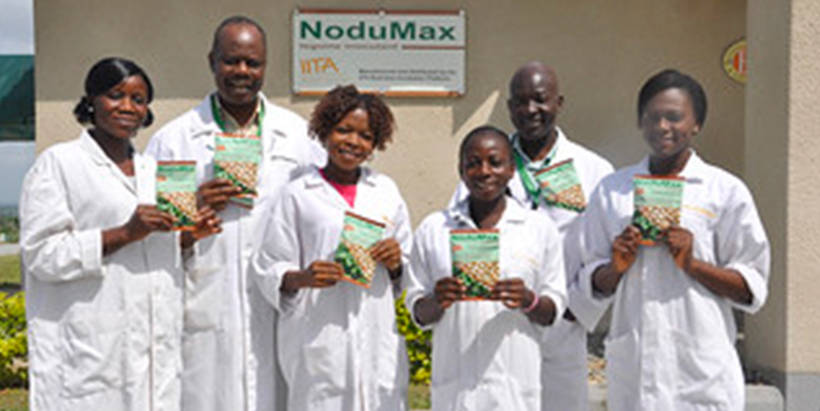
IITA staff with packets of legume biofertilizer, NODUMAX.
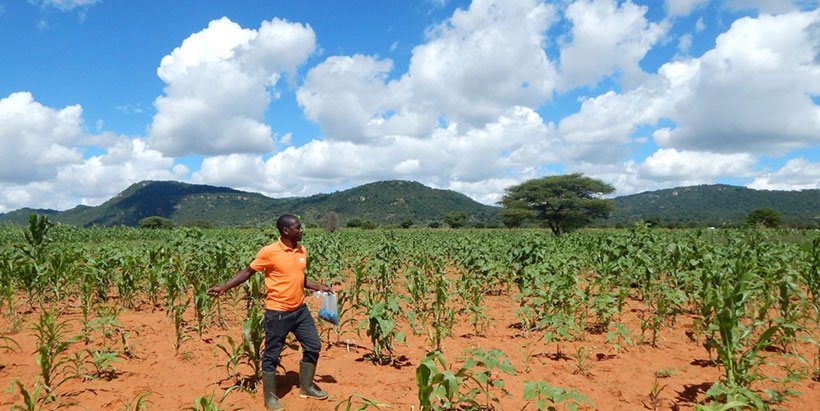
Applying Aflasafe in a farm in Tanzania: Aflasafe is one of the biocircular economy innovations of IITA. Feleke Shiferaw, lead author.
Contributed by
Recent stories
No items found