
Peas ‘n’ Chips: Creating food security with African yam bean
April 23, 2021
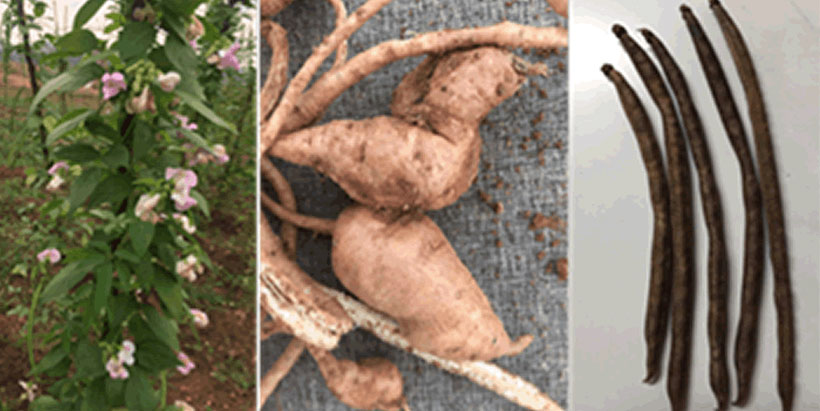
The African yam bean (AYB), Sphenostylis stenocarpa, produces beans in pods above-ground and tubers beneath. This climate-resilient tuberous legume replenishes the soil through nitrogen fixation and is highly nutritious, with the protein-rich beans and the tuber as an energy source. AYB has a high amino-acid profile and alleviated malnourishment during the Nigerian civil war in the 1960s. As a result, scientists now consider revitalizing AYB to be essential.
To promote this underutilized crop while intensifying efforts to establish a sustainable seed system, breeding for bigger tubers, and a short cooking time for the beans, the Peas ’n’ Chips entrepreneurs are organizing various activities with different themes. The Peas ‘n’ Chips team, consisting of researchers from the University of Cambridge and IITA, hosted one such event during the recent Cambridge Festival on 26 March. Fifty-six registered attendees participated in the webinar.
 Drs Nadia Radzman and Curie Park from the University of Cambridge and IITA’s Drs Morufat Balogun, Sarafat Tijani, and Ademola Aina are on this initiative of integrating AYB, an underutilized crop, into the food value chain for sustainable food security in Africa.
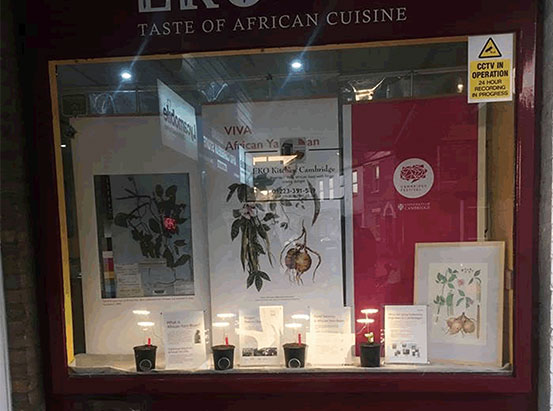
The Cambridge Festival included a window museum exhibition at the Eko kitchen presenting the AYB crop. Talks at the webinar highlighted the harnessed indigenous perspectives and scientific knowledge geared towards developing improved farmers’ preferred varieties.
Radzman elaborated on why AYB is a potential food security crop. Fulfilling the criteria of diversity, proximity, and resilience qualifies the AYB to address better food security. AYB also reduces overreliance on a few major crops and ensures safety in case of other crop failures. Because AYB fixes atmospheric nitrogen, it limits nitrogen fertilizer use, leading to a smaller carbon footprint.
Drs Nadia Radzman and Curie Park from the University of Cambridge and IITA’s Drs Morufat Balogun, Sarafat Tijani, and Ademola Aina are on this initiative of integrating AYB, an underutilized crop, into the food value chain for sustainable food security in Africa.
The Cambridge Festival included a window museum exhibition at the Eko kitchen presenting the AYB crop. Talks at the webinar highlighted the harnessed indigenous perspectives and scientific knowledge geared towards developing improved farmers’ preferred varieties.
Radzman elaborated on why AYB is a potential food security crop. Fulfilling the criteria of diversity, proximity, and resilience qualifies the AYB to address better food security. AYB also reduces overreliance on a few major crops and ensures safety in case of other crop failures. Because AYB fixes atmospheric nitrogen, it limits nitrogen fertilizer use, leading to a smaller carbon footprint.
 In discussing the development of the crop’s tuber, Aina noted, “AYB could grow to almost the size of yam, as obtained by some colleagues in Ebonyi State, Nigeria.” He also highlighted the research outcome of both the field and laboratory work at IITA and the University of Ibadan in Nigeria.
Park gave an overview of the project’s origins, stating that the researchers are propelled with a zeal to raise awareness about AYB (a forgotten crop) and promote a sustainable market structure towards food security and enhanced livelihood of farmers, consumers, and other stakeholders in Africa.
Park also underlined the challenges facing AYB and non-AYB farmers during the AYB exploratory interviews organized in February. These include long cooking time for the bean, short shelf life for the tuber, relatively small tuber size, and inconsistent tuber production.
With the global population increase, AYB is a promising crop with a high seed yield per unit of land. Having established the high nutritional profile of both the tuber and legume, Balogun declared that AYB could be commercially successful in Africa. The Bean_preneur project is attempting to answer some of the key research questions. Balogun also noted that to realize global food resilience through AYB, we need an active and versatile value chain for AYB.
In her remarks, Tijani spoke about the immediate and medium-term actions. She indicated that intercropping AYB with other crops would encourage dietary diversity, developing early maturing varieties of AYB will feature AYB in 2‒3 successive production cycles annually, and the development of processing technologies will prevent wastage due to storage loss. These points will help make AYB available, accessible, affordable, and adopted for global food resilience.
The exhibition at Eko kitchen in Cambridge included a first-ever commissioned botanical illustration of African Yam Bean. They also featured a video of nicely cooked African yam bean with a special sauce to attract people willing to have a taste during the festival period.
In discussing the development of the crop’s tuber, Aina noted, “AYB could grow to almost the size of yam, as obtained by some colleagues in Ebonyi State, Nigeria.” He also highlighted the research outcome of both the field and laboratory work at IITA and the University of Ibadan in Nigeria.
Park gave an overview of the project’s origins, stating that the researchers are propelled with a zeal to raise awareness about AYB (a forgotten crop) and promote a sustainable market structure towards food security and enhanced livelihood of farmers, consumers, and other stakeholders in Africa.
Park also underlined the challenges facing AYB and non-AYB farmers during the AYB exploratory interviews organized in February. These include long cooking time for the bean, short shelf life for the tuber, relatively small tuber size, and inconsistent tuber production.
With the global population increase, AYB is a promising crop with a high seed yield per unit of land. Having established the high nutritional profile of both the tuber and legume, Balogun declared that AYB could be commercially successful in Africa. The Bean_preneur project is attempting to answer some of the key research questions. Balogun also noted that to realize global food resilience through AYB, we need an active and versatile value chain for AYB.
In her remarks, Tijani spoke about the immediate and medium-term actions. She indicated that intercropping AYB with other crops would encourage dietary diversity, developing early maturing varieties of AYB will feature AYB in 2‒3 successive production cycles annually, and the development of processing technologies will prevent wastage due to storage loss. These points will help make AYB available, accessible, affordable, and adopted for global food resilience.
The exhibition at Eko kitchen in Cambridge included a first-ever commissioned botanical illustration of African Yam Bean. They also featured a video of nicely cooked African yam bean with a special sauce to attract people willing to have a taste during the festival period.
The African yam bean produces edible beans and tubers.
An African yam bean window exhibition at the Eko Kitchen in Cambridge.
Contributed by
Recent stories
No items found