
Experts examine plant health from a One Health approach
April 23, 2021
Sustainably feeding the growing world population and safeguarding the environment we depend on for food requires a one-health approach. This assertion was the foundation of the fourth webinar in the CGIAR-organized International Year of Plant Health (IYPH) Webinar Series on 31 March.
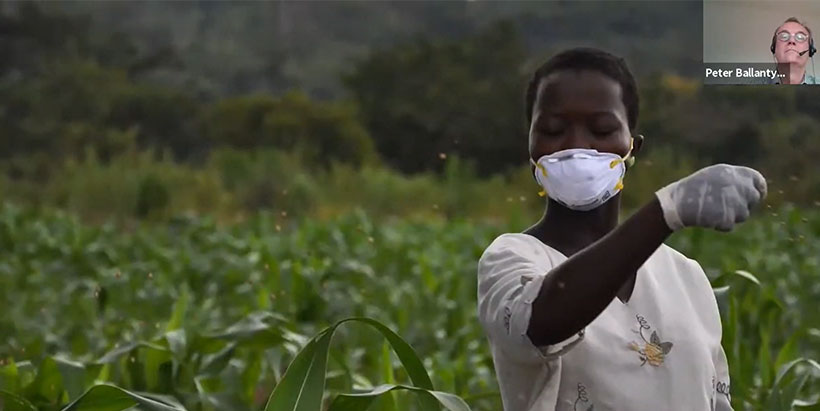 Plant health is critical in the one health approach to ensure food security, zero hunger, and poverty reduction. And given the central role women and men play in agriculture, their extraordinary efforts are also being recognized to propel plant health for one health.
With agriculture as the biggest cause of biodiversity loss, the most significant user and polluter of water, and the highest emitter of greenhouse gases, the challenge facing the world is how to produce more food at lower environmental costs. “We need to find ways to increase food production without using more land and offset our agroecological balance,” Prof. Navin Ramankutty, the Research Chair at the University of British Columbia, emphasized in his presentation.
“With sustainable intensification through conventional food production systems, we can certainly increase food produce very efficiently. We can increase food production by 30% with a 9% increase in nitrogen application rate,” Ramankutty said.
Dr Arshnee Moodley, CGIAR Antimicrobial Resistance Hub Leader, said, “We live in a complex, connected ecosystem where humans and wildlife use the same food and water, and the same antibiotics and antimicrobial systems. Livestock use 73% of globally used antibiotics and resistance to these antibiotics is spreading across the systems. The dung and other by-products of livestock and wildlife return to our environment in fertilizing crops. To reduce the antimicrobial resistance (AMR) risks from agriculture to humans is to reduce the usage and transmission of antimicrobial residues from animals to man.
Plant health is critical in the one health approach to ensure food security, zero hunger, and poverty reduction. And given the central role women and men play in agriculture, their extraordinary efforts are also being recognized to propel plant health for one health.
With agriculture as the biggest cause of biodiversity loss, the most significant user and polluter of water, and the highest emitter of greenhouse gases, the challenge facing the world is how to produce more food at lower environmental costs. “We need to find ways to increase food production without using more land and offset our agroecological balance,” Prof. Navin Ramankutty, the Research Chair at the University of British Columbia, emphasized in his presentation.
“With sustainable intensification through conventional food production systems, we can certainly increase food produce very efficiently. We can increase food production by 30% with a 9% increase in nitrogen application rate,” Ramankutty said.
Dr Arshnee Moodley, CGIAR Antimicrobial Resistance Hub Leader, said, “We live in a complex, connected ecosystem where humans and wildlife use the same food and water, and the same antibiotics and antimicrobial systems. Livestock use 73% of globally used antibiotics and resistance to these antibiotics is spreading across the systems. The dung and other by-products of livestock and wildlife return to our environment in fertilizing crops. To reduce the antimicrobial resistance (AMR) risks from agriculture to humans is to reduce the usage and transmission of antimicrobial residues from animals to man.
 Rousseau Djouaka, IITA Molecular Entomologist, stating the connection between human health and the environment, said, “Residues of pesticides get into the environment through meat and dairy products, dung used as fertilizer, and through mosquitoes, which develop resistance to the pesticide residues.” He further emphasized the need for sustainable management of agrochemicals in plant treatments.
Emeritus Prof. Janice Olawoye of the Department of Rural Sociology, University of Ibadan, said incorporating gender concerns into topical issues is increasingly gaining credence in agricultural research and implementation circles. She said the diversity of gender roles and constraints limit the ability to generalize across localities, status groups, commodities, and value chains. “We need to focus on gender diversity among commodities (maize, cassava), across value chains (production to consumption), localities (drier or wetter regions), and across status groups (richer, poorer, young or old).” She gave the example that women are often given less fertile land, which invariably affects yield and crops for sale.
The interactive webinar enabled participants to ask questions and take polls to express their views on the factors that drive plant health in a one-health approach. The contributions reiterated that human beings are healthier when our crops, natural environment, and animals are healthy and free from the insects, pests, and diseases that militate against food security. Watch this video to understand the concept of One Health approach: (13) Plant Health for One Health – YouTube.
Rousseau Djouaka, IITA Molecular Entomologist, stating the connection between human health and the environment, said, “Residues of pesticides get into the environment through meat and dairy products, dung used as fertilizer, and through mosquitoes, which develop resistance to the pesticide residues.” He further emphasized the need for sustainable management of agrochemicals in plant treatments.
Emeritus Prof. Janice Olawoye of the Department of Rural Sociology, University of Ibadan, said incorporating gender concerns into topical issues is increasingly gaining credence in agricultural research and implementation circles. She said the diversity of gender roles and constraints limit the ability to generalize across localities, status groups, commodities, and value chains. “We need to focus on gender diversity among commodities (maize, cassava), across value chains (production to consumption), localities (drier or wetter regions), and across status groups (richer, poorer, young or old).” She gave the example that women are often given less fertile land, which invariably affects yield and crops for sale.
The interactive webinar enabled participants to ask questions and take polls to express their views on the factors that drive plant health in a one-health approach. The contributions reiterated that human beings are healthier when our crops, natural environment, and animals are healthy and free from the insects, pests, and diseases that militate against food security. Watch this video to understand the concept of One Health approach: (13) Plant Health for One Health – YouTube.
The One Health approach has the potential to create a win-win outcomes for people, animals, and the natural environment.
Rousseau Djouaka, IITA Molecular Entomologist, stating the connection between human health and the environment, said, “Residues of pesticides get into the environment through meat and dairy products, dung used as fertilizer, and through mosquitoes, which develop resistance to the pesticide residues.” He further emphasized the need for sustainable management of agrochemicals in plant treatments.
Emeritus Prof. Janice Olawoye of the Department of Rural Sociology, University of Ibadan, said incorporating gender concerns into topical issues is increasingly gaining credence in agricultural research and implementation circles. She said the diversity of gender roles and constraints limit the ability to generalize across localities, status groups, commodities, and value chains. “We need to focus on gender diversity among commodities (maize, cassava), across value chains (production to consumption), localities (drier or wetter regions), and across status groups (richer, poorer, young or old).” She gave the example that women are often given less fertile land, which invariably affects yield and crops for sale.
The interactive webinar enabled participants to ask questions and take polls to express their views on the factors that drive plant health in a one-health approach. The contributions reiterated that human beings are healthier when our crops, natural environment, and animals are healthy and free from the insects, pests, and diseases that militate against food security. Watch this video to understand the concept of One Health approach: (13) Plant Health for One Health – YouTube.
Contributed by
Recent stories
No items found