FMARD – Nigeria: IITA holds critical position in Nigeria’s agricultural sector
January 25, 2021
Mr Richard-Mark Mbaram, the Technical Adviser on Knowledge Management and Communication to Nigeria’s Minister of Agriculture and Rural Development, Honorable Mohammed Sabo Nanono, has highlighted IITA’s role in the nation’s agricultural sector. He spoke on this during a visit to the Institute on 18 December 2020.
According to Mbaram, the visit aimed to explore opportunities to encourage the country’s youth to engage in productive and profitable agricultural enterprises. In his words: “Young people, by their nature, are capable of generating the economic energy needed to recalibrate the Nigerian economy.”
Mbaram with IYA members at the board meeting discussing purpose of visit.
IITA Deputy Director General, Partnerships for Delivery, Kenton Dashiell, received the Ministerial aide and a team of IITA Youth Agripreneurs (IYA). Mbaram watched a presentation highlighting IITA’s innovative contributions to agriculture, particularly the IYA program, which aims to improve Africans’ quality of life by creating employment. A significant highlight of the visit was a tour of the IITA campus, including the hatchery, TAAT Aquaculture Compact demonstration site, the fishpond, and cage culture.
While there are so many ways young people can be economically engaged, Mbaram stated that the Minister is pushing for a revitalization of Nigeria’s agro-industrial competencies, with its attendant benefit of job creation. He noted that the African Development Bank (AfDB) is supporting this objective through the $500 million Special Agro-Industrial Processing Zones (SAPZ) Program.
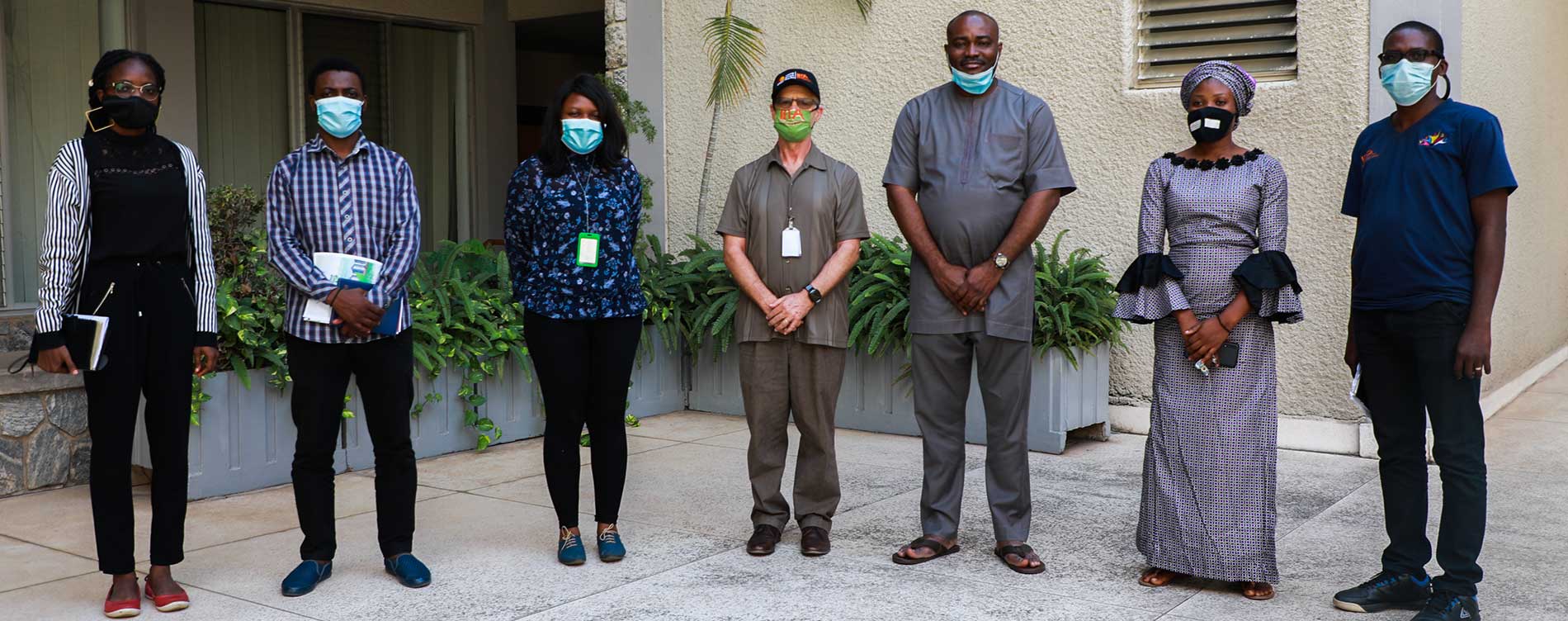
Group picture of Mbaram and Dashiell with IYA members.
The IITA DDG noted that “Youth have the fundamental background that gives them the capacity to learn quickly, to be ingenious, and come up with ideas.”
He added: “For the past nine years, we have had a major program with youth in agribusiness. A lot of mistakes have been made, successes celebrated, and we will continue to learn. But it all began with helping youth have a mindset change about agriculture, which was very negative. This was changed after they were exposed to modern agriculture as a business and not the traditional labor-intensive methods that rely on the use of hoes and cutlasses.” Dashiell further indicated the willingness of the Institute to understand the vision of the Honorable Minister and to be part of his delivery team.
For Mbaram, the Federal Ministry of Agriculture and Rural Development’s (FMARD) emphasis on the SAPZ program hinges on the immense economic growth potentials present in the agricultural sector. “When this is combined with the promise of qualitative job creation, one
can see that the Honorable Minister intends to deploy it as a means to address the youth unemployment challenge.” Speaking further, the Technical Adviser pointed out that the current high levels of postharvest losses experienced in the agriculture sector are alarming, with a total loss rate of 50‒60% at different stages from harvest to consumption. “As a team, we believe industrialization is key to addressing this. Increased industrial off-take of farmers’ harvest will surely reduce postharvest losses and guarantee good returns for our primary producers,” Mbaram stated.
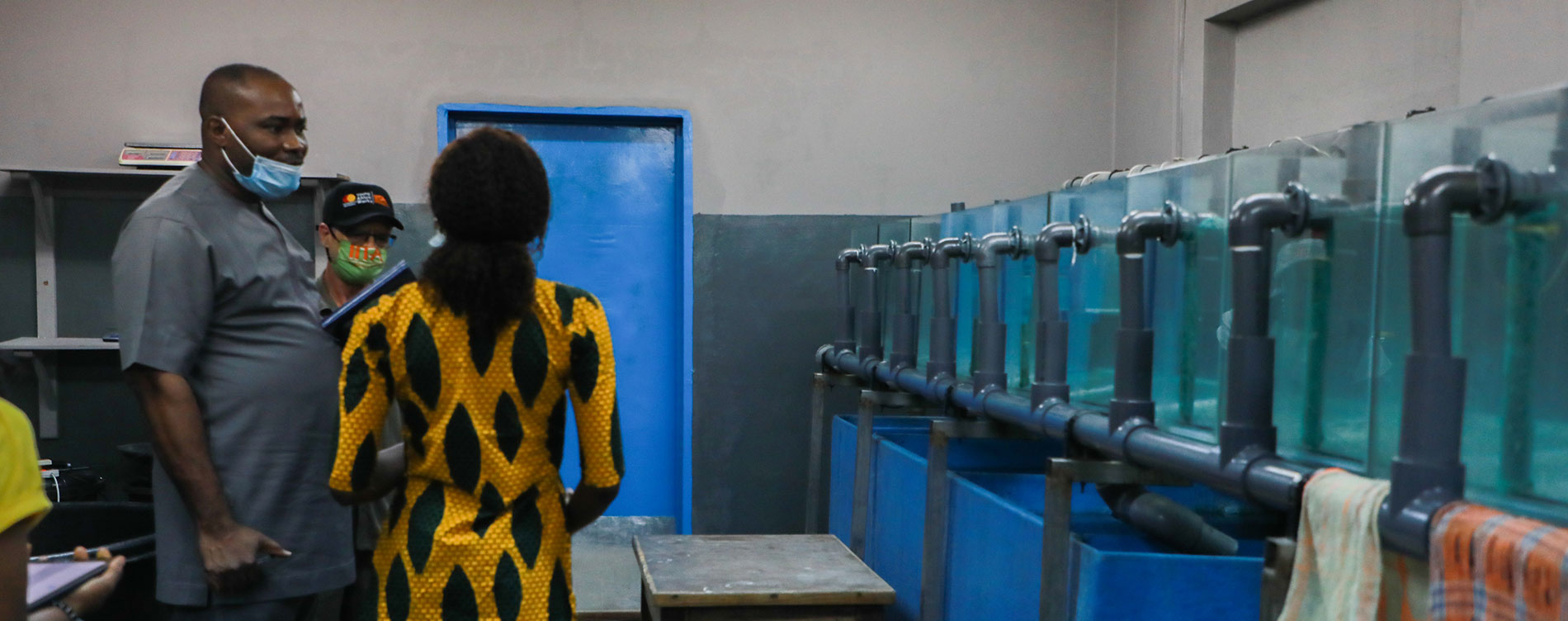
Mbaram on a tour of the hatchery.
He also revealed the plan to roll out the SAPZ program in the early part of 2021 in different locations representing Nigeria’s geo-economic zones. He added that the various zones would become hotbeds for job creation and agribusiness incubation for young people once the Program begins.
Also contributing, IYA representatives Adedayo Adefioye, Oluyemi Adunoye, Bolanle Larinde, and Idowu Osun, fully supported the SAPZ plan confirming that agribusinesses would be very successful in the supportive environment contemplated by the SAPZ and that the IITA Youth in Agribusiness programs would like to partner with the Ministry in the Program’s implementation.
In his closing remarks, Dashiell said: “You have really motivated us to work even harder for the Nigerian youth in 2021. We appreciate your words of encouragement and advice and the goodwill message from the Honorable Minister, which reflects our shared ideologies in transforming agriculture in Nigeria. This is very encouraging for us.”
Olamide Deborah Nwanze is a Senior Research Associate specializing in gender mainstreaming research to inform participatory and inclusive breeding, variety development, and seed systems policies regarding root, tuber, and banana (RTB) crops in the International Institute of Tropical Agriculture Headquarters, Ibadan, Nigeria. She is a PhD candidate at the University of Ibadan and holds an MSc and B. Agric in Agricultural Extension and Rural Development. Olamide is a fellow of the African Women in Agricultural Research and Development – Gender Responsive Agricultural Systems Policy (AWARD-GRASP) and the Gender Responsive Researchers Equipped for Agricultural Transformation (GREAT). She seeks to apply her gender-mainstreaming learnings, gender-responsive research, and policy development, and review expertise to facilitate women, youth, children, and vulnerable social group’s access to and adoption of agricultural Innovations that guarantee food, nutrition, income, and livelihood security in Africa. Her current roles include mentoring research fellows, development of guides and training manuals, implementation and adaptation of gender frameworks and tools, value chain actors’ engagement as citizen science partners, policy review and redesign, data management, and analysis. Her current research explores mixed methods and participatory and interdisciplinary approaches to capture and highlight gender dynamics, needs, preferences, and challenges stakeholders face within the agricultural livelihood value chain to prioritize gender-inclusive strategies in breeding programs, policy design, and implementation.
de Sousa, K., van Etten, J., Manners, R. Bello, A., Teeken, B., Olaosebikan, O., et al. 2024. The tricot approach: an agile framework for decentralized on-farm testing supported by citizen science. A retrospective. Agron. Sustain. Dev. 44, 8. https://doi.org/10.1007/s13593-023-00937-1
Madu, T., Onwuka, S., Nwafor, S., Onyemauwa, N., Ejechi, M., Ofoeze, M., Ukeje, B., Eluagu, C., Olaosebikan, O., Okoye, B., 2024. Gender-Inclusive Consumer Studies Improve Cassava Breeding in Nigeria in: Frontiers in Sociology, volume 9, number: 1224504, doi: 10.3389/fsoc.2024.1224504
Olaosebikan, O.; Bello, A.; Utoblo, O.; Okoye, B.; Olutegbe, N.; Garner, E.; Teeken, B.; Bryan, E.; Forsythe, L.; Cole, S.; Madu, T. 2023. Stressors and Resilience within the Cassava Value Chain in Nigeria: Preferred Cassava Variety Traits and Response Strategies of Men and Women to Inform Breeding. Sustainability 15, 7837. https://doi.org/10.3390/su15107837
Okoye, B., Ofoeze, M., Ejechi, M., Onwuka, S., Nwafor, S., Onyemauwa, N., Ukeje, B., Eluagu, C., Obidiegwu, J.*, Olaosebikan, O., Madu, T.* 2023. Prioritizing preferred traits in the yam value chain in Nigeria: a gender situation analysis in: Frontiers in Sociology, volume 8, number: 1232626, pages 1 – 9, ISSN 2297-7775, 2023. https://www.frontiersin.org/articles/10.3389/fsoc.2023.1232626/full
Olaosebikan, O., Bello, A. A., de Sousa, K., Ndjouenkeu, R., Adesokan, M., Alamu, E. O., Agbona, A., van Etten, J., Kegah, F. N.*, Dufour, D., Bouniol, A., Teeken, B. 2023. Consumer acceptability of cassava gari-eba food products across cultural and environmental settings using the triadic comparison of technologies approach (tricot) in: Journal of the Science of Food and Agriculture,
Teeken, B., Olaosebikan, O., Bello, A. A., Madu, T.*, Cole, S. M. 2023. Qualitative assessment on the positionality and preferences of dyads in relation to cassava-related activities: working with tricot trial citizen scientists https://hdl.handle.net/10568/138326 Type: Manual
Bouniol, A., Ceballos, H., Bello, A. A., Teeken, B., Olaosebikan, O., Owoade, D., Agbona, A., Fotso Kuate, A., Madu, T.*, Okoye, B.*, Ofoeze, M.*, Nwafor, S.*, Onyemauwa, N.*, Adinsi, L.*, Forsythe, L., Dufour, D. 2023. Varietal impact on women’s labour, workload and related drudgery in processing root, tuber and banana crops: focus on cassava in sub-Saharan Africa in: Journal of the Science of Food and Agriculture, pages 1 – 25, ISSN 0022-5142,
Bello, A. A., Agbona, A., Olaosebikan, O., Edughaen, G., Dufour, D., Bouniol, A., Iluebbey, P., Ndjouenkeu, R.*, Rabbi, I. Y., Teeken, B. 2023. Genetic and environmental effects on processing productivity and food product yield: drudgery of women’s work in: Journal of the Science of Food and Agriculture, pages 1 – 32, ISSN 0022-5142, 5
Cavicchioli, M., Zimbiti, T., Teeken, B., Nwanze, D.O., Liani, M., Parkes, E. & Bello, A. 2023. IITA-Gender Responsive Breeding Training Report. Genetic Resources Center, IITA-HQ, Ibadan, 21-23 September, 2022. Ibadan, Nigeria: IITA, (34 p.).https://hdl.handle.net/10568/131368
Agbona, A. Peteti P., Teeken B., Olaosebikan O. Bello, A. A., Parkes, E., Rabbi, I. Y., Mueller, L., Egesi, C., Kulakow, P. 2022. Data Management in Multi-disciplinary African RTB Crop Breeding Programs. In: Williamson, H.F., Leonelli, S. (eds) Towards Responsible Plant Data Linkage: Data Challenges for Agricultural Research and Development. Springer, Cham. https://doi.org/10.1007/978-3-031-13276-6_5
Lora Forsythe, Pricilla Marimo, Sarah Mayanja, Olamide D. Olaosebikan, Esme Stuart, Bela Teeken, Benjamin Okoye, Tessy Madu, (2021). Cross-product Gender Analysis of RTBfoods Step 2 Gendered Food Mapping on RTB Products. Understanding the Drivers of Trait Preferences and the Development of Multi-user RTB Product Profiles, WP1. London, UK: RTBfoods Field Scientific Report, 30 p.
Teeken, B., Garner, E., Agbona, A., Balogun, I., Olaosebikan, O., Bello, A., Madu, T., Okoye, B., Egesi, C., Kulakow, P. and Tufan, H.A. 2021. Beyond “Women’s Traits”: Exploring How Gender, Social Difference, and Household Characteristics Influence Trait Preferences. Frontiers Sustainable Food Systems 5:740926. https://doi.org/10.3389/fsufs.2021.740926
Teeken, B., Agbona, A., Bello, A., Olaosebikan, O., Alamu, E., Adesokan, M., Awoyale, W., Madu, T., Okoye, B., Chijioke, U., Owoade, D., Okoro, M., Bouniol, A., Dufour, D., Hershey, C., Rabbi, I., Maziya‐Dixon, B., Egesi, C., Tufan, H. and Kulakow, P. (020. Understanding cassava varietal preferences through pairwise ranking of gari‐eba and fufu prepared by local farmer–processors. Int J Food Sci Technol.https://doi.org/10.1111/ijfs.14862
Bela Teeken, Olamide Olaosebikan, Ireti Balogun, Benjamin Okoye, Tessy Madu, Steven Cole, Abolore Bello, Elizabeth Parkes. (2020). Piloting the G+ customer and product profile tools for gender-responsive cassava breeding in Nigeria. Nigeria: International Institute of Tropical Agriculture (IITA). https://hdl.handle.net/20.500.11766/13000