STEP impact goes beyond secondary schools to communities
September 30, 2020
The Start Them Early Program (STEP) of IITA is making more impact than was envisioned at the beginning of the program. STEP, which was initially meant to change the negative mindset of secondary school students about agriculture, has also begun to positively impact parents and the communities where these secondary schools are located.
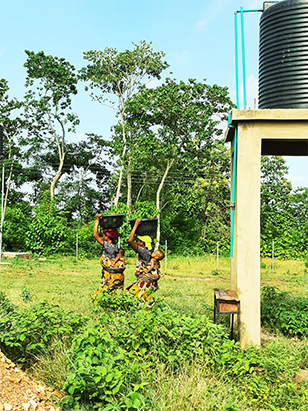
Fasola community women, fetching
water from the school borehole.
The STEP program officially kicked off in 2019 with funding from the 2018 Africa Food Prize award, which the IITA DG, Nteranya Sanginga, dedicated to the program. STEP was initiated in three secondary schools each in DR Congo, Kenya, and Nigeria, for a 2-year dry run, with the plan of expanding to other schools and countries in Africa over the years. Despite the financial and technical challenges experienced, STEP has made substantial progress.
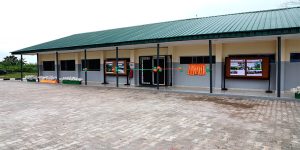
Recently in Nigeria, STEP was launched in Fasola Grammar school, Oyo town, after infrastructural transformation by the STEP team. Some of the changes include the renovation of the school hall, staff building, and laboratory while providing the school with new chairs, marker boards, and a projector. Others include building the school toilet and a STEP agribusiness center from scratch and sinking a borehole in the school from which the community now gets water. There is also a biogas tank where electricity is generated for the school, and the community benefits from it.
The school poultry which now supplies the community chicken and eggs
“This transformation happened within three months during the COVID-19 lockdown period,” said Bola Larinde, Coordinator of the STEP-Oyo project. “The school hall can also be used for community meetings as it can accommodate up to 200 people,” she added.
IITA, in conjunction with the Oyo State Government, recently inaugurated STEP in Fasola Grammar school. His Excellency, Governor Seyi Makinde of Oyo State, was thrilled by both the transformation that had taken place in the school and the rate at which the mindset of the students had changed positively about agriculture. He noted this after the students made presentations, showcasing what they have learned from the STEP team, which included the use of modern equipment for farming, processing agricultural produce into finished goods, the use of ICT, and poultry rearing.
The STEP center at Fasola school.
Some of the students have decided to build a career in agriculture, while some are already making plans to start businesses in the agricultural line to pay their school fees and support their families. “The students have also influenced their parents to accept the use of modern farming tools as it makes farming more fun,” said Dayo Adefioye, STEP Coordinator for Nigeria.
The Governor has initiated a STEP-Oyo State project with the aim of rapidly expanding STEP to more secondary schools, starting with one secondary school per zone, across the six geopolitical zones of Oyo State. His Excellency has also made Fasola school the infrastructural and agribusiness model for other schools in the State.
The biogas tank at Fasola school, converting waste to energy for the school and fertilizer for its farm.
Olamide Deborah Nwanze is a Senior Research Associate specializing in gender mainstreaming research to inform participatory and inclusive breeding, variety development, and seed systems policies regarding root, tuber, and banana (RTB) crops in the International Institute of Tropical Agriculture Headquarters, Ibadan, Nigeria. She is a PhD candidate at the University of Ibadan and holds an MSc and B. Agric in Agricultural Extension and Rural Development. Olamide is a fellow of the African Women in Agricultural Research and Development – Gender Responsive Agricultural Systems Policy (AWARD-GRASP) and the Gender Responsive Researchers Equipped for Agricultural Transformation (GREAT). She seeks to apply her gender-mainstreaming learnings, gender-responsive research, and policy development, and review expertise to facilitate women, youth, children, and vulnerable social group’s access to and adoption of agricultural Innovations that guarantee food, nutrition, income, and livelihood security in Africa. Her current roles include mentoring research fellows, development of guides and training manuals, implementation and adaptation of gender frameworks and tools, value chain actors’ engagement as citizen science partners, policy review and redesign, data management, and analysis. Her current research explores mixed methods and participatory and interdisciplinary approaches to capture and highlight gender dynamics, needs, preferences, and challenges stakeholders face within the agricultural livelihood value chain to prioritize gender-inclusive strategies in breeding programs, policy design, and implementation.
de Sousa, K., van Etten, J., Manners, R. Bello, A., Teeken, B., Olaosebikan, O., et al. 2024. The tricot approach: an agile framework for decentralized on-farm testing supported by citizen science. A retrospective. Agron. Sustain. Dev. 44, 8. https://doi.org/10.1007/s13593-023-00937-1
Madu, T., Onwuka, S., Nwafor, S., Onyemauwa, N., Ejechi, M., Ofoeze, M., Ukeje, B., Eluagu, C., Olaosebikan, O., Okoye, B., 2024. Gender-Inclusive Consumer Studies Improve Cassava Breeding in Nigeria in: Frontiers in Sociology, volume 9, number: 1224504, doi: 10.3389/fsoc.2024.1224504
Olaosebikan, O.; Bello, A.; Utoblo, O.; Okoye, B.; Olutegbe, N.; Garner, E.; Teeken, B.; Bryan, E.; Forsythe, L.; Cole, S.; Madu, T. 2023. Stressors and Resilience within the Cassava Value Chain in Nigeria: Preferred Cassava Variety Traits and Response Strategies of Men and Women to Inform Breeding. Sustainability 15, 7837. https://doi.org/10.3390/su15107837
Okoye, B., Ofoeze, M., Ejechi, M., Onwuka, S., Nwafor, S., Onyemauwa, N., Ukeje, B., Eluagu, C., Obidiegwu, J.*, Olaosebikan, O., Madu, T.* 2023. Prioritizing preferred traits in the yam value chain in Nigeria: a gender situation analysis in: Frontiers in Sociology, volume 8, number: 1232626, pages 1 – 9, ISSN 2297-7775, 2023. https://www.frontiersin.org/articles/10.3389/fsoc.2023.1232626/full
Olaosebikan, O., Bello, A. A., de Sousa, K., Ndjouenkeu, R., Adesokan, M., Alamu, E. O., Agbona, A., van Etten, J., Kegah, F. N.*, Dufour, D., Bouniol, A., Teeken, B. 2023. Consumer acceptability of cassava gari-eba food products across cultural and environmental settings using the triadic comparison of technologies approach (tricot) in: Journal of the Science of Food and Agriculture,
Teeken, B., Olaosebikan, O., Bello, A. A., Madu, T.*, Cole, S. M. 2023. Qualitative assessment on the positionality and preferences of dyads in relation to cassava-related activities: working with tricot trial citizen scientists https://hdl.handle.net/10568/138326 Type: Manual
Bouniol, A., Ceballos, H., Bello, A. A., Teeken, B., Olaosebikan, O., Owoade, D., Agbona, A., Fotso Kuate, A., Madu, T.*, Okoye, B.*, Ofoeze, M.*, Nwafor, S.*, Onyemauwa, N.*, Adinsi, L.*, Forsythe, L., Dufour, D. 2023. Varietal impact on women’s labour, workload and related drudgery in processing root, tuber and banana crops: focus on cassava in sub-Saharan Africa in: Journal of the Science of Food and Agriculture, pages 1 – 25, ISSN 0022-5142,
Bello, A. A., Agbona, A., Olaosebikan, O., Edughaen, G., Dufour, D., Bouniol, A., Iluebbey, P., Ndjouenkeu, R.*, Rabbi, I. Y., Teeken, B. 2023. Genetic and environmental effects on processing productivity and food product yield: drudgery of women’s work in: Journal of the Science of Food and Agriculture, pages 1 – 32, ISSN 0022-5142, 5
Cavicchioli, M., Zimbiti, T., Teeken, B., Nwanze, D.O., Liani, M., Parkes, E. & Bello, A. 2023. IITA-Gender Responsive Breeding Training Report. Genetic Resources Center, IITA-HQ, Ibadan, 21-23 September, 2022. Ibadan, Nigeria: IITA, (34 p.).https://hdl.handle.net/10568/131368
Agbona, A. Peteti P., Teeken B., Olaosebikan O. Bello, A. A., Parkes, E., Rabbi, I. Y., Mueller, L., Egesi, C., Kulakow, P. 2022. Data Management in Multi-disciplinary African RTB Crop Breeding Programs. In: Williamson, H.F., Leonelli, S. (eds) Towards Responsible Plant Data Linkage: Data Challenges for Agricultural Research and Development. Springer, Cham. https://doi.org/10.1007/978-3-031-13276-6_5
Lora Forsythe, Pricilla Marimo, Sarah Mayanja, Olamide D. Olaosebikan, Esme Stuart, Bela Teeken, Benjamin Okoye, Tessy Madu, (2021). Cross-product Gender Analysis of RTBfoods Step 2 Gendered Food Mapping on RTB Products. Understanding the Drivers of Trait Preferences and the Development of Multi-user RTB Product Profiles, WP1. London, UK: RTBfoods Field Scientific Report, 30 p.
Teeken, B., Garner, E., Agbona, A., Balogun, I., Olaosebikan, O., Bello, A., Madu, T., Okoye, B., Egesi, C., Kulakow, P. and Tufan, H.A. 2021. Beyond “Women’s Traits”: Exploring How Gender, Social Difference, and Household Characteristics Influence Trait Preferences. Frontiers Sustainable Food Systems 5:740926. https://doi.org/10.3389/fsufs.2021.740926
Teeken, B., Agbona, A., Bello, A., Olaosebikan, O., Alamu, E., Adesokan, M., Awoyale, W., Madu, T., Okoye, B., Chijioke, U., Owoade, D., Okoro, M., Bouniol, A., Dufour, D., Hershey, C., Rabbi, I., Maziya‐Dixon, B., Egesi, C., Tufan, H. and Kulakow, P. (020. Understanding cassava varietal preferences through pairwise ranking of gari‐eba and fufu prepared by local farmer–processors. Int J Food Sci Technol.https://doi.org/10.1111/ijfs.14862
Bela Teeken, Olamide Olaosebikan, Ireti Balogun, Benjamin Okoye, Tessy Madu, Steven Cole, Abolore Bello, Elizabeth Parkes. (2020). Piloting the G+ customer and product profile tools for gender-responsive cassava breeding in Nigeria. Nigeria: International Institute of Tropical Agriculture (IITA). https://hdl.handle.net/20.500.11766/13000

 The STEP program officially kicked off in 2019 with funding from the 2018 Africa Food Prize award, which the IITA DG, Nteranya Sanginga, dedicated to the program. STEP was initiated in three secondary schools each in DR Congo, Kenya, and Nigeria, for a 2-year dry run, with the plan of expanding to other schools and countries in Africa over the years. Despite the financial and technical challenges experienced, STEP has made substantial progress.
Recently in Nigeria, STEP was launched in Fasola Grammar school, Oyo town, after infrastructural transformation by the STEP team. Some of the changes include the renovation of the school hall, staff building, and laboratory while providing the school with new chairs, marker boards, and a projector. Others include building the school toilet and a STEP agribusiness center from scratch and sinking a borehole in the school from which the community now gets water. There is also a biogas tank where electricity is generated for the school, and the community benefits from it.
“This transformation happened within three months during the COVID-19 lockdown period,” said Bola Larinde, Coordinator of the STEP-Oyo project. “The school hall can also be used for community meetings as it can accommodate up to 200 people,” she added.
IITA, in conjunction with the Oyo State Government, recently inaugurated STEP in Fasola Grammar school. His Excellency, Governor Seyi Makinde of Oyo State, was thrilled by both the transformation that had taken place in the school and the rate at which the mindset of the students had changed positively about agriculture. He noted this after the students made presentations, showcasing what they have learned from the STEP team, which included the use of modern equipment for farming, processing agricultural produce into finished goods, the use of ICT, and poultry rearing.
The STEP program officially kicked off in 2019 with funding from the 2018 Africa Food Prize award, which the IITA DG, Nteranya Sanginga, dedicated to the program. STEP was initiated in three secondary schools each in DR Congo, Kenya, and Nigeria, for a 2-year dry run, with the plan of expanding to other schools and countries in Africa over the years. Despite the financial and technical challenges experienced, STEP has made substantial progress.
Recently in Nigeria, STEP was launched in Fasola Grammar school, Oyo town, after infrastructural transformation by the STEP team. Some of the changes include the renovation of the school hall, staff building, and laboratory while providing the school with new chairs, marker boards, and a projector. Others include building the school toilet and a STEP agribusiness center from scratch and sinking a borehole in the school from which the community now gets water. There is also a biogas tank where electricity is generated for the school, and the community benefits from it.
“This transformation happened within three months during the COVID-19 lockdown period,” said Bola Larinde, Coordinator of the STEP-Oyo project. “The school hall can also be used for community meetings as it can accommodate up to 200 people,” she added.
IITA, in conjunction with the Oyo State Government, recently inaugurated STEP in Fasola Grammar school. His Excellency, Governor Seyi Makinde of Oyo State, was thrilled by both the transformation that had taken place in the school and the rate at which the mindset of the students had changed positively about agriculture. He noted this after the students made presentations, showcasing what they have learned from the STEP team, which included the use of modern equipment for farming, processing agricultural produce into finished goods, the use of ICT, and poultry rearing.
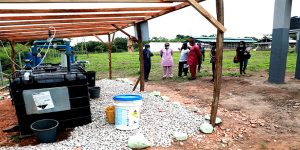 The biogas tank at Fasola school, converting waste to energy for the school and fertilizer for its farm.
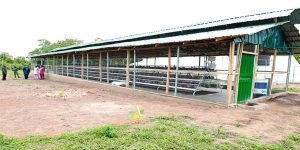 The school poultry which now supplies the community chicken and eggs