
Food safety issues impact consumer health enormously due to climate change and increasing chemical use in agriculture, particularly in developing countries. This trend is raising concern among consumers, producers, and policymakers.

Some major causes of food safety issues are aflatoxins and informal market hazards. Aflatoxins are poisonous carcinogens that affect much of the global food supply. These affect both human and animal health, while informal market hazards involve food safety challenges because they lack refrigeration units, making food unsafe for consumption.
Several organizations worldwide are collaborating with IITA–CGIAR to execute the Food Safety for Africa (FS4Africa) project to address these global food safety challenges.
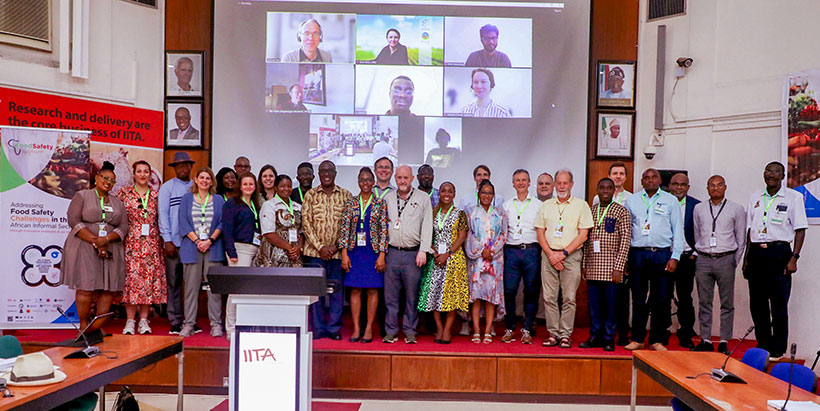
The collaborating organizations convened a kick-off meeting from 13 to 15 February at IITA’s headquarters in Ibadan, Nigeria. The meeting served as an avenue to provide a deep understanding of all the work packages (WPs) and their interconnection, focusing on use cases. It also established collaboration modalities for technical and administrative aspects of FS4Africa.

FS4Africa Project Lead Titilayo Falade explained that the major causes of informal market hazards are coliform contamination, food fraud, heavy metals, mycotoxins, and pesticide residues. “FS4Africa would apply newly developed innovative approaches, convergence strategies, and stable partnerships to promote food safety across the globe,” she stated.
The European Union (EU)-funded project would focus on ensuring food safety by addressing contamination from informal markets and food hazards. IITA is implementing the project in partnership with several organizations, including Wageningen University and Research (WUR), Innovation Technology Cluster (ITC), Council for Scientific and Industrial Research, Ghana (CSIR-GH), Food Scale Hub Greece Association for Entrepreneurship and Innovation (FSH), and Ubuntoo. Other partners include Food Systems Transformation Solutions (FSTS), the University of Pretoria (UP), Knowledge Economy Foundation for Society Development (KEF), African Union Development Agency (AUDA-NEPAD), Aglobe Development Center (ADC), Bayer, and McGill University.
With the support from partners, FS4Africa will also enhance environmental sustainability, food security, and health.
FS4Africa Project Ethical Adviser Ilja Pavone said the project would be based on the ‘One Health Approach,’ recognizing co-existence and interdependence among people, animals, plants, and their environment. He added, “Embracing the One Health Approach would improve consumer well-being, with animal inclusiveness and ecosystem resilience against food safety challenges globally.”
Contributed by Anita Akinyomade
Related story: CGIAR discusses One Health approach as key to improved planetary health (iita.org)
Contributed by
Recent stories