
Stakeholders express interest in SAH technology in DR Congo
May 10, 2019
In February, a meeting was organized at IITA Kalambo to share the progress made in the introduction of the Semi-Autotrophic Hydroponics (SAH) technology at Kalambo station.
 Cassava is one of DR Congo’s principal crops, with per capita consumption of 453 kg per year; it is also a main pillar for food security for 80% of the Congolese population and a major cash crop. Since the SAH technology is a novel, low-cost method to rapidly multiply cassava seed, IITA has introduced this technology as a rapid response to disease threat and poor-quality planting materials. The SAH method was developed in Argentina and replicated at IITA-DR Congo in 2018 after being tested at IITA-Ibadan from 2016.
In his opening remarks, Christopher Okafor, Officer-in-Charge of the IITA Kalambo station, welcomed all participants to the meeting and highlighted the need for this technology to go to the new tissue culture building and expand very fast to its full potential.
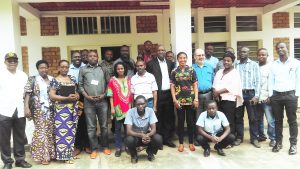
The participants included various stakeholders in the cassava value chain, IITA Kalambo partners as well as IITA Kalambo scientists who gathered to discuss the benefit of the SAH technology in the production of clean planting material.
Two specialists from Ibadan, Head of Cassava Breeding Unit, Peter Kulakow and Cassava Seed Systems Specialist, Mercy Elohor Diebiru-Ojo, were on hand to explain the technology to the participants. In her presentation, Diebiru-Ojo demonstrated the rapid multiplication ratio and the low-cost production of the SAH technology. “With 100 boxes of SAH plantlets we are able to produce 1600 boxes of SAH plantlets within two months and plant about 10 hectares within a year from the plantlets in the SAH laboratory,” she said.
In his presentation, Kulakow said that it can be a great business opportunity even for youth agripreneurs and urged the national institutions and private sector players to take advantage of this opportunity for income generation and improving livelihoods of the DRC population, a critical element in the implementation of SAH technology.
Cassava is one of DR Congo’s principal crops, with per capita consumption of 453 kg per year; it is also a main pillar for food security for 80% of the Congolese population and a major cash crop. Since the SAH technology is a novel, low-cost method to rapidly multiply cassava seed, IITA has introduced this technology as a rapid response to disease threat and poor-quality planting materials. The SAH method was developed in Argentina and replicated at IITA-DR Congo in 2018 after being tested at IITA-Ibadan from 2016.
In his opening remarks, Christopher Okafor, Officer-in-Charge of the IITA Kalambo station, welcomed all participants to the meeting and highlighted the need for this technology to go to the new tissue culture building and expand very fast to its full potential.
The participants included various stakeholders in the cassava value chain, IITA Kalambo partners as well as IITA Kalambo scientists who gathered to discuss the benefit of the SAH technology in the production of clean planting material.
Two specialists from Ibadan, Head of Cassava Breeding Unit, Peter Kulakow and Cassava Seed Systems Specialist, Mercy Elohor Diebiru-Ojo, were on hand to explain the technology to the participants. In her presentation, Diebiru-Ojo demonstrated the rapid multiplication ratio and the low-cost production of the SAH technology. “With 100 boxes of SAH plantlets we are able to produce 1600 boxes of SAH plantlets within two months and plant about 10 hectares within a year from the plantlets in the SAH laboratory,” she said.
In his presentation, Kulakow said that it can be a great business opportunity even for youth agripreneurs and urged the national institutions and private sector players to take advantage of this opportunity for income generation and improving livelihoods of the DRC population, a critical element in the implementation of SAH technology.
 Sequel to the meeting, SAH Technology Expert Adetoro Najimu visited the station on an official mission to expand cassava production, and explain about the correct SAH production techniques, among others. He seized the opportunity to interact with IITA Kalambo scientists and FMS staff about properly equipping the new SAH building.
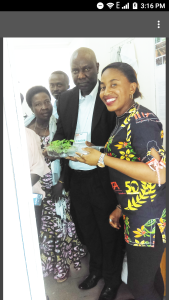
The meeting ended with a visit to the small SAH facility where Angel Kajibwami, the technician in charge of the cassava rapid multiplication, explained the technical aspects of the SAH technology and how SAH is expected to have a significant impact on the ability to quickly bring suitable cassava varieties to produce clean planting materials that are disease-free, and develop a uniform cassava seed system.
IITA Kalambo partners including INERA-Mulungu, IPAPEL, the Food and Agriculture Organization (FAO), SENASEM, and private organizations that attended the meeting expressed their interest in the SAH technology. They were all impressed with and willing to connect with new technology.
Sequel to the meeting, SAH Technology Expert Adetoro Najimu visited the station on an official mission to expand cassava production, and explain about the correct SAH production techniques, among others. He seized the opportunity to interact with IITA Kalambo scientists and FMS staff about properly equipping the new SAH building.
The meeting ended with a visit to the small SAH facility where Angel Kajibwami, the technician in charge of the cassava rapid multiplication, explained the technical aspects of the SAH technology and how SAH is expected to have a significant impact on the ability to quickly bring suitable cassava varieties to produce clean planting materials that are disease-free, and develop a uniform cassava seed system.
IITA Kalambo partners including INERA-Mulungu, IPAPEL, the Food and Agriculture Organization (FAO), SENASEM, and private organizations that attended the meeting expressed their interest in the SAH technology. They were all impressed with and willing to connect with new technology.
Mr Floribert Mbolila (2nd from right) and partners visiting pilot SAH laboratory facility.
Stakeholders and IITA Kalambo scientists in a group photo.
Contributed by
Recent stories
No items found