
Celebrating World Environment Day 2018: combating plastic pollution
June 30, 2018
World Environment Day (WED) occurs every year on 5 June, and is the United Nation’s principal vehicle for encouraging awareness and action for the protection of our environment. First held in 1974, it has been a flagship campaign for raising awareness on emerging environmental issues from marine pollution, human overpopulation, and global warming, to sustainable consumption and wildlife crime.
 WED has grown to become a global platform for public outreach, with participation from over 143 countries annually. Each year, WED has a new theme that major corporations, NGOs, communities, governments, and celebrities worldwide adopt to advocate environmental causes.
The theme this year was “Beat Plastic Pollution” and was celebrated by the IITA Forest Center at two of our School Conservation Clubs—Olive Branches School, Osogbo and St. Anthony’s School, Ikoyi—both in Osun state.
The event at Olive Branches School had over a hundred students in attendance with presentations from members of the Forest Center team. Speaking on the theme of this year’s celebration, Ademola Ajayi, IITA Forest Center Environmental Education Assistant, took the attendees on a historical journey from the first World Environment Day celebration. Ajayi highlighted the causes of plastic pollution, its dangers to humans, animals, and the environment, and alternatives to the use of plastic. He also talked on recycling plastic waste for other products rather than single use scenarios; with this he shared the contact details of a company that gives reward points for plastic waste.
Adewale Awoyemi, IITA Forest Center Manager, used the medium to thank the school management for their commitment and punctual attendance at all Forest Center events; he said he is convinced that the school can play a leading role in environmental conservation in Osun state. He spoke further about the harmful effects of plastic pollution on the environment. Awoyemi coordinated an interactive session during which students and staff of the School asked various questions bordering on the feasibility of banning the use of plastic. Responding to questions, Awoyemi encouraged them to only use plastic that is reuseable in a sustainable way.
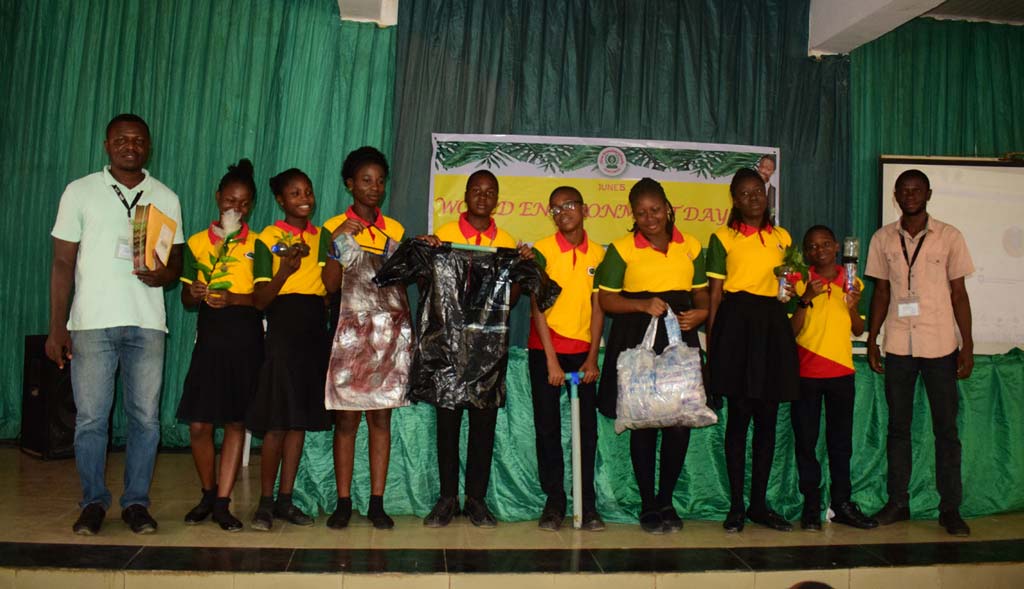
The highlight of the event was the display of items such as a hand bag, inflating pump, plastic flowers, raincoat, and flower pot, all from plastic waste materials.
The Forest Center team noted the need to continue to support the students and school management to help increase the level of their knowledge concerning the natural environment to the point where they would become champions for the environment.
At St. Anthony’s High School, the Forest Center team celebrated the day with the School Conservation Club (SCC) members who they were meeting for the first time.
Awoyemi highlighted the significance of SCC in the School while informing the club members about the activities of the Club and Forest Center’s projection for the newly formed club.
Speaking to the club members on the significance of the World Environment Day, Ajayi reiterated the aim of this year’s celebration: “to reduce the rate of plastic pollution in the world.” He noted that improper disposal of plastic will come back to “hurt us” by polluting our underground water, destroying natural habitats, and causing ocean and air pollution all of which will have negative effects on humans and the environment at large.
The meeting had about 20 SCC members attending along with SCC school coordinator, Mrs Olayemi Olawale, Emerald Forest Reserve team led by Dr Modupe Oladipo, and the IITA Forest Center team.
WED has grown to become a global platform for public outreach, with participation from over 143 countries annually. Each year, WED has a new theme that major corporations, NGOs, communities, governments, and celebrities worldwide adopt to advocate environmental causes.
The theme this year was “Beat Plastic Pollution” and was celebrated by the IITA Forest Center at two of our School Conservation Clubs—Olive Branches School, Osogbo and St. Anthony’s School, Ikoyi—both in Osun state.
The event at Olive Branches School had over a hundred students in attendance with presentations from members of the Forest Center team. Speaking on the theme of this year’s celebration, Ademola Ajayi, IITA Forest Center Environmental Education Assistant, took the attendees on a historical journey from the first World Environment Day celebration. Ajayi highlighted the causes of plastic pollution, its dangers to humans, animals, and the environment, and alternatives to the use of plastic. He also talked on recycling plastic waste for other products rather than single use scenarios; with this he shared the contact details of a company that gives reward points for plastic waste.
Adewale Awoyemi, IITA Forest Center Manager, used the medium to thank the school management for their commitment and punctual attendance at all Forest Center events; he said he is convinced that the school can play a leading role in environmental conservation in Osun state. He spoke further about the harmful effects of plastic pollution on the environment. Awoyemi coordinated an interactive session during which students and staff of the School asked various questions bordering on the feasibility of banning the use of plastic. Responding to questions, Awoyemi encouraged them to only use plastic that is reuseable in a sustainable way.
The highlight of the event was the display of items such as a hand bag, inflating pump, plastic flowers, raincoat, and flower pot, all from plastic waste materials.
The Forest Center team noted the need to continue to support the students and school management to help increase the level of their knowledge concerning the natural environment to the point where they would become champions for the environment.
At St. Anthony’s High School, the Forest Center team celebrated the day with the School Conservation Club (SCC) members who they were meeting for the first time.
Awoyemi highlighted the significance of SCC in the School while informing the club members about the activities of the Club and Forest Center’s projection for the newly formed club.
Speaking to the club members on the significance of the World Environment Day, Ajayi reiterated the aim of this year’s celebration: “to reduce the rate of plastic pollution in the world.” He noted that improper disposal of plastic will come back to “hurt us” by polluting our underground water, destroying natural habitats, and causing ocean and air pollution all of which will have negative effects on humans and the environment at large.
The meeting had about 20 SCC members attending along with SCC school coordinator, Mrs Olayemi Olawale, Emerald Forest Reserve team led by Dr Modupe Oladipo, and the IITA Forest Center team.
Students, with Forest Center team members, displaying items made from plastic waste. Photo O.Olubodun
Contributed by
Recent stories
No items found