
IITA NEWS

Researchers predict worse impacts of climate change on plantain and educational attendance in Central Africa
June 30, 2018
The impact of climate change continues to be high but coincides with low adaptive capacity of farmers in Central Africa. A recent study explored climatic effects on agriculture and education in rural areas in Cameroon. According to the findings, the two sectors are threatened by climate disruption in the coming decades with declines in plantain yields and educational attendance.
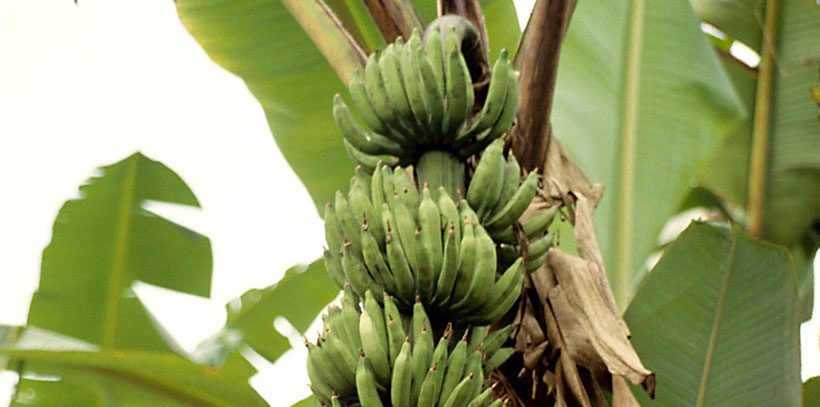
Plantain is an important crop in the economy of Cameroon.

Plantain is an important crop in the economy of Cameroon.

Focusing on plantain, researchers assessed whether recent climate changes have caused reduced yields, and what were the resulting social and economic effects on rural households in Cameroon.

Climate context in Cameroon and Central Africa

The study, titled Climate warming causes declines in crop yields and lowers school attendance rates in Central Africa, by Trevon Fuller, Paul Sesink Clee, Kevin Y. Njabo, Anthony Trochez, Katy Morgan, Demetrio Bocuma Mene, Nicolas M. Anthony, Mary Katherine Gonder, Walter R. Allen, Thomas B. Smith, and Rachid Hanna, focused on the complex interaction between climate change, agricultural productivity, and school attendance in the period 1950–2013 across 10 regions of Cameroon. It predicted future yields and education outcomes over the period from 2030 to 2080. According to forecasts for Cameroon, the plantain crop will be more sensitive to climate change, notably the increase in temperature could delay flowering. Banana requires 1200 mm of water for irrigation in tropical areas, and the decrease in rainfall could cause difficulty in accessing water.

Research methods and focus

Using analysis and survey methods, the researchers were able to examine climate variability over the last 6 decades, while looking at the trends in mean annual temperature from 1950 to 2013. Afterwards, the researchers analyzed the interactions between co- variability of climate, crop increase, and educational endpoints in the period 1991–2011. The researchers focused their analysis on plantain yields because plantain is a staple food in Central Africa and the local economy largely depends on it; banana and plantain are Cameroon’s highest agricultural export and agriculture is the largest sector of the economy. In 2010, focus group discussions were held in the Southwest Region of Cameroon, which indicated that crop yields affected educational attainment such as rates of enrolment, literacy, and graduation in rural areas because parents use income from crop sales to purchase their children’s textbooks, uniforms, and other school supplies. Between 1991 and 2004, there was a decline in the average number of years of post-secondary education completed by students between 19 and 24 years of age, but the decrease from one period to the next was not significant. However, the level of educational attainment in 2011 was significantly lower than two decades earlier. The school dropout rates were also linked to crop failure; plantain yield emerged as the most significant driver of the number of years of school completed, with household wealth also being a significant factor. Looking at annual temperature from 1950 to 2013 and from 1991 to 2011, researchers established that there was a significant increase in temperature and significant decrease in plantain yield. Using Intergovernmental Panel on Climate Change (IPCC) scenarios to develop predictions about future crop yields and educational trend outcomes over the period from 2030 to 2080, researchers predict a 39% decrease in plantain yields and 51% in education outcomes by 2080.

How climate might drive crop yields in the future

Banana and plantain are predicted to be highly vulnerable to the direct effects of climate change due to low temperature and water tolerance. Regarding crop productivity, the analysis of plantain production in Cameroon indicated that yields decreased 43% from 1991 to 2011 and projections indicate that yields will continue to decline, dropping to 47% of 1991 levels by 2030 and 39% by 2080. The researchers concluded that an adaptation effort is needed to address the climate change impacts on plantain yield by focusing on harnessing the potential of crop breeding programs. A promising approach is genetic improvement of Musa to breed plantain varieties that are tolerant of high temperatures, but this is unlikely to eliminate all these impacts due to the time and the significant financial investment required to carry out crop improvement programs. With mean annual temperature in Central Africa expected to increase at least 2 °C by 2080, there is an urgent need and a call to action for climate change mitigation policies to be developed and implemented to forestall the decline in agricultural yields in Central Africa. The study was conducted as part of a collaboration of researchers from the Center for Tropical Research, Institute of the Environment and Sustainability, University of CaliforniaDepartment of Biology, Drexel University, Graduate School of Education and Information Studies, Department of Biology, University of New Orleans, IITA-Cameroon, and Department of Ecology and Evolutionary Biology, University of California.

Contributed by

Recent stories

No items found

Leave a Reply

Your email address will not be published. Required fields are marked *

Scroll to Top
Olaosebikan, Olamide

Olamide Deborah Nwanze is a Senior Research Associate specializing in gender mainstreaming research to inform participatory and inclusive breeding, variety development, and seed systems policies regarding root, tuber, and banana (RTB) crops in the International Institute of Tropical Agriculture Headquarters, Ibadan, Nigeria. She is a PhD candidate at the University of Ibadan and holds an MSc and B. Agric in Agricultural Extension and Rural Development. Olamide is a fellow of the African Women in Agricultural Research and Development – Gender Responsive Agricultural Systems Policy (AWARD-GRASP) and the Gender Responsive Researchers Equipped for Agricultural Transformation (GREAT). She seeks to apply her gender-mainstreaming learnings, gender-responsive research, and policy development, and review expertise to facilitate women, youth, children, and vulnerable social group’s access to and adoption of agricultural Innovations that guarantee food, nutrition, income, and livelihood security in Africa. Her current roles include mentoring research fellows, development of guides and training manuals, implementation and adaptation of gender frameworks and tools, value chain actors’ engagement as citizen science partners, policy review and redesign, data management, and analysis. Her current research explores mixed methods and participatory and interdisciplinary approaches to capture and highlight gender dynamics, needs, preferences, and challenges stakeholders face within the agricultural livelihood value chain to prioritize gender-inclusive strategies in breeding programs, policy design, and implementation.

At IITA, she contributes to the implementation of the CGIAR Accelerated Breeding Initiative and Genetic Innovation Programs; participatory and gender research within the NextGen CassavaHarvestPlusRTBFoods, and Tricot-ClimMob 1000Farms Projects; and gender knowledge communication via the G-LENS webinar series, video documentary, policy briefspublications, and blogs.


Recent publications

de Sousa, K., van Etten, J., Manners, R. Bello, A., Teeken, B., Olaosebikan, O., et al. 2024. The tricot approach: an agile framework for decentralized on-farm testing supported by citizen science. A retrospective. Agron. Sustain. Dev. 44, 8. https://doi.org/10.1007/s13593-023-00937-1

Madu, T., Onwuka, S., Nwafor, S., Onyemauwa, N., Ejechi, M., Ofoeze, M., Ukeje, B., Eluagu, C., Olaosebikan, O., Okoye, B., 2024. Gender-Inclusive Consumer Studies Improve Cassava Breeding in Nigeria in: Frontiers in Sociology, volume 9, number: 1224504, doi: 10.3389/fsoc.2024.1224504

Olaosebikan, O.; Bello, A.; Utoblo, O.; Okoye, B.; Olutegbe, N.; Garner, E.; Teeken, B.; Bryan, E.; Forsythe, L.; Cole, S.; Madu, T. 2023.  Stressors and Resilience within the Cassava Value Chain in Nigeria: Preferred Cassava Variety Traits and Response Strategies of Men and Women to Inform Breeding. Sustainability 15, 7837. https://doi.org/10.3390/su15107837

Okoye, B., Ofoeze, M., Ejechi, M., Onwuka, S., Nwafor, S., Onyemauwa, N., Ukeje, B., Eluagu, C., Obidiegwu, J.*, Olaosebikan, O., Madu, T.* 2023. Prioritizing preferred traits in the yam value chain in Nigeria: a gender situation analysis in: Frontiers in Sociology, volume 8, number: 1232626, pages 1 – 9, ISSN 2297-7775, 2023. https://www.frontiersin.org/articles/10.3389/fsoc.2023.1232626/full

Olaosebikan, O., Bello, A. A., de Sousa, K., Ndjouenkeu, R., Adesokan, M., Alamu, E. O., Agbona, A., van Etten, J., Kegah, F. N.*, Dufour, D., Bouniol, A., Teeken, B. 2023. Consumer acceptability of cassava gari-eba food products across cultural and environmental settings using the triadic comparison of technologies approach (tricot) in: Journal of the Science of Food and Agriculture,

Teeken, B., Olaosebikan, O., Bello, A. A., Madu, T.*, Cole, S. M. 2023. Qualitative assessment on the positionality and preferences of dyads in relation to cassava-related activities: working with tricot trial citizen scientists https://hdl.handle.net/10568/138326 Type: Manual

Bouniol, A., Ceballos, H., Bello, A. A., Teeken, B., Olaosebikan, O., Owoade, D., Agbona, A., Fotso Kuate, A., Madu, T.*, Okoye, B.*, Ofoeze, M.*, Nwafor, S.*, Onyemauwa, N.*, Adinsi, L.*, Forsythe, L., Dufour, D. 2023. Varietal impact on women’s labour, workload and related drudgery in processing root, tuber and banana crops: focus on cassava in sub-Saharan Africa in: Journal of the Science of Food and Agriculture, pages 1 – 25, ISSN 0022-5142,

Bello, A. A., Agbona, A., Olaosebikan, O., Edughaen, G., Dufour, D., Bouniol, A., Iluebbey, P., Ndjouenkeu, R.*, Rabbi, I. Y., Teeken, B. 2023. Genetic and environmental effects on processing productivity and food product yield: drudgery of women’s work in: Journal of the Science of Food and Agriculture, pages 1 – 32, ISSN 0022-5142, 5

Cavicchioli, M., Zimbiti, T., Teeken, B., Nwanze, D.O., Liani, M., Parkes, E. & Bello, A. 2023. IITA-Gender Responsive Breeding Training Report. Genetic Resources Center, IITA-HQ, Ibadan, 21-23 September, 2022. Ibadan, Nigeria: IITA, (34 p.).https://hdl.handle.net/10568/131368

Agbona, A. Peteti P., Teeken B., Olaosebikan O. Bello, A. A., Parkes, E., Rabbi, I. Y., Mueller, L., Egesi, C., Kulakow, P. 2022. Data Management in Multi-disciplinary African RTB Crop Breeding Programs. In: Williamson, H.F., Leonelli, S. (eds) Towards Responsible Plant Data Linkage: Data Challenges for Agricultural Research and Development. Springer, Cham. https://doi.org/10.1007/978-3-031-13276-6_5

Lora Forsythe, Pricilla Marimo, Sarah Mayanja, Olamide D. Olaosebikan, Esme Stuart, Bela Teeken, Benjamin Okoye, Tessy Madu, (2021). Cross-product Gender Analysis of RTBfoods Step 2 Gendered Food Mapping on RTB Products. Understanding the Drivers of Trait Preferences and the Development of Multi-user RTB Product Profiles, WP1. London, UK: RTBfoods Field Scientific Report, 30 p.

Teeken, B., Garner, E., Agbona, A., Balogun, I., Olaosebikan, O., Bello, A., Madu, T., Okoye, B., Egesi, C., Kulakow, P. and Tufan, H.A. 2021. Beyond “Women’s Traits”: Exploring How Gender, Social Difference, and Household Characteristics Influence Trait Preferences. Frontiers Sustainable Food Systems 5:740926. https://doi.org/10.3389/fsufs.2021.740926

Teeken, B., Agbona, A., Bello, A., Olaosebikan, O., Alamu, E., Adesokan, M., Awoyale, W., Madu, T., Okoye, B., Chijioke, U., Owoade, D., Okoro, M., Bouniol, A., Dufour, D., Hershey, C., Rabbi, I., Maziya‐Dixon, B., Egesi, C., Tufan, H. and Kulakow, P. (020. Understanding cassava varietal preferences through pairwise ranking of gari‐eba and fufu prepared by local farmer–processors. Int J Food Sci Technol. https://doi.org/10.1111/ijfs.14862

Bela Teeken, Olamide Olaosebikan, Ireti Balogun, Benjamin Okoye, Tessy Madu, Steven Cole, Abolore Bello, Elizabeth Parkes. (2020). Piloting the G+ customer and product profile tools for gender-responsive cassava breeding in Nigeria. Nigeria: International Institute of Tropical Agriculture (IITA). https://hdl.handle.net/20.500.11766/13000