
N2Africa success story: Malawi
September 10, 2017
This is the second in a series of articles on the beneficiaries /successes of the N2Africa project, a large-scale, science-based, research-in-development project focused on putting nitrogen fixation to work for smallholder farmers growing legume crops in Africa. The project, which is now halfway through its second phase is working in DR Congo, Ethiopia, Ghana, Kenya, Malawi, Mozambique, Nigeria, Rwanda, Tanzania, Uganda, and Zimbabwe. Our story (and photos) was contributed by Emmanuel Mwale of IITA Malawi.
 “When we started, we improved the packaging and handling of Nitrofix. We invested in solar coolers for proper storage. From the first 20,000 sachets of 50 g, we have moved to 280,000 sachets managing to reach over 95,000 farmers. All this has happened within a space of three years. We are envisaging that we will reach 1 million sachets which will translate to about 350,000 farmers having access to the product in the next five years,” he said.
Kawalewale, who holds an MBA, says his background gave him the opportunity to find practical solutions for farmers.
“I did not need to be an agriculturalist to figure out that farmers face problems in the value chain. We needed to be doing things that serve the needs of farmers,” he said.
“When we started, we improved the packaging and handling of Nitrofix. We invested in solar coolers for proper storage. From the first 20,000 sachets of 50 g, we have moved to 280,000 sachets managing to reach over 95,000 farmers. All this has happened within a space of three years. We are envisaging that we will reach 1 million sachets which will translate to about 350,000 farmers having access to the product in the next five years,” he said.
Kawalewale, who holds an MBA, says his background gave him the opportunity to find practical solutions for farmers.
“I did not need to be an agriculturalist to figure out that farmers face problems in the value chain. We needed to be doing things that serve the needs of farmers,” he said.
Successful private sector partnership eases delivery of soybean inoculant in Malawi: The story of AISL
After developing and demonstrating the benefits of soybean inoculants in boosting the crop’s productivity in Malawi, the challenge for the N2Africa project was to ensure that the technology would be both available and affordable for farmers. The inoculant, which adds nitrogen-fixing bacteria to the soil to improve its fertility, has been found to boost soybean yield by at least 40 to 50%. Other benefits include increasing the protein content of the grain—an increase of up to 40.6% if well inoculated. The project had been importing the inoculant Biofix from MEA, Kenya, for research and demonstration purposes. Previously the Government of Malawi, through the Department of Agricultural Research Services (DARS), produced and supplied about 2000 sachets of an inoculant named “Soy” that was accessible to a limited number of farmers who would come to the research station to buy the product and for research.Private sector to the rescue
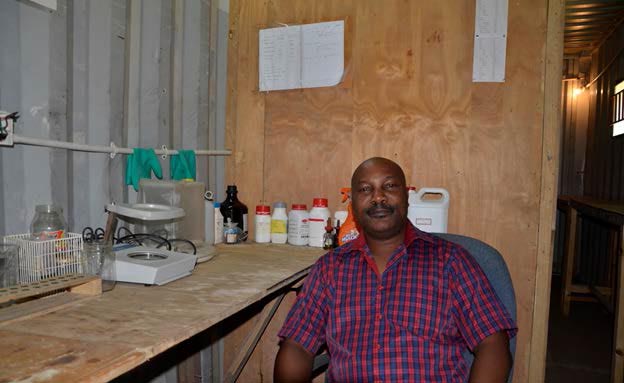
The project therefore sought out private sector actors to partner in producing affordable inoculant in Malawi. Fredrick Kawalewale, a qualified accountant, quickly seized the business opportunity through his company Agro-Input Suppliers Limited (AISL). He invested in lab equipment and in 2014 AISL produced 20,000 sachets of Nitrofix inoculant as a pilot.
Mr Kawalewale in his inoculant production lab.
Quality assurance
To ensure that the inoculant meets the required standards, Kawalewale has set up a well-equipped, high-standard laboratory for production and testing, and excellent packaging for delivery to farmers. He is also currently constructing bigger facilities with robust laboratory equipment to increase production of the inoculant to cater for the whole of southern Africa and later, the world. AISL is also coming up with inoculants for beans and groundnut. Farmers in Malawi are reaping immense benefits from the use of the inoculant and other good agronomic practices introduced by N2Africa and have noted the easier accessibility of the inoculum with AISL’s involvement.Farmers now have easier access to soybean inoculant
Natalia Matiasi, a soybean lead farmer from Mpingu Extension Planning Area (EPA) in Lilongwe, is helping fellow farmers with best practices and new technologies of legume farming. In her field, she applies all the agronomical practices she has learned from N2Africa to increase her legume production; she applies inoculant to her seed before planting, planted in double rows to increase yields. She is a clear evidence of how new technologies can improve farmers’ livelihoods. Natalia says there are clear differences in the crop when the inoculant is applied. The plants have greener leaves, longer stems, and more pods than when the inoculant is not applied. Even the roots also had a lot of nodules and were therefore able to introduce more nitrogen into the soil. She also compared her maize harvest from the following year from the same field and observed that yields had increased even with reduced application of inorganic fertilizer. With AISL, access to the inoculant is now easier. “This year, it was easier for us to get the inoculant than other years. We bought it from our local agrodealer at a price of MK1000.00 (US$1.4) per sachet and applied 12 sachets to at least two hectares of land (translating into $8.4 worth of inoculant per hectare), which proves how economical planting soybean is compared to tobacco farming which I did previously and required about $220 worth of fertilizer to establish the crop. I am now able to send my children to school from my earnings in soybean farming.” And like every mother, Natalia hopes that soybean farming can help improve her life and that of her children. She hopes she will be able to send her children to high school and college with savings from soybean farming. She plans to renovate her house and buy more land. As a lead farmer, she says over 400 farmers visited her field in the last planting season to learn about her farming practices. Some of them have already started planting inoculated soybean under her supervision. N2Africa is supporting her through training, mounting demonstration plots, and facilitating field days on soybean and legume farming and marketing strategies. Phiphira is proud to see that N2Africa’s vision is materializing and thinks Malawi is a model of impact that has been achieved with partnership with the private sector and government. “N2Africa is proud of what AISL has achieved. Many of our targets have been met mainly through partnerships. We have seen the lives of farmers improving and this was our goal. We are also happy to see the private sector blossoming and ready to sustain that which we dreamed of from phase one of the project,” says Phiphira. N2Africa is a large-scale, science-based project funded by the Bill & Melinda Gates Foundation working in different countries in Africa.Contributed by
Recent stories
No items found