
Nigeria’s Minister of Agriculture urges youth to prop agriculture
May 2, 2017
Chief Audu Ogbeh, Nigeria’s Honorable Minister of Agriculture (HMA), has urged the IITA Youth Agripreneurs in the IITA-Onne station to produce large volumes of improved suckers, pledging government’s commitment to procure the inputs.
 He said he was counting on IITA to provide improved suckers of banana and plantain, which government will distribute to youth farmers all over Nigeria, to boost the production of dessert banana in the country.
“This country produces the tastiest bananas I have ever eaten; we have the best! However, we don’t grow them well; thus, we are not in the international market. I am happy to see that IITA is setting up a youth training facility and tissue culture laboratory here. The Government will support the Institute with equipment useful in producing plantain and banana, so the Ministry will buy whatever quantity of suckers IITA produces,” Chief Ogbeh said.
Addressing IYA, Chief Ogbeh said the agricultural sector was vital in eradicating unemployment and praised the Institute for empowering young men and women with agricultural skills to sustain themselves and the country at large.
The Honorable Minister spoke at the IITA-Onne station on 26 April, when he visited to inspect the youth training center and research facilities there. He was accompanied by an entourage from the Ministry of Agriculture and Rural Development including Heneiken Lokpobiri, the Honorable Minister of State for Agriculture; Onimim Jacks, Rivers state Commissioner of Agriculture; Week Agbapou Doodei, Commissioner of Agriculture, Bayelsa State as well as directors from the Federal and State ministries of agriculture.
“The skills you have acquired should be passed on to other youth especially in this locality so that Nigerian agriculture can overtake and have a comparative advantage in the world market. The future of Nigerian agriculture is here and it is in your hands. The country depends on the youth because if you cannot feed yourselves then there’s no future. It is a serious responsibility you have,” he said.
Richardson Okechukwu, Head of station, IITA in Onne, welcomed the dignitaries and expressed IITA’s gratitude to the Nigerian government for its strong support to IITA through the ATASP-1 Outreach and Cassava Transformation Agenda programs which have helped to bring back the station into a functional state.
“IITA Onne has recorded award-winning research in plantain and banana and is the best benchmark site in Africa. The station has been reopened to serve Nigeria better especially the South-East and South-South geo-political zones. It will also serve as a center for youth empowerment and training,” Okechukwu said.
Chief Ogbeh had previously visited IITA-Onne in 2002 when he launched actions that proved effective in forestalling the imminent threat of Cassava Mosaic Disease in West Africa. The effort revolutionized cassava production and its value chains in Africa and facilitated the release of new improved cassava varieties.
Chief Ogbeh was delighted to be in IITA Onne station for the second time since its inception. He also enjoined the Institute to stay very close to the Ministry of Agriculture and the government.
“We are aware that the station was closed down and are happy it is functional again… We can work together to ensure that this center and other youth centers are developed. As you expand, keep us informed. When you have new varieties, let us know, there are markets all around,” he concluded.
He said he was counting on IITA to provide improved suckers of banana and plantain, which government will distribute to youth farmers all over Nigeria, to boost the production of dessert banana in the country.
“This country produces the tastiest bananas I have ever eaten; we have the best! However, we don’t grow them well; thus, we are not in the international market. I am happy to see that IITA is setting up a youth training facility and tissue culture laboratory here. The Government will support the Institute with equipment useful in producing plantain and banana, so the Ministry will buy whatever quantity of suckers IITA produces,” Chief Ogbeh said.
Addressing IYA, Chief Ogbeh said the agricultural sector was vital in eradicating unemployment and praised the Institute for empowering young men and women with agricultural skills to sustain themselves and the country at large.
The Honorable Minister spoke at the IITA-Onne station on 26 April, when he visited to inspect the youth training center and research facilities there. He was accompanied by an entourage from the Ministry of Agriculture and Rural Development including Heneiken Lokpobiri, the Honorable Minister of State for Agriculture; Onimim Jacks, Rivers state Commissioner of Agriculture; Week Agbapou Doodei, Commissioner of Agriculture, Bayelsa State as well as directors from the Federal and State ministries of agriculture.
“The skills you have acquired should be passed on to other youth especially in this locality so that Nigerian agriculture can overtake and have a comparative advantage in the world market. The future of Nigerian agriculture is here and it is in your hands. The country depends on the youth because if you cannot feed yourselves then there’s no future. It is a serious responsibility you have,” he said.
Richardson Okechukwu, Head of station, IITA in Onne, welcomed the dignitaries and expressed IITA’s gratitude to the Nigerian government for its strong support to IITA through the ATASP-1 Outreach and Cassava Transformation Agenda programs which have helped to bring back the station into a functional state.
“IITA Onne has recorded award-winning research in plantain and banana and is the best benchmark site in Africa. The station has been reopened to serve Nigeria better especially the South-East and South-South geo-political zones. It will also serve as a center for youth empowerment and training,” Okechukwu said.
Chief Ogbeh had previously visited IITA-Onne in 2002 when he launched actions that proved effective in forestalling the imminent threat of Cassava Mosaic Disease in West Africa. The effort revolutionized cassava production and its value chains in Africa and facilitated the release of new improved cassava varieties.
Chief Ogbeh was delighted to be in IITA Onne station for the second time since its inception. He also enjoined the Institute to stay very close to the Ministry of Agriculture and the government.
“We are aware that the station was closed down and are happy it is functional again… We can work together to ensure that this center and other youth centers are developed. As you expand, keep us informed. When you have new varieties, let us know, there are markets all around,” he concluded.
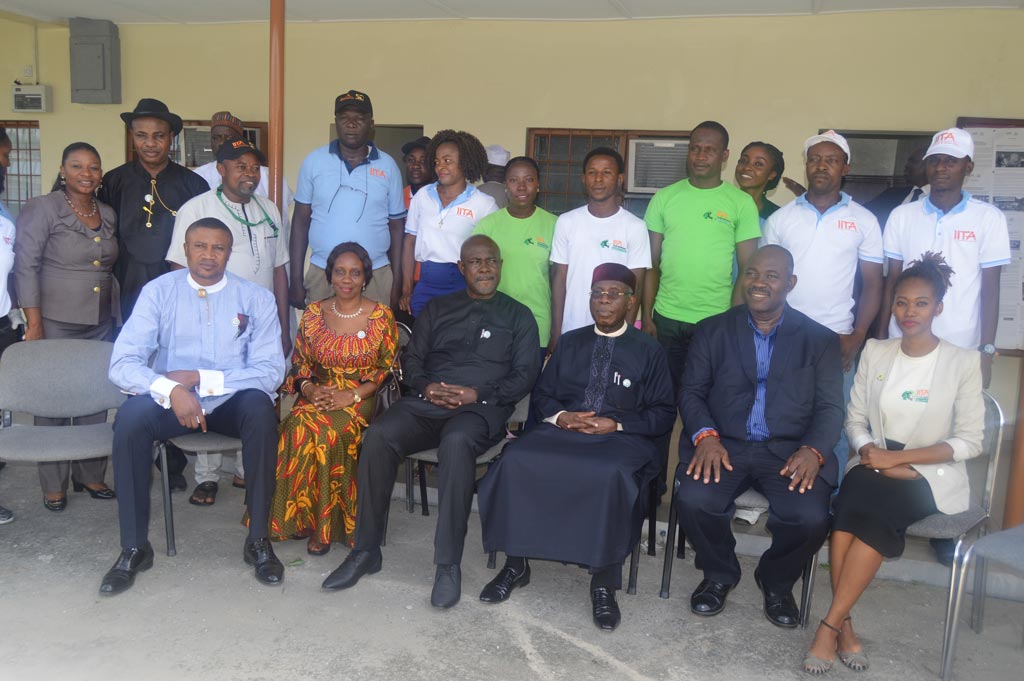
Chief Audu Ogbeh (seated, fourth from left), with top executives from the Ministry of Agriculture, pose for a group photo with IITA staff, agripreneurs, and scientists at Onne

- Chief Ogbeh chatting with the agripreneurs.
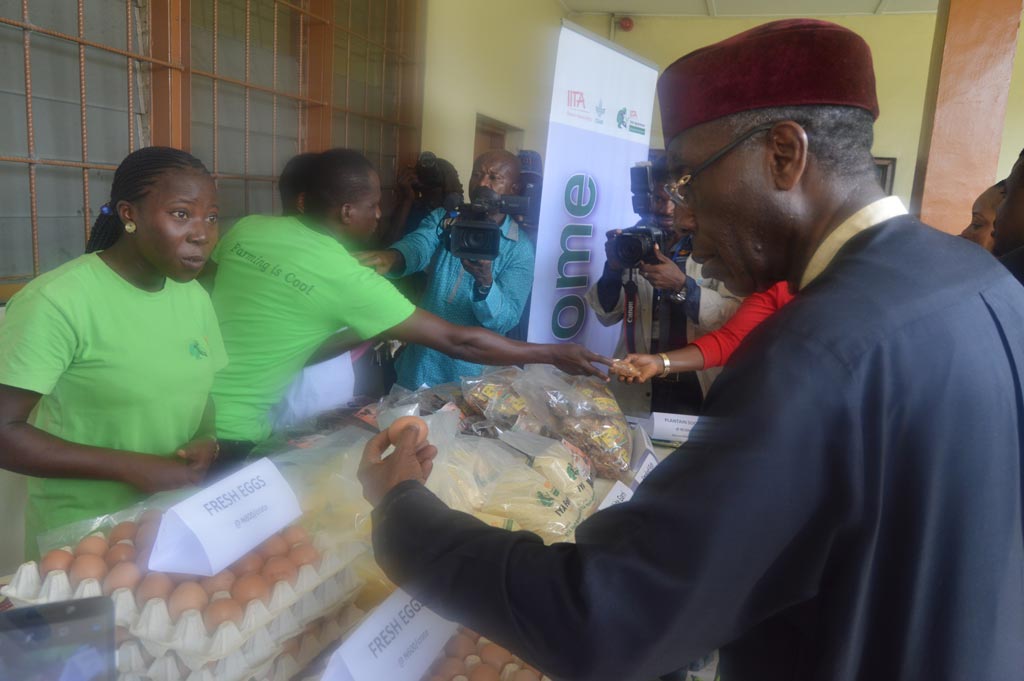
- Chief Ogbeh inspecting the products from the farm of young farmers
Contributed by
Recent stories
No items found