
Partnerships for perpetuity: N2Africa consolidates PPPs as plans for exit strategy progresses
May 2, 2017
Among agricultural researchers, there exists a growing consensus that developing excellent technologies for farmers to grow their enterprises is no longer enough. What needs to be done for such technologies to remain effective and sustainable beyond the life of any intervention program? This is the question the N2Africa project is trying to answer in its wider efforts to put nitrogen fixation to work on the fields of groundnut, soybean, and cowpea farmers in Africa.
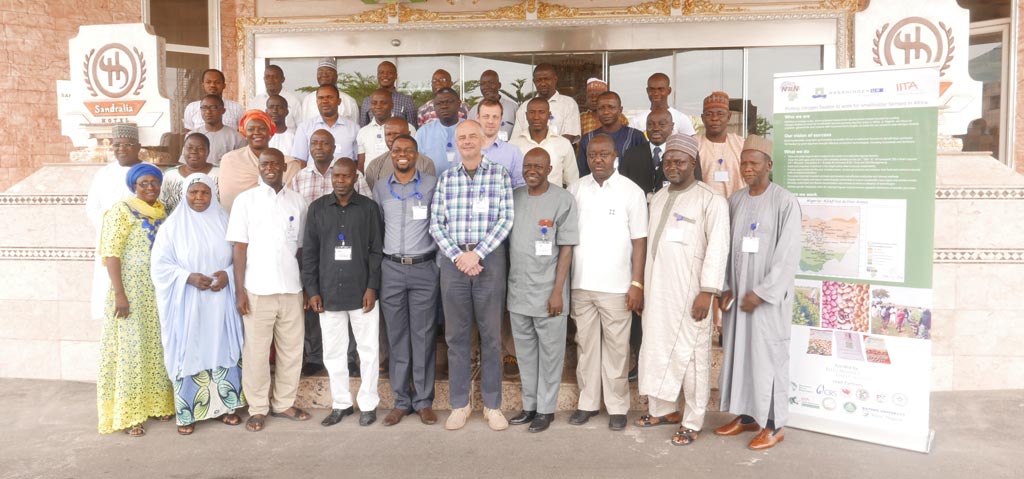 During its third annual review and planning meeting on 25-27 April held in Abuja, over 40 partners comprising IITA scientists, as well as representatives from various NGOs, public and private sector companies underpinned active involvement with both public and private partners as a vital option in ensuring that N2Africa technologies stay relevant beyond 2018 when the project ends. The partners also reported key achievements and challenges from the past year and developed work plans for 2017.
Overall, the project goal is to reach 140,000 legume farmers in Nigeria with best bet agronomic practices and inputs especially NoduMax—an IITA invented biofertilizer (inoculant) that promotes nitrogen fixation in the soil and is proven to maximize legume yields when used in combination with phosphorus-based fertilizers. The project also aims to provide job opportunities for at least 2,000 youth in Borno State, Nigeria through agro-based enterprises.
But more than the numbers, Fred Kanampiu, N2Africa Project Coordinator, stressed that the project’s greater target is to ensure the sustainability of the practices deployed to beneficiaries through the project.
“Our impact is not just centered on reaching so many people, but on making sure that the packages we sell to them during the life of this project empowers and improves farmers’ livelihoods so that these people continue to use these technologies even after the life of this project. We are more driven to leave a worthy legacy as we prepare to exit,” he said.
In its first phase, from 2009 to 2013, the project had promoted research activities in relation to legume agronomy, cropping system design, and rhizobiology. Now in its second phase, it has established long-term public-private partnerships (PPPs) with legume value chain actors. N2Africa is actively working with its dissemination partners to create an unobstructed retail channel for inoculants and seeds as well as for information and production technologies. It is also dedicated to link scientific knowledge with capacity building especially among women and the youth.
“N2Africa is empowering 13 MSc and 5 PhD students in Nigeria to continue work on inoculants and for women’s groups through various capacity building initiatives to be able to produce and market the legumes they cultivate,” said Kamai Nkeki, coordinator, N2Africa-Nigeria.
Another approach being explored by N2Africa is working with the Federal Government of Nigeria through its new Anchor Borrowers Program (ABP) to increase the chances of its beneficiaries to access credit and other inputs.
Explaining why the project is keying into this initiative, Innocent Okuku, CEO, Intrio Synergy Limited and N2Africa partner, said the move was necessary to help smallholder farmers overcome the bottlenecks limiting them from getting available agricultural technological packages.
“Many smallholder farmers still don’t get optimum yields and income from their production because they are poor. They are unable to afford the cost of improved seeds and other production inputs which they need even though these are readily available. In 2017, N2Africa will bridge that gap and help its farmers to reach the benchmark set by the government so that they can get all the benefits from the program,” Okuku said.
N2Africa phase 2 is funded by the Bill & Melinda Gates Foundation by a grant to Wageningen University & Research which leads the project together with IITA, ILRI, University of Zimbabwe and many other partners in Ethiopia, Ghana, Nigeria, Tanzania, Uganda, DR Congo, Rwanda, Kenya, Malawi, and Mozambique.
During its third annual review and planning meeting on 25-27 April held in Abuja, over 40 partners comprising IITA scientists, as well as representatives from various NGOs, public and private sector companies underpinned active involvement with both public and private partners as a vital option in ensuring that N2Africa technologies stay relevant beyond 2018 when the project ends. The partners also reported key achievements and challenges from the past year and developed work plans for 2017.
Overall, the project goal is to reach 140,000 legume farmers in Nigeria with best bet agronomic practices and inputs especially NoduMax—an IITA invented biofertilizer (inoculant) that promotes nitrogen fixation in the soil and is proven to maximize legume yields when used in combination with phosphorus-based fertilizers. The project also aims to provide job opportunities for at least 2,000 youth in Borno State, Nigeria through agro-based enterprises.
But more than the numbers, Fred Kanampiu, N2Africa Project Coordinator, stressed that the project’s greater target is to ensure the sustainability of the practices deployed to beneficiaries through the project.
“Our impact is not just centered on reaching so many people, but on making sure that the packages we sell to them during the life of this project empowers and improves farmers’ livelihoods so that these people continue to use these technologies even after the life of this project. We are more driven to leave a worthy legacy as we prepare to exit,” he said.
In its first phase, from 2009 to 2013, the project had promoted research activities in relation to legume agronomy, cropping system design, and rhizobiology. Now in its second phase, it has established long-term public-private partnerships (PPPs) with legume value chain actors. N2Africa is actively working with its dissemination partners to create an unobstructed retail channel for inoculants and seeds as well as for information and production technologies. It is also dedicated to link scientific knowledge with capacity building especially among women and the youth.
“N2Africa is empowering 13 MSc and 5 PhD students in Nigeria to continue work on inoculants and for women’s groups through various capacity building initiatives to be able to produce and market the legumes they cultivate,” said Kamai Nkeki, coordinator, N2Africa-Nigeria.
Another approach being explored by N2Africa is working with the Federal Government of Nigeria through its new Anchor Borrowers Program (ABP) to increase the chances of its beneficiaries to access credit and other inputs.
Explaining why the project is keying into this initiative, Innocent Okuku, CEO, Intrio Synergy Limited and N2Africa partner, said the move was necessary to help smallholder farmers overcome the bottlenecks limiting them from getting available agricultural technological packages.
“Many smallholder farmers still don’t get optimum yields and income from their production because they are poor. They are unable to afford the cost of improved seeds and other production inputs which they need even though these are readily available. In 2017, N2Africa will bridge that gap and help its farmers to reach the benchmark set by the government so that they can get all the benefits from the program,” Okuku said.
N2Africa phase 2 is funded by the Bill & Melinda Gates Foundation by a grant to Wageningen University & Research which leads the project together with IITA, ILRI, University of Zimbabwe and many other partners in Ethiopia, Ghana, Nigeria, Tanzania, Uganda, DR Congo, Rwanda, Kenya, Malawi, and Mozambique.
Group photograph of meeting participants in Abuja.
Contributed by
Recent stories
No items found