Cameroon program graduates second cohort of ENABLE Youth agripreneurs
June 14, 2024
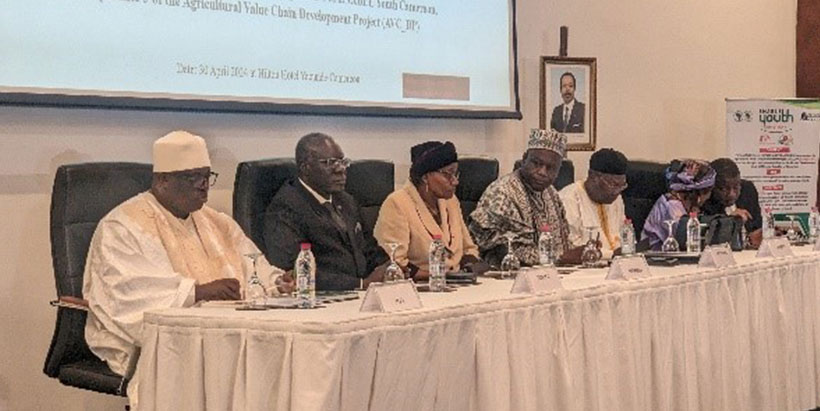
Gabriel Mbairobe and officials during the graduation ceremony of 30 April 2024.
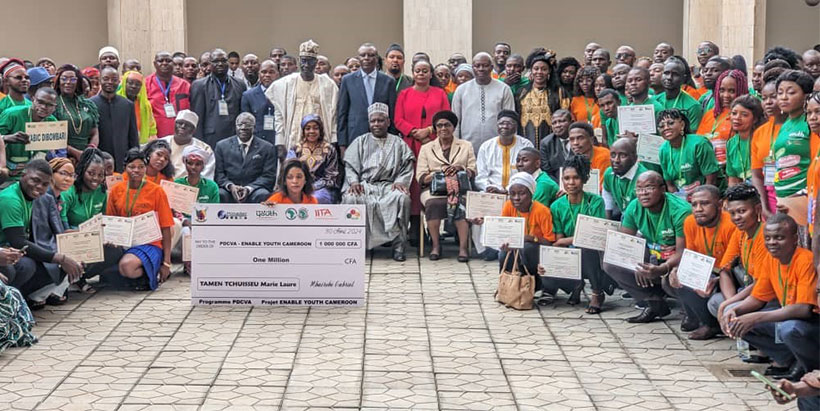
The ENABLE Youth Cameroon (EYC) program aims to train 1,536 young Cameroonians—targeting 40% female participation—and create at least 600 agricultural enterprises. On 14 April, 273 agripreneurs (110 females and 163 males) graduated, while another batch of 695 (254 females and 441 males) graduated on 30 April at the Yaounde Hilton Hotel. All 968 graduates received 1 million CFA franc (USD1,690) incentive packages to boost their agribusiness start-ups while awaiting the funds for their business projects through banks and other financial institutions.
Members of government, graduates and guests posing with the 1 million FCFA cheque for personal project startup during EYC agripreneurs graduation on 30 April 2024.
The Minister of Agriculture and Rural Development (MINADER), Gabriel Mbairobe, presided over the ceremony. The Minister of Fisheries and Livestock, Dr Taïga; the Minister for Youth and Civic Education, Mounouna Foutsou; and the Minister of Women Empowerment and the Family, Marie-Thérèse Abena Ondoa. Other attendees at the joy-filled graduation included the National Coordinator of the Agricultural Value Chain Development Project (AVC_DP), Mme Marie Jeanine Nkodo; the IITA country representative and Technical Coordinator of the EYC, Komi Fiaboe; the EYC coordination unit; the coordinators of the Youth Agribusiness Incubation Centers (YABICS); the YABICS host institution directors; senior officers from the different ministries; and the young agripreneurs. The successful completion of the program represents a huge win for the joint effort of the African Development Bank (AfDB) and the Cameroon government to help young people create jobs for themselves and fight hunger and poverty in the country.
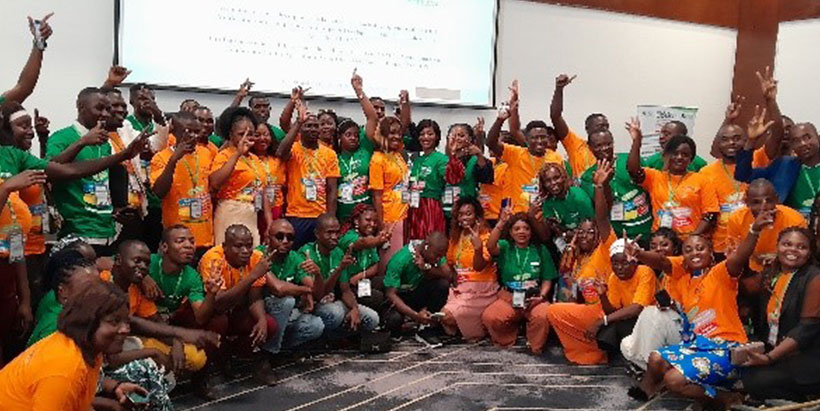
The second cohort of AAs upon receiving their end of training certificates.
In her opening speech, Nkodo applauded IITA–CGIAR for the achievement despite difficult beginnings and thanked AfDB for its continued support toward the youth agenda. Fiaboe congratulated the youths and reminded them of the change of paradigm, where they represent the unique hope for the long-desired African agricultural transformation and the Africa-feeding Africans’ expectations. He thanked the Minister for his strong support of IITA in this assignment. He also congratulated the Program Coordinator for successfully turning around a sinking program into a very inclusive and successful initiative. Minister Mbairobe, in his speech, cautioned the graduates to be responsible in using the resources at their disposal. During the graduation ceremony, he announced that 13 billion francs CFA had been deposited at the Commercial Bank of Cameroon to serve as guarantee funds for agripreneurs who will show up for loans if their projects are bankable. He congratulated both AVC_DP and IITA for their success and thanked AfDB for supporting youth agripreneurship. He expressed a desire to work with IITA on other initiatives soon.
The future of the graduates
The enthusiastic graduates look forward to fighting against hunger, joblessness, and poverty.
This is not possible without the necessary ammunition. So far, more than 385 agripreneurs have established agribusinesses.
Agnes Ndouga, an aspiring agripreneur from the YABIC Obala, revived a fish farming project associated with black soldier fly rearing from her initial project in apiculture after completing the program. The young graduate said she captured all rudiments to have her fish project take off. Soya beans, a protein source used in fish farming, are now costly, and its price keeps rising. With black soldier flies, which are a cheaper source of protein, she plans to produce more affordable, quality fish.
Contributed by IITA Cameroon
Olamide Deborah Nwanze is a Senior Research Associate specializing in gender mainstreaming research to inform participatory and inclusive breeding, variety development, and seed systems policies regarding root, tuber, and banana (RTB) crops in the International Institute of Tropical Agriculture Headquarters, Ibadan, Nigeria. She is a PhD candidate at the University of Ibadan and holds an MSc and B. Agric in Agricultural Extension and Rural Development. Olamide is a fellow of the African Women in Agricultural Research and Development – Gender Responsive Agricultural Systems Policy (AWARD-GRASP) and the Gender Responsive Researchers Equipped for Agricultural Transformation (GREAT). She seeks to apply her gender-mainstreaming learnings, gender-responsive research, and policy development, and review expertise to facilitate women, youth, children, and vulnerable social group’s access to and adoption of agricultural Innovations that guarantee food, nutrition, income, and livelihood security in Africa. Her current roles include mentoring research fellows, development of guides and training manuals, implementation and adaptation of gender frameworks and tools, value chain actors’ engagement as citizen science partners, policy review and redesign, data management, and analysis. Her current research explores mixed methods and participatory and interdisciplinary approaches to capture and highlight gender dynamics, needs, preferences, and challenges stakeholders face within the agricultural livelihood value chain to prioritize gender-inclusive strategies in breeding programs, policy design, and implementation.
de Sousa, K., van Etten, J., Manners, R. Bello, A., Teeken, B., Olaosebikan, O., et al. 2024. The tricot approach: an agile framework for decentralized on-farm testing supported by citizen science. A retrospective. Agron. Sustain. Dev. 44, 8. https://doi.org/10.1007/s13593-023-00937-1
Madu, T., Onwuka, S., Nwafor, S., Onyemauwa, N., Ejechi, M., Ofoeze, M., Ukeje, B., Eluagu, C., Olaosebikan, O., Okoye, B., 2024. Gender-Inclusive Consumer Studies Improve Cassava Breeding in Nigeria in: Frontiers in Sociology, volume 9, number: 1224504, doi: 10.3389/fsoc.2024.1224504
Olaosebikan, O.; Bello, A.; Utoblo, O.; Okoye, B.; Olutegbe, N.; Garner, E.; Teeken, B.; Bryan, E.; Forsythe, L.; Cole, S.; Madu, T. 2023. Stressors and Resilience within the Cassava Value Chain in Nigeria: Preferred Cassava Variety Traits and Response Strategies of Men and Women to Inform Breeding. Sustainability 15, 7837. https://doi.org/10.3390/su15107837
Okoye, B., Ofoeze, M., Ejechi, M., Onwuka, S., Nwafor, S., Onyemauwa, N., Ukeje, B., Eluagu, C., Obidiegwu, J.*, Olaosebikan, O., Madu, T.* 2023. Prioritizing preferred traits in the yam value chain in Nigeria: a gender situation analysis in: Frontiers in Sociology, volume 8, number: 1232626, pages 1 – 9, ISSN 2297-7775, 2023. https://www.frontiersin.org/articles/10.3389/fsoc.2023.1232626/full
Olaosebikan, O., Bello, A. A., de Sousa, K., Ndjouenkeu, R., Adesokan, M., Alamu, E. O., Agbona, A., van Etten, J., Kegah, F. N.*, Dufour, D., Bouniol, A., Teeken, B. 2023. Consumer acceptability of cassava gari-eba food products across cultural and environmental settings using the triadic comparison of technologies approach (tricot) in: Journal of the Science of Food and Agriculture,
Teeken, B., Olaosebikan, O., Bello, A. A., Madu, T.*, Cole, S. M. 2023. Qualitative assessment on the positionality and preferences of dyads in relation to cassava-related activities: working with tricot trial citizen scientists https://hdl.handle.net/10568/138326 Type: Manual
Bouniol, A., Ceballos, H., Bello, A. A., Teeken, B., Olaosebikan, O., Owoade, D., Agbona, A., Fotso Kuate, A., Madu, T.*, Okoye, B.*, Ofoeze, M.*, Nwafor, S.*, Onyemauwa, N.*, Adinsi, L.*, Forsythe, L., Dufour, D. 2023. Varietal impact on women’s labour, workload and related drudgery in processing root, tuber and banana crops: focus on cassava in sub-Saharan Africa in: Journal of the Science of Food and Agriculture, pages 1 – 25, ISSN 0022-5142,
Bello, A. A., Agbona, A., Olaosebikan, O., Edughaen, G., Dufour, D., Bouniol, A., Iluebbey, P., Ndjouenkeu, R.*, Rabbi, I. Y., Teeken, B. 2023. Genetic and environmental effects on processing productivity and food product yield: drudgery of women’s work in: Journal of the Science of Food and Agriculture, pages 1 – 32, ISSN 0022-5142, 5
Cavicchioli, M., Zimbiti, T., Teeken, B., Nwanze, D.O., Liani, M., Parkes, E. & Bello, A. 2023. IITA-Gender Responsive Breeding Training Report. Genetic Resources Center, IITA-HQ, Ibadan, 21-23 September, 2022. Ibadan, Nigeria: IITA, (34 p.).https://hdl.handle.net/10568/131368
Agbona, A. Peteti P., Teeken B., Olaosebikan O. Bello, A. A., Parkes, E., Rabbi, I. Y., Mueller, L., Egesi, C., Kulakow, P. 2022. Data Management in Multi-disciplinary African RTB Crop Breeding Programs. In: Williamson, H.F., Leonelli, S. (eds) Towards Responsible Plant Data Linkage: Data Challenges for Agricultural Research and Development. Springer, Cham. https://doi.org/10.1007/978-3-031-13276-6_5
Lora Forsythe, Pricilla Marimo, Sarah Mayanja, Olamide D. Olaosebikan, Esme Stuart, Bela Teeken, Benjamin Okoye, Tessy Madu, (2021). Cross-product Gender Analysis of RTBfoods Step 2 Gendered Food Mapping on RTB Products. Understanding the Drivers of Trait Preferences and the Development of Multi-user RTB Product Profiles, WP1. London, UK: RTBfoods Field Scientific Report, 30 p.
Teeken, B., Garner, E., Agbona, A., Balogun, I., Olaosebikan, O., Bello, A., Madu, T., Okoye, B., Egesi, C., Kulakow, P. and Tufan, H.A. 2021. Beyond “Women’s Traits”: Exploring How Gender, Social Difference, and Household Characteristics Influence Trait Preferences. Frontiers Sustainable Food Systems 5:740926. https://doi.org/10.3389/fsufs.2021.740926
Teeken, B., Agbona, A., Bello, A., Olaosebikan, O., Alamu, E., Adesokan, M., Awoyale, W., Madu, T., Okoye, B., Chijioke, U., Owoade, D., Okoro, M., Bouniol, A., Dufour, D., Hershey, C., Rabbi, I., Maziya‐Dixon, B., Egesi, C., Tufan, H. and Kulakow, P. (020. Understanding cassava varietal preferences through pairwise ranking of gari‐eba and fufu prepared by local farmer–processors. Int J Food Sci Technol.https://doi.org/10.1111/ijfs.14862
Bela Teeken, Olamide Olaosebikan, Ireti Balogun, Benjamin Okoye, Tessy Madu, Steven Cole, Abolore Bello, Elizabeth Parkes. (2020). Piloting the G+ customer and product profile tools for gender-responsive cassava breeding in Nigeria. Nigeria: International Institute of Tropical Agriculture (IITA). https://hdl.handle.net/20.500.11766/13000