A leap toward modern data management: IITA cowpea breeding program trains in EBS
June 7, 2024
The cowpea breeding program at IITA Kano Station participated in a four-day training on the Enterprise Breeding System (EBS) from 7 to 10 May. Thirteen participants attended, including Cowpea Breeding Lead Boukar Ousmane and bioinformatics, data management, and molecular breeding experts. The training focused on introducing breeders and technicians to a new tool to support effective data management as part of the EBS adoption initiative across CGIAR and NARES breeding programs.
The training aimed to:
streamline breeding activities and eliminate manual data exchange across various applications and databases
familiarize participants with the EBS platform and its core breeding and analytics functionalities
enable participants to efficiently access EBS User Guides and correctly submit requests to the EBS Service Desk (ESD) for support
gather initial feedback from participants to improve the cowpea data and workflows in the production environment.
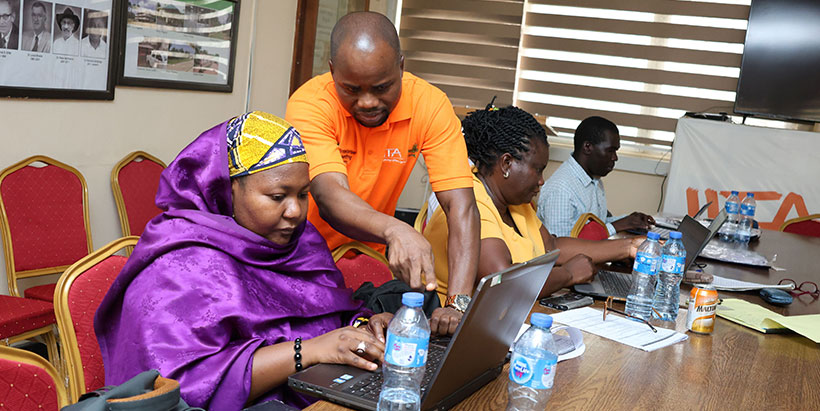
Participants during the EBS training.
Simon Imoro, IITA Breeding Data Manager and the program facilitator, explained that the EBS is designed to manage data effectively from end to end, covering nurseries and trials creation and management, data collection and quality checks, germplasm advancement, seed inventory management, genotyping, and analyses. He added that the system has powerful search tools for germplasm and seed records, making and sharing different list types, and supporting network breeding where CGIAR-NARES partners can easily collaborate on experiments established using the system. The training equipped participants with skills to increase accuracy and efficiency in their work.
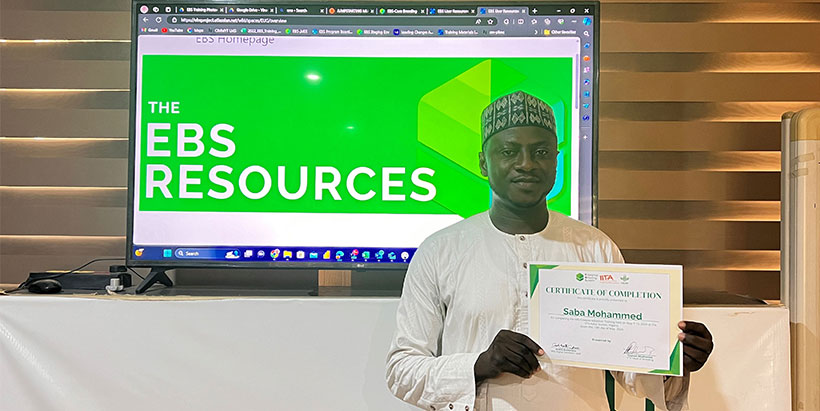
Certificate presented to Dr Mohammed Saba after the EBS training.
Imoro and Trushar Shah, Bioinformatician and PI of the IITA Digitization project, delivered in-depth presentations and demonstrations on the concepts and applications of all the EBS Core Breeding and Breeding Analytics (Phenotypic Data Manager and the Analysis Request Manager) domains. They aimed to equip participants with the requisite EBS knowledge, from creating experiments to collecting data and analyzing the collected data through hands-on exercises.
The training followed a workflow-based approach, covering relevant tools for supported experiment types: generation nurseries, cross nurseries, and breeding trials. Important use-case scenarios were highlighted to relate EBS terminologies and processes to actual field practices. This included experimental planning and designs, seed source management, printouts, data collection, data sharing with in-program and NARES collaborators, data quality checks and analysis, and harvesting and advancement.
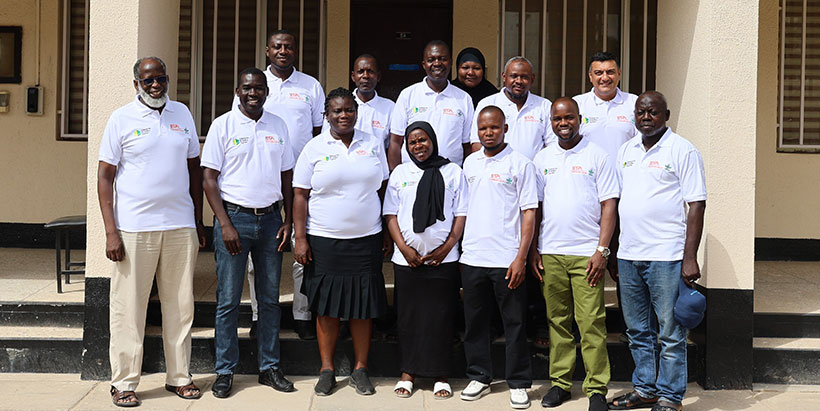
Participants after EBS training in Kano.
Participants asked questions during and at the end of each session. Hands-on exercises were administered to assess their understanding of concepts and workflows. They provided positive feedback, indicating the usefulness of the training to the breeding team. IITA Molecular Breeder Patrick Ongom emphasized the importance of the training, stating that the EBS will support the management of data from the breeding field and the laboratory. Ongom also mentioned that the training has been useful to the breeding team as they have been equipped with skills to make their work more efficient.
“Today, I am happy to be introduced to this new tool. The tool is important, particularly to the breeding program, to help us manage our data. We learned how to use the software to organize our data. This is our first time using the software, and we hope we will soon migrate completely to the EBS system.”
Trushar Shah highlighted that the training achieved its objectives, covering all breeding workflows, analytics, and peripheral data attached to the program.
Participants in the training expressed gratitude for such an opportunity to learn and be equipped with knowledge about the EBS. During the closing remarks, Boukar, on behalf of his team, expressed their readiness and confidence in using EBS, eagerly anticipating the transition to the production environment sooner. They are keen to start using the EBS for the upcoming planting season starting in June 2024.
Shah and Imoro congratulated the participants for their engagement and enthusiasm. All participants were awarded EBS certificates for completing the training and performing all the required exercises.
The trainers extended their heartfelt appreciation to the Crops to End Hunger (CtEH) through the IITA Enabling Digitization grant that made the training possible. They also acknowledged the significant contributions of IITA, CGIAR Digital Solutions, Global User Support, and the entire EBS team involved in the digitization activities, ensuring a comprehensive and impactful adoption of the Cowpea improvement program.
Contributed by Sarah Sallau
Olamide Deborah Nwanze is a Senior Research Associate specializing in gender mainstreaming research to inform participatory and inclusive breeding, variety development, and seed systems policies regarding root, tuber, and banana (RTB) crops in the International Institute of Tropical Agriculture Headquarters, Ibadan, Nigeria. She is a PhD candidate at the University of Ibadan and holds an MSc and B. Agric in Agricultural Extension and Rural Development. Olamide is a fellow of the African Women in Agricultural Research and Development – Gender Responsive Agricultural Systems Policy (AWARD-GRASP) and the Gender Responsive Researchers Equipped for Agricultural Transformation (GREAT). She seeks to apply her gender-mainstreaming learnings, gender-responsive research, and policy development, and review expertise to facilitate women, youth, children, and vulnerable social group’s access to and adoption of agricultural Innovations that guarantee food, nutrition, income, and livelihood security in Africa. Her current roles include mentoring research fellows, development of guides and training manuals, implementation and adaptation of gender frameworks and tools, value chain actors’ engagement as citizen science partners, policy review and redesign, data management, and analysis. Her current research explores mixed methods and participatory and interdisciplinary approaches to capture and highlight gender dynamics, needs, preferences, and challenges stakeholders face within the agricultural livelihood value chain to prioritize gender-inclusive strategies in breeding programs, policy design, and implementation.
de Sousa, K., van Etten, J., Manners, R. Bello, A., Teeken, B., Olaosebikan, O., et al. 2024. The tricot approach: an agile framework for decentralized on-farm testing supported by citizen science. A retrospective. Agron. Sustain. Dev. 44, 8. https://doi.org/10.1007/s13593-023-00937-1
Madu, T., Onwuka, S., Nwafor, S., Onyemauwa, N., Ejechi, M., Ofoeze, M., Ukeje, B., Eluagu, C., Olaosebikan, O., Okoye, B., 2024. Gender-Inclusive Consumer Studies Improve Cassava Breeding in Nigeria in: Frontiers in Sociology, volume 9, number: 1224504, doi: 10.3389/fsoc.2024.1224504
Olaosebikan, O.; Bello, A.; Utoblo, O.; Okoye, B.; Olutegbe, N.; Garner, E.; Teeken, B.; Bryan, E.; Forsythe, L.; Cole, S.; Madu, T. 2023. Stressors and Resilience within the Cassava Value Chain in Nigeria: Preferred Cassava Variety Traits and Response Strategies of Men and Women to Inform Breeding. Sustainability 15, 7837. https://doi.org/10.3390/su15107837
Okoye, B., Ofoeze, M., Ejechi, M., Onwuka, S., Nwafor, S., Onyemauwa, N., Ukeje, B., Eluagu, C., Obidiegwu, J.*, Olaosebikan, O., Madu, T.* 2023. Prioritizing preferred traits in the yam value chain in Nigeria: a gender situation analysis in: Frontiers in Sociology, volume 8, number: 1232626, pages 1 – 9, ISSN 2297-7775, 2023. https://www.frontiersin.org/articles/10.3389/fsoc.2023.1232626/full
Olaosebikan, O., Bello, A. A., de Sousa, K., Ndjouenkeu, R., Adesokan, M., Alamu, E. O., Agbona, A., van Etten, J., Kegah, F. N.*, Dufour, D., Bouniol, A., Teeken, B. 2023. Consumer acceptability of cassava gari-eba food products across cultural and environmental settings using the triadic comparison of technologies approach (tricot) in: Journal of the Science of Food and Agriculture,
Teeken, B., Olaosebikan, O., Bello, A. A., Madu, T.*, Cole, S. M. 2023. Qualitative assessment on the positionality and preferences of dyads in relation to cassava-related activities: working with tricot trial citizen scientists https://hdl.handle.net/10568/138326 Type: Manual
Bouniol, A., Ceballos, H., Bello, A. A., Teeken, B., Olaosebikan, O., Owoade, D., Agbona, A., Fotso Kuate, A., Madu, T.*, Okoye, B.*, Ofoeze, M.*, Nwafor, S.*, Onyemauwa, N.*, Adinsi, L.*, Forsythe, L., Dufour, D. 2023. Varietal impact on women’s labour, workload and related drudgery in processing root, tuber and banana crops: focus on cassava in sub-Saharan Africa in: Journal of the Science of Food and Agriculture, pages 1 – 25, ISSN 0022-5142,
Bello, A. A., Agbona, A., Olaosebikan, O., Edughaen, G., Dufour, D., Bouniol, A., Iluebbey, P., Ndjouenkeu, R.*, Rabbi, I. Y., Teeken, B. 2023. Genetic and environmental effects on processing productivity and food product yield: drudgery of women’s work in: Journal of the Science of Food and Agriculture, pages 1 – 32, ISSN 0022-5142, 5
Cavicchioli, M., Zimbiti, T., Teeken, B., Nwanze, D.O., Liani, M., Parkes, E. & Bello, A. 2023. IITA-Gender Responsive Breeding Training Report. Genetic Resources Center, IITA-HQ, Ibadan, 21-23 September, 2022. Ibadan, Nigeria: IITA, (34 p.).https://hdl.handle.net/10568/131368
Agbona, A. Peteti P., Teeken B., Olaosebikan O. Bello, A. A., Parkes, E., Rabbi, I. Y., Mueller, L., Egesi, C., Kulakow, P. 2022. Data Management in Multi-disciplinary African RTB Crop Breeding Programs. In: Williamson, H.F., Leonelli, S. (eds) Towards Responsible Plant Data Linkage: Data Challenges for Agricultural Research and Development. Springer, Cham. https://doi.org/10.1007/978-3-031-13276-6_5
Lora Forsythe, Pricilla Marimo, Sarah Mayanja, Olamide D. Olaosebikan, Esme Stuart, Bela Teeken, Benjamin Okoye, Tessy Madu, (2021). Cross-product Gender Analysis of RTBfoods Step 2 Gendered Food Mapping on RTB Products. Understanding the Drivers of Trait Preferences and the Development of Multi-user RTB Product Profiles, WP1. London, UK: RTBfoods Field Scientific Report, 30 p.
Teeken, B., Garner, E., Agbona, A., Balogun, I., Olaosebikan, O., Bello, A., Madu, T., Okoye, B., Egesi, C., Kulakow, P. and Tufan, H.A. 2021. Beyond “Women’s Traits”: Exploring How Gender, Social Difference, and Household Characteristics Influence Trait Preferences. Frontiers Sustainable Food Systems 5:740926. https://doi.org/10.3389/fsufs.2021.740926
Teeken, B., Agbona, A., Bello, A., Olaosebikan, O., Alamu, E., Adesokan, M., Awoyale, W., Madu, T., Okoye, B., Chijioke, U., Owoade, D., Okoro, M., Bouniol, A., Dufour, D., Hershey, C., Rabbi, I., Maziya‐Dixon, B., Egesi, C., Tufan, H. and Kulakow, P. (020. Understanding cassava varietal preferences through pairwise ranking of gari‐eba and fufu prepared by local farmer–processors. Int J Food Sci Technol.https://doi.org/10.1111/ijfs.14862
Bela Teeken, Olamide Olaosebikan, Ireti Balogun, Benjamin Okoye, Tessy Madu, Steven Cole, Abolore Bello, Elizabeth Parkes. (2020). Piloting the G+ customer and product profile tools for gender-responsive cassava breeding in Nigeria. Nigeria: International Institute of Tropical Agriculture (IITA). https://hdl.handle.net/20.500.11766/13000