Nigeria Integrated Agriculture Activity donates certified seeds to Borno State
July 15, 2024
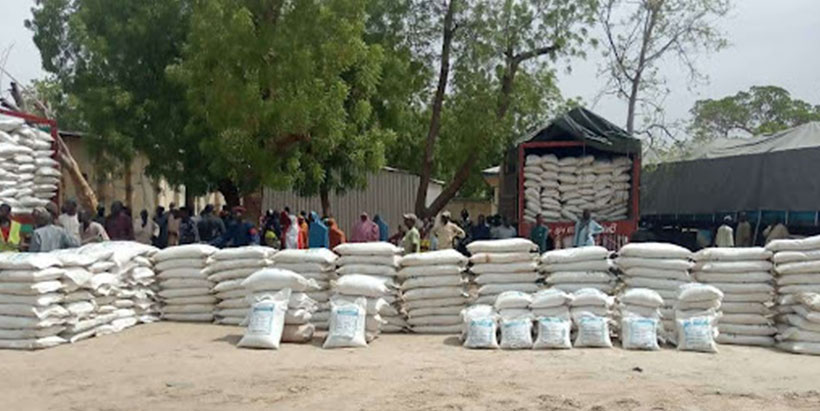
In a collaborative effort to boost agricultural productivity and support sustainable farming practices, the Nigeria Integrated Agriculture Activity (NIAA) donated 17 tons of certified seeds to the Borno State Government recently. The Activity is a five-and-half-year program being implemented by the IITA-CGIAR and its partner, the International Crops Research Institute for the Semi-Arid Tropics (ICRISAT) as part of the United States Agency for International Development (USAID)’s contribution to the economic recovery in Northeast Nigeria, in the wake of the devastation caused by insurgency in the region.
The 17 tons of certified seeds donation on display at Maiduguri, Borno State.The certified seeds donated by the Activity, including rice, soybean, and maize varieties, were recovered from the Community-Based Seed Entrepreneurs (CBSEs) after the successful 2023 wet season seed production. Initially loaned to the CBSEs as foundation seeds, the seeds were meticulously cultivated and harvested, bolstering the effectiveness of the community-based seed production model. The donation aims to support Internally Displaced Persons (IDPs) and vulnerable populations in Borno State, ensuring they have access to high-quality seeds for the upcoming planting seasons.
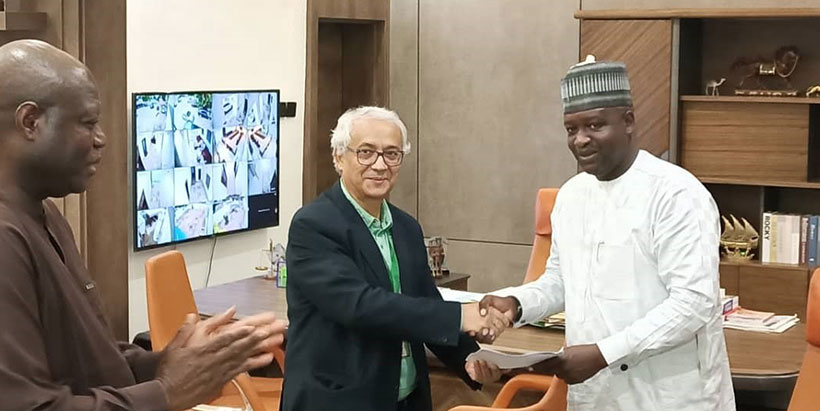
Following the seed donation, a Memorandum of Understanding (MoU) was signed between IITA and the Borno State Government. This MoU is a step forward in collaborative efforts to further strengthen agricultural development in the region. The signing ceremony was attended by key officials, including NIAA Chief of Party, Prakash Kant Silwal, and the Deputy Chief of Party, Kayode Faleti. The Deputy Governor of Borno State, His Excellency Hon. Umar Usman Kadafur, received the donation on behalf of the state government.
The MoU outlined a comprehensive framework for cooperation, focusing on several critical areas such as the establishment of the Agriculture Technology and Business Incubation Centre, and scaling up the CBSE Model to enhance agricultural productivity and sustainability in the Northeast.
The Deputy Governor, Borno State, His Excellency Hon. Umar Usman Kadafur (middle), meeting with the NIAA team after the donation. Also in attendance are the Secretary to Borno State Government, Alhaji Bukar Tijani (second right) and the Permanent Secretary, Borno State Ministry of Agriculture and Natural Resources, Alhaji Bulama (first right).The agreement will help in strengthening the extension services, thereby providing effective support to farmers in Borno state.
During the event, Philemon Fada, a member of the Kam-Lau Community-Based Seed Entrepreneurs, highlighted the profound impact of NIAA’s initiatives on their agricultural practices.
“In just one year, we have seen significant growth and development,” he said. “The introduction of modern farming techniques and high-quality seeds has revolutionized our approach to agriculture. We are grateful to USAID and IITA for their support and look forward to continued collaboration.”
The Borno State Government has assured commitment to mobilizing the resources needed to fully achieve the objectives outlined in the MoU. They are working closely with FAO and other donors to develop a comprehensive framework for cooperation, ensuring that the necessary support and partnerships are in place.
The Deputy Governor, Borno State, His Excellency Hon. Umar Usman Kadafur (Right) during the signing of the Memorandum of Understanding (MoU) in Maiduguri, Borno State.As part of this collaboration, other key areas will be improving market systems, enhancing youth and women’s engagement in agri-entrepreneurship, and diversifying livelihoods to strengthen community resilience. The initiative also aims to build a robust monitoring and evaluation system to track progress and ensure that the targeted outcomes and results are achieved. By leveraging modern techniques, high-quality seeds, and community-based models, the collaboration has the promise of a lasting impact on the livelihoods of farmers in Borno State.
As the Activity draws to a close in Northeast Nigeria, this commitment is a sustainability measure in ensuring that the farming community continues to enjoy offerings of the five-and-half-year engagement that has now culminated in the Seed System Development for Northeast Nigeria, a model that has a potential for nationwide scaling and benefits.
Olamide Deborah Nwanze is a Senior Research Associate specializing in gender mainstreaming research to inform participatory and inclusive breeding, variety development, and seed systems policies regarding root, tuber, and banana (RTB) crops in the International Institute of Tropical Agriculture Headquarters, Ibadan, Nigeria. She is a PhD candidate at the University of Ibadan and holds an MSc and B. Agric in Agricultural Extension and Rural Development. Olamide is a fellow of the African Women in Agricultural Research and Development – Gender Responsive Agricultural Systems Policy (AWARD-GRASP) and the Gender Responsive Researchers Equipped for Agricultural Transformation (GREAT). She seeks to apply her gender-mainstreaming learnings, gender-responsive research, and policy development, and review expertise to facilitate women, youth, children, and vulnerable social group’s access to and adoption of agricultural Innovations that guarantee food, nutrition, income, and livelihood security in Africa. Her current roles include mentoring research fellows, development of guides and training manuals, implementation and adaptation of gender frameworks and tools, value chain actors’ engagement as citizen science partners, policy review and redesign, data management, and analysis. Her current research explores mixed methods and participatory and interdisciplinary approaches to capture and highlight gender dynamics, needs, preferences, and challenges stakeholders face within the agricultural livelihood value chain to prioritize gender-inclusive strategies in breeding programs, policy design, and implementation.
de Sousa, K., van Etten, J., Manners, R. Bello, A., Teeken, B., Olaosebikan, O., et al. 2024. The tricot approach: an agile framework for decentralized on-farm testing supported by citizen science. A retrospective. Agron. Sustain. Dev. 44, 8. https://doi.org/10.1007/s13593-023-00937-1
Madu, T., Onwuka, S., Nwafor, S., Onyemauwa, N., Ejechi, M., Ofoeze, M., Ukeje, B., Eluagu, C., Olaosebikan, O., Okoye, B., 2024. Gender-Inclusive Consumer Studies Improve Cassava Breeding in Nigeria in: Frontiers in Sociology, volume 9, number: 1224504, doi: 10.3389/fsoc.2024.1224504
Olaosebikan, O.; Bello, A.; Utoblo, O.; Okoye, B.; Olutegbe, N.; Garner, E.; Teeken, B.; Bryan, E.; Forsythe, L.; Cole, S.; Madu, T. 2023. Stressors and Resilience within the Cassava Value Chain in Nigeria: Preferred Cassava Variety Traits and Response Strategies of Men and Women to Inform Breeding. Sustainability 15, 7837. https://doi.org/10.3390/su15107837
Okoye, B., Ofoeze, M., Ejechi, M., Onwuka, S., Nwafor, S., Onyemauwa, N., Ukeje, B., Eluagu, C., Obidiegwu, J.*, Olaosebikan, O., Madu, T.* 2023. Prioritizing preferred traits in the yam value chain in Nigeria: a gender situation analysis in: Frontiers in Sociology, volume 8, number: 1232626, pages 1 – 9, ISSN 2297-7775, 2023. https://www.frontiersin.org/articles/10.3389/fsoc.2023.1232626/full
Olaosebikan, O., Bello, A. A., de Sousa, K., Ndjouenkeu, R., Adesokan, M., Alamu, E. O., Agbona, A., van Etten, J., Kegah, F. N.*, Dufour, D., Bouniol, A., Teeken, B. 2023. Consumer acceptability of cassava gari-eba food products across cultural and environmental settings using the triadic comparison of technologies approach (tricot) in: Journal of the Science of Food and Agriculture,
Teeken, B., Olaosebikan, O., Bello, A. A., Madu, T.*, Cole, S. M. 2023. Qualitative assessment on the positionality and preferences of dyads in relation to cassava-related activities: working with tricot trial citizen scientists https://hdl.handle.net/10568/138326 Type: Manual
Bouniol, A., Ceballos, H., Bello, A. A., Teeken, B., Olaosebikan, O., Owoade, D., Agbona, A., Fotso Kuate, A., Madu, T.*, Okoye, B.*, Ofoeze, M.*, Nwafor, S.*, Onyemauwa, N.*, Adinsi, L.*, Forsythe, L., Dufour, D. 2023. Varietal impact on women’s labour, workload and related drudgery in processing root, tuber and banana crops: focus on cassava in sub-Saharan Africa in: Journal of the Science of Food and Agriculture, pages 1 – 25, ISSN 0022-5142,
Bello, A. A., Agbona, A., Olaosebikan, O., Edughaen, G., Dufour, D., Bouniol, A., Iluebbey, P., Ndjouenkeu, R.*, Rabbi, I. Y., Teeken, B. 2023. Genetic and environmental effects on processing productivity and food product yield: drudgery of women’s work in: Journal of the Science of Food and Agriculture, pages 1 – 32, ISSN 0022-5142, 5
Cavicchioli, M., Zimbiti, T., Teeken, B., Nwanze, D.O., Liani, M., Parkes, E. & Bello, A. 2023. IITA-Gender Responsive Breeding Training Report. Genetic Resources Center, IITA-HQ, Ibadan, 21-23 September, 2022. Ibadan, Nigeria: IITA, (34 p.).https://hdl.handle.net/10568/131368
Agbona, A. Peteti P., Teeken B., Olaosebikan O. Bello, A. A., Parkes, E., Rabbi, I. Y., Mueller, L., Egesi, C., Kulakow, P. 2022. Data Management in Multi-disciplinary African RTB Crop Breeding Programs. In: Williamson, H.F., Leonelli, S. (eds) Towards Responsible Plant Data Linkage: Data Challenges for Agricultural Research and Development. Springer, Cham. https://doi.org/10.1007/978-3-031-13276-6_5
Lora Forsythe, Pricilla Marimo, Sarah Mayanja, Olamide D. Olaosebikan, Esme Stuart, Bela Teeken, Benjamin Okoye, Tessy Madu, (2021). Cross-product Gender Analysis of RTBfoods Step 2 Gendered Food Mapping on RTB Products. Understanding the Drivers of Trait Preferences and the Development of Multi-user RTB Product Profiles, WP1. London, UK: RTBfoods Field Scientific Report, 30 p.
Teeken, B., Garner, E., Agbona, A., Balogun, I., Olaosebikan, O., Bello, A., Madu, T., Okoye, B., Egesi, C., Kulakow, P. and Tufan, H.A. 2021. Beyond “Women’s Traits”: Exploring How Gender, Social Difference, and Household Characteristics Influence Trait Preferences. Frontiers Sustainable Food Systems 5:740926. https://doi.org/10.3389/fsufs.2021.740926
Teeken, B., Agbona, A., Bello, A., Olaosebikan, O., Alamu, E., Adesokan, M., Awoyale, W., Madu, T., Okoye, B., Chijioke, U., Owoade, D., Okoro, M., Bouniol, A., Dufour, D., Hershey, C., Rabbi, I., Maziya‐Dixon, B., Egesi, C., Tufan, H. and Kulakow, P. (020. Understanding cassava varietal preferences through pairwise ranking of gari‐eba and fufu prepared by local farmer–processors. Int J Food Sci Technol.https://doi.org/10.1111/ijfs.14862
Bela Teeken, Olamide Olaosebikan, Ireti Balogun, Benjamin Okoye, Tessy Madu, Steven Cole, Abolore Bello, Elizabeth Parkes. (2020). Piloting the G+ customer and product profile tools for gender-responsive cassava breeding in Nigeria. Nigeria: International Institute of Tropical Agriculture (IITA). https://hdl.handle.net/20.500.11766/13000