
IITA to partner with KALRO to produce Aflasafe in Kenya
May 21, 2016
The top management of the Kenyan Agricultural and Livestock Research Organization (KALRO) paid an official visit to IITA-Ibadan, Nigeria, to learn first-hand about IITA’s work on aflatoxin research in Africa, discuss the modalities of operationalizing production of AflasafeTM in a modular manufacturing plant that is currently being constructed by IITA for KALRO in Katumani, Kenya, and explore opportunities to further strengthen the partnership between the two organizations on various crops and other activities.
 The Director General, Eliud Kiplomo Kireger; the Deputy Director General in charge of crops, Felister Mambugha Makini; and the Director of Cropping Systems, Lusike Wasilwa comprised the KALRO leadership team. They were accompanied by Charity Mutegi, IITA East Africa Aflasafe Coordinator based in Kenya.
The three-day visit, held 2-4 May, included a comprehensive tour of the Aflasafe factory and other start-up businesses in the Business Incubation Platform (BIP) in IITA-Ibadan, meeting with IITA Youth Agripreneurs, and discussions with leaders of the various crop improvement units, Genebank, soil fertility unit, and food processing unit. They also visited the farm of an AflasafeTM adopter to listen to his experiences.
Welcoming the delegation, Kenton Dashiell, Deputy Director General, Partnerships and Capacity Development, IITA, noted the importance of Kenya starting to produce its own Aflasafe requirements.
The country suffers from high levels of aflatoxins – a carcinogenic fungal toxin that can be controlled by Aflasafe. In recent years, Kenya has experienced multiple aflatoxicosis outbreaks, often resulting in fatalities. Aflasafe, a biocontrol product, reduces aflatoxin contamination by as much as 80 to 99%. “(Kenya) is a place where it is needed more than anywhere else in the world,” Dashiell stated.
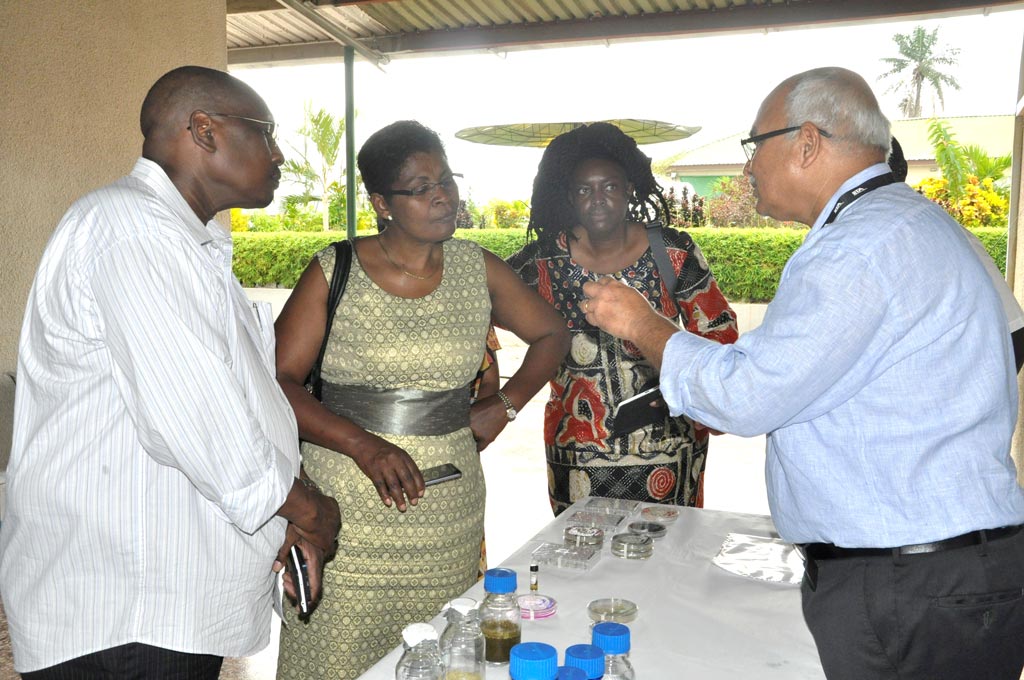
The delegation was taken through the process of Aflasafe production by the various members of the project. Ranajit Bandyopadhyay, IITA pathologist and Aflasafe project leader, walked the group through a brief background on identifying regional strains and the development of regional products. Aflasafe Process Engineer, Lawrence Kaptoge, who is supervising the construction of the Modular Manufacturing Plant in Katumani, explained the Aflasafe manufacturing and quality control processes. The visitors were impressed by the Aflasafe factory and the new Aflasafe lab. Alejandro Ortega-Beltran, IITA plant pathologist, drew attention to IITA’s efforts to develop a new formulation of Aflasafe using pellets of cassava peel (in partnership with the International Livestock Research Institute, ILRI), which would incorporate the use of industrial waste and significantly decrease the cost of the final product, making it more appealing to farmers.
An indirect benefit of AflasafeTM, the KALRO delegation learned during the field visit, was the adoption of improved agronomical practices of farmers using the product. Deji Degun, a private implementer that liaises between IITA and over 500 farmers on the AgResults-Aflasafe project, noted an increased attention to better agronomical practices by farmers who used the product. According to him, the results were cleaner and aflatoxin-free yield that fetched premium prices. Ganiyu Mutahiru, a maize and cassava farmer who works with Degun, acknowledged this and expressed satisfaction about the product. Mutahiru now trains 19 other farmers on how to effectively use AflasafeTM.
During the wrap-up session, a draft Technology Transfer Agreement was discussed specifically about manufacturing and commercialization of Aflasafe in Kenya. The KALRO leadership team said that during the familiarization visit on aflatoxin research, they were impressed by the breadth and depth of IITA’s research in different areas. KALRO identified several opportunities for collaboration with IITA in addition to Aflasafe. These include exchange of materials and technologies on NoduMax, maize, banana/plantain, yam, Bambara groundnut, cowpea, food processing, and soil fertility. They were equally impressed with the IITA BIP and Youth Agripreneurs. Victor Manyong, Director of IITA East Africa, was also present during the wrap-up session.
The IITA-KALRO partnership on Aflasafe production in Kenya will see more Kenyan farmers having access to AflasafeTM and decreased levels of aflatoxin contamination. IITA will play a prominent role in this process particularly in ensuring the high quality of the final product. Production of Aflasafe in Kenya will begin by the end of the year.
The Director General, Eliud Kiplomo Kireger; the Deputy Director General in charge of crops, Felister Mambugha Makini; and the Director of Cropping Systems, Lusike Wasilwa comprised the KALRO leadership team. They were accompanied by Charity Mutegi, IITA East Africa Aflasafe Coordinator based in Kenya.
The three-day visit, held 2-4 May, included a comprehensive tour of the Aflasafe factory and other start-up businesses in the Business Incubation Platform (BIP) in IITA-Ibadan, meeting with IITA Youth Agripreneurs, and discussions with leaders of the various crop improvement units, Genebank, soil fertility unit, and food processing unit. They also visited the farm of an AflasafeTM adopter to listen to his experiences.
Welcoming the delegation, Kenton Dashiell, Deputy Director General, Partnerships and Capacity Development, IITA, noted the importance of Kenya starting to produce its own Aflasafe requirements.
The country suffers from high levels of aflatoxins – a carcinogenic fungal toxin that can be controlled by Aflasafe. In recent years, Kenya has experienced multiple aflatoxicosis outbreaks, often resulting in fatalities. Aflasafe, a biocontrol product, reduces aflatoxin contamination by as much as 80 to 99%. “(Kenya) is a place where it is needed more than anywhere else in the world,” Dashiell stated.
The delegation was taken through the process of Aflasafe production by the various members of the project. Ranajit Bandyopadhyay, IITA pathologist and Aflasafe project leader, walked the group through a brief background on identifying regional strains and the development of regional products. Aflasafe Process Engineer, Lawrence Kaptoge, who is supervising the construction of the Modular Manufacturing Plant in Katumani, explained the Aflasafe manufacturing and quality control processes. The visitors were impressed by the Aflasafe factory and the new Aflasafe lab. Alejandro Ortega-Beltran, IITA plant pathologist, drew attention to IITA’s efforts to develop a new formulation of Aflasafe using pellets of cassava peel (in partnership with the International Livestock Research Institute, ILRI), which would incorporate the use of industrial waste and significantly decrease the cost of the final product, making it more appealing to farmers.
An indirect benefit of AflasafeTM, the KALRO delegation learned during the field visit, was the adoption of improved agronomical practices of farmers using the product. Deji Degun, a private implementer that liaises between IITA and over 500 farmers on the AgResults-Aflasafe project, noted an increased attention to better agronomical practices by farmers who used the product. According to him, the results were cleaner and aflatoxin-free yield that fetched premium prices. Ganiyu Mutahiru, a maize and cassava farmer who works with Degun, acknowledged this and expressed satisfaction about the product. Mutahiru now trains 19 other farmers on how to effectively use AflasafeTM.
During the wrap-up session, a draft Technology Transfer Agreement was discussed specifically about manufacturing and commercialization of Aflasafe in Kenya. The KALRO leadership team said that during the familiarization visit on aflatoxin research, they were impressed by the breadth and depth of IITA’s research in different areas. KALRO identified several opportunities for collaboration with IITA in addition to Aflasafe. These include exchange of materials and technologies on NoduMax, maize, banana/plantain, yam, Bambara groundnut, cowpea, food processing, and soil fertility. They were equally impressed with the IITA BIP and Youth Agripreneurs. Victor Manyong, Director of IITA East Africa, was also present during the wrap-up session.
The IITA-KALRO partnership on Aflasafe production in Kenya will see more Kenyan farmers having access to AflasafeTM and decreased levels of aflatoxin contamination. IITA will play a prominent role in this process particularly in ensuring the high quality of the final product. Production of Aflasafe in Kenya will begin by the end of the year.
Ranajit Bandyopadhyay (right) explains Aflasafe production to KALRO management team
Contributed by
Recent stories
No items found