
IITA launches state of the art AgResults-Aflasafe laboratory at the BIP
May 21, 2016
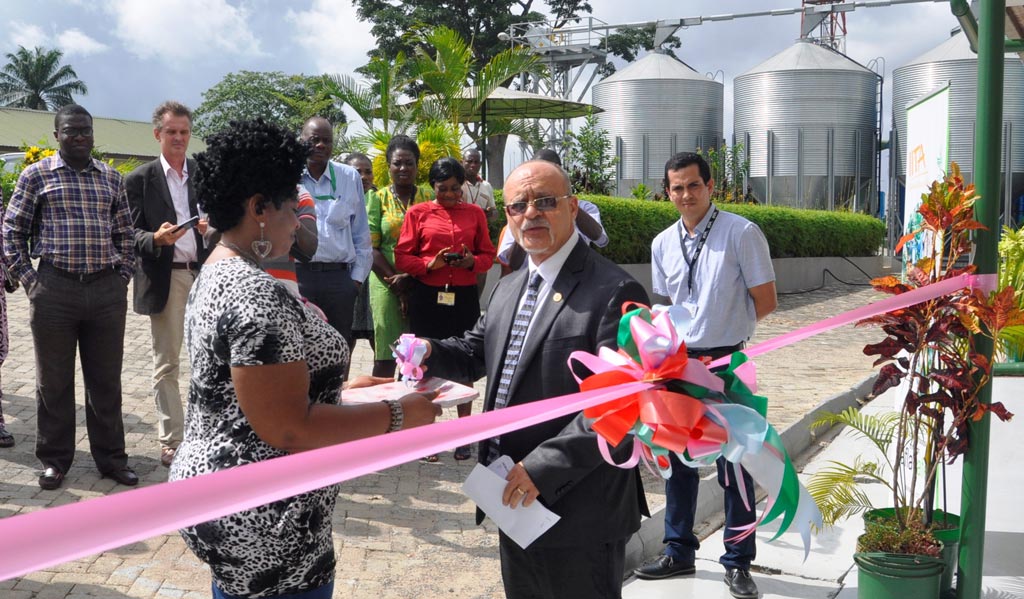
The AgResults-Aflasafe laboratory built exclusively for the study of aflatoxin in Africa was officially launched on 6 May by Kenton Dashiell, Deputy Director General for Partnership and Capacity Development. The foundation brick of this lab was laid by IITA Director General Nteranya Sanginga on 24 March 2015.
 The AgResults-Aflasafe project works with private and public sector enterprises (also called implementers) which provide inputs and farm services including AflasafeTM to their constituent farmers at cost. The project pays incentives to farmers and implementers when their crops are verified to contain a high frequency of Aflasafe strains, the tell-tale sign that the product was appropriately applied on the crop.
The new laboratory was built to cope with the large number of samples that required rapid microbial, DNA and chemical verification tests for payment of incentives to Aflasafe adopters by the AgResults-Aflasafe project. Built exclusively for the verification of AflasafeTM usage in the AgResults project, the laboratory will also serve to develop Aflasafe products for other countries after completion of the AgResults-Aflasafe initiative. This will accelerate the scaling up of Aflasafe and help in greatly reducing the aflatoxin burden in Africa. “Looking at the big picture of helping greatly reduce and eradicate aflatoxin in Africa, this is a very historic day,” observed Dashiell during the launch ceremony.
Dashiell was joined by IITA management, staff, and a donor representative for a tour of the new facility. Alejandro Ortega, an IITA plant pathologist speaking on behalf of Ranajit Bandyopadhyay, the senior IITA plant pathologist and Aflasafe team leader, stated that “With this laboratory, much effort will go to develop effective biocontrol agents for target regions that will allow farmers to produce healthy crops and gain better income. The laboratory will allow us conduct research to both have a better understanding of the aflatoxin contamination process and design better aflatoxin management strategies”. IITA’s flagship biocontrol product, Aflasafe, reduces aflatoxin contamination by 80-99%. One annual application provides multiple years and multiple crop benefits. Health and economic benefits are achieved through the use of Aflasafe. The laboratory will be committed to furthering research on Aflasafe.
The laboratory will provide ample space for a larger number of visiting researchers who will join to study different aspects of the aflatoxin contamination process and the methods used to reduce aflatoxin contamination. The training of significantly more national and international researchers will aid in reducing the aflatoxin problem in Nigeria and throughout Africa. On this note, Debo Akande, the AgResults Aflasafe Pilot Manager, speaking on behalf of the project’s donors, stated: “The said the laboratory was primary built to help with the verification process of the AgResults samples; however, we expect this particular lab to help increase the knowledge of the national partners on the issue of aflatoxin. This is not just for Nigeria; this is for all of Africa”.
Lawrence Kaptoge, the Engineer in charge, and Benito Zeledon Factory supervisor, provided information on summary costs and savings that enabled Aflasafe to construct two DNA labs and purchase lab furniture that were not in the initial budget. They walked the group through the Laboratory and elaborated on the building’s top-of-the-line finishing. “The antimicrobial tops and seamless flooring inhibit growth of fungus and bacteria”, stated Kaptoge. Ibrahim Sheriff, who was the lead architect, IITA, also joined the tour.
The Aflasafe laboratory is funded by AgResults, a multi-donor and multi-lateral initiative supported by The Gates Foundation, USAID, UK DFID, Canada Finance, AUSAID through Deloitte Consulting LLP on behalf of the World Bank.
The AgResults-Aflasafe project works with private and public sector enterprises (also called implementers) which provide inputs and farm services including AflasafeTM to their constituent farmers at cost. The project pays incentives to farmers and implementers when their crops are verified to contain a high frequency of Aflasafe strains, the tell-tale sign that the product was appropriately applied on the crop.
The new laboratory was built to cope with the large number of samples that required rapid microbial, DNA and chemical verification tests for payment of incentives to Aflasafe adopters by the AgResults-Aflasafe project. Built exclusively for the verification of AflasafeTM usage in the AgResults project, the laboratory will also serve to develop Aflasafe products for other countries after completion of the AgResults-Aflasafe initiative. This will accelerate the scaling up of Aflasafe and help in greatly reducing the aflatoxin burden in Africa. “Looking at the big picture of helping greatly reduce and eradicate aflatoxin in Africa, this is a very historic day,” observed Dashiell during the launch ceremony.
Dashiell was joined by IITA management, staff, and a donor representative for a tour of the new facility. Alejandro Ortega, an IITA plant pathologist speaking on behalf of Ranajit Bandyopadhyay, the senior IITA plant pathologist and Aflasafe team leader, stated that “With this laboratory, much effort will go to develop effective biocontrol agents for target regions that will allow farmers to produce healthy crops and gain better income. The laboratory will allow us conduct research to both have a better understanding of the aflatoxin contamination process and design better aflatoxin management strategies”. IITA’s flagship biocontrol product, Aflasafe, reduces aflatoxin contamination by 80-99%. One annual application provides multiple years and multiple crop benefits. Health and economic benefits are achieved through the use of Aflasafe. The laboratory will be committed to furthering research on Aflasafe.
The laboratory will provide ample space for a larger number of visiting researchers who will join to study different aspects of the aflatoxin contamination process and the methods used to reduce aflatoxin contamination. The training of significantly more national and international researchers will aid in reducing the aflatoxin problem in Nigeria and throughout Africa. On this note, Debo Akande, the AgResults Aflasafe Pilot Manager, speaking on behalf of the project’s donors, stated: “The said the laboratory was primary built to help with the verification process of the AgResults samples; however, we expect this particular lab to help increase the knowledge of the national partners on the issue of aflatoxin. This is not just for Nigeria; this is for all of Africa”.
Lawrence Kaptoge, the Engineer in charge, and Benito Zeledon Factory supervisor, provided information on summary costs and savings that enabled Aflasafe to construct two DNA labs and purchase lab furniture that were not in the initial budget. They walked the group through the Laboratory and elaborated on the building’s top-of-the-line finishing. “The antimicrobial tops and seamless flooring inhibit growth of fungus and bacteria”, stated Kaptoge. Ibrahim Sheriff, who was the lead architect, IITA, also joined the tour.
The Aflasafe laboratory is funded by AgResults, a multi-donor and multi-lateral initiative supported by The Gates Foundation, USAID, UK DFID, Canada Finance, AUSAID through Deloitte Consulting LLP on behalf of the World Bank.
DDG Kenton Dashiell cuts the ribbon to launch the new AgResults Aflasafe laboratory at the Business Incubation Platform, Ibadan
Contributed by
Recent stories
No items found