NEWS

Special feature: IITA long-term trials validate ISFM benefits
February 19, 2016
Integrated Soil Fertility Management: Contributions of framework and practices to climate- smart agriculture

Integrated Soil Fertility Management: Contributions of framework and practices to climate-smart agriculture

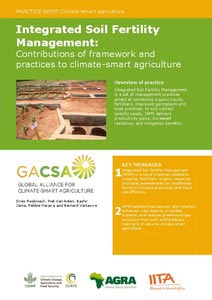
IITA researchers working together with other scientists have shown that food security, crop yields and farmers’ livelihoods; the resilience of cropping systems to climatic change impacts; and mitigation of greenhouse gas (GHG) emissions derived from fertilizer or soil are significantly enhanced when Integrated Soil Fertility Management (ISFM) is practiced during production. To achieve these, stakeholders in agriculture advocate a shift in agro-practices to production systems that are “climate smart”. This means systems that are more productive, use inputs more efficiently, and are more responsive to local climate and socioeconomic conditions while also contributing to address climate change. The ISFM system – a set of agro-practices adapted to local conditions for increasing production and the efficiency of inputs – is one such system which decades of research show as being able to satisfy the goals of Climate Smart Agriculture (CSA). ISFM promotes the systematic combination of both organic and inorganic inputs, improved germplasm, and sound agronomic practices as the best fit technology to successfully increase agricultural production and achieve food and nutrition security especially for poor smallholder farmers in developing countries relying on rainfed agriculture for their livelihoods. The technology is anchored on the germplasm of crops and use of inorganic fertilizer; organic resource management; and other limitations to productivity such as soil acidity, erosion, pests and diseases. These pillars make ISFM invaluable to CSA. IITA researchers carried out a 20-year trial in Nigeria to show the benefits of ISFM on all dimensions of CSA. In the study, reduced rates of nitrogen phosphorus potassium (NPK) fertilizer application to maize crops and input of nitrogen-rich organic residues were employed while rotating maize and cowpea. The technology produced a much higher and better quality harvest for cultivated maize and cowpea. The study also demonstrates a cost-effective and environmentally friendlier alternative to boosting food security and generating wealth compared to lone use of synthetic chemical pesticides. ISFM practices of combining fertilizers with organic input showed an average maize productivity of 2.8 t/ha versus 1.7 t/ha when only fertilizers were used. Cowpea yielded about 1.2 t/ha under the ISFM system compared to 0.7 t/ha when no organic inputs were made. The study further showed that the variability in maize grain yields between growing seasons was reduced by 63% in the ISFM system whereas soil carbon content was almost double under non-ISFM farming practices, demonstrating that ISFM practice does indeed mitigate GHG emissions. Details of the study are contained in a report by the Global Alliance for Climate-Smart Agriculture (GACSA) titled “Integrated Soil Fertility Management: Contributions of framework and practices to climate-smart agriculture.” The report, authored by D RoobroeckP Van Asten, B Jama, R Harawa, and B Vanlauwe, elaborates on and serves as a guidebook for the practice of ISFM as well as identifies and proposes solutions to adoption barriers. Even though the benefits of ISFM practice are demonstrably clear, adoption and maintenance rates remain very low across sub-Saharan Africa. The report identifies contributory factors that include high transaction costs, inadequate access to input/output and credit markets, land size and property rights issues, poor information dissemination systems, non-existent agricultural extension services, and a paucity of government and donor-funded projects. The solution to these challenges may, however, lie in replicating across sub-Saharan Africa, an experiment facilitated by the Clinton Development Initiative (CDI) and Alliance for a Green Revolution in Africa (AGRA) to upscale ISFM in Malawi. The program which combines maize-soybean rotations with strategic use of NPK fertilizers employs a model that brings different participants in the value chain together, facilitating close relationships and enabling better access by smallholder farmers to information, input/output, and credit markets. As a result, average maize and soybean yields have increased by 140% and 86%, respectively, in three years while women make up about 50% of the 18,000 smallholder farmers to have adopted the ISFM practice. Another 30,000 farmers, half of which are women, are currently being trained on ISFM practices and a total of 9,906 hectares of land have been converted to the ISFM system. This demonstrates that accelerating adoption rates of ISFM across the region will ensure that smallholder farmers can secure their food and nutrition needs and enhance their incomes in the face of climate change.

Contributed by

Recent stories

No items found

Leave a Reply

Your email address will not be published. Required fields are marked *

Scroll to Top
Olaosebikan, Olamide

Olamide Deborah Nwanze is a Senior Research Associate specializing in gender mainstreaming research to inform participatory and inclusive breeding, variety development, and seed systems policies regarding root, tuber, and banana (RTB) crops in the International Institute of Tropical Agriculture Headquarters, Ibadan, Nigeria. She is a PhD candidate at the University of Ibadan and holds an MSc and B. Agric in Agricultural Extension and Rural Development. Olamide is a fellow of the African Women in Agricultural Research and Development – Gender Responsive Agricultural Systems Policy (AWARD-GRASP) and the Gender Responsive Researchers Equipped for Agricultural Transformation (GREAT). She seeks to apply her gender-mainstreaming learnings, gender-responsive research, and policy development, and review expertise to facilitate women, youth, children, and vulnerable social group’s access to and adoption of agricultural Innovations that guarantee food, nutrition, income, and livelihood security in Africa. Her current roles include mentoring research fellows, development of guides and training manuals, implementation and adaptation of gender frameworks and tools, value chain actors’ engagement as citizen science partners, policy review and redesign, data management, and analysis. Her current research explores mixed methods and participatory and interdisciplinary approaches to capture and highlight gender dynamics, needs, preferences, and challenges stakeholders face within the agricultural livelihood value chain to prioritize gender-inclusive strategies in breeding programs, policy design, and implementation.

At IITA, she contributes to the implementation of the CGIAR Accelerated Breeding Initiative and Genetic Innovation Programs; participatory and gender research within the NextGen CassavaHarvestPlusRTBFoods, and Tricot-ClimMob 1000Farms Projects; and gender knowledge communication via the G-LENS webinar series, video documentary, policy briefspublications, and blogs.


Recent publications

de Sousa, K., van Etten, J., Manners, R. Bello, A., Teeken, B., Olaosebikan, O., et al. 2024. The tricot approach: an agile framework for decentralized on-farm testing supported by citizen science. A retrospective. Agron. Sustain. Dev. 44, 8. https://doi.org/10.1007/s13593-023-00937-1

Madu, T., Onwuka, S., Nwafor, S., Onyemauwa, N., Ejechi, M., Ofoeze, M., Ukeje, B., Eluagu, C., Olaosebikan, O., Okoye, B., 2024. Gender-Inclusive Consumer Studies Improve Cassava Breeding in Nigeria in: Frontiers in Sociology, volume 9, number: 1224504, doi: 10.3389/fsoc.2024.1224504

Olaosebikan, O.; Bello, A.; Utoblo, O.; Okoye, B.; Olutegbe, N.; Garner, E.; Teeken, B.; Bryan, E.; Forsythe, L.; Cole, S.; Madu, T. 2023.  Stressors and Resilience within the Cassava Value Chain in Nigeria: Preferred Cassava Variety Traits and Response Strategies of Men and Women to Inform Breeding. Sustainability 15, 7837. https://doi.org/10.3390/su15107837

Okoye, B., Ofoeze, M., Ejechi, M., Onwuka, S., Nwafor, S., Onyemauwa, N., Ukeje, B., Eluagu, C., Obidiegwu, J.*, Olaosebikan, O., Madu, T.* 2023. Prioritizing preferred traits in the yam value chain in Nigeria: a gender situation analysis in: Frontiers in Sociology, volume 8, number: 1232626, pages 1 – 9, ISSN 2297-7775, 2023. https://www.frontiersin.org/articles/10.3389/fsoc.2023.1232626/full

Olaosebikan, O., Bello, A. A., de Sousa, K., Ndjouenkeu, R., Adesokan, M., Alamu, E. O., Agbona, A., van Etten, J., Kegah, F. N.*, Dufour, D., Bouniol, A., Teeken, B. 2023. Consumer acceptability of cassava gari-eba food products across cultural and environmental settings using the triadic comparison of technologies approach (tricot) in: Journal of the Science of Food and Agriculture,

Teeken, B., Olaosebikan, O., Bello, A. A., Madu, T.*, Cole, S. M. 2023. Qualitative assessment on the positionality and preferences of dyads in relation to cassava-related activities: working with tricot trial citizen scientists https://hdl.handle.net/10568/138326 Type: Manual

Bouniol, A., Ceballos, H., Bello, A. A., Teeken, B., Olaosebikan, O., Owoade, D., Agbona, A., Fotso Kuate, A., Madu, T.*, Okoye, B.*, Ofoeze, M.*, Nwafor, S.*, Onyemauwa, N.*, Adinsi, L.*, Forsythe, L., Dufour, D. 2023. Varietal impact on women’s labour, workload and related drudgery in processing root, tuber and banana crops: focus on cassava in sub-Saharan Africa in: Journal of the Science of Food and Agriculture, pages 1 – 25, ISSN 0022-5142,

Bello, A. A., Agbona, A., Olaosebikan, O., Edughaen, G., Dufour, D., Bouniol, A., Iluebbey, P., Ndjouenkeu, R.*, Rabbi, I. Y., Teeken, B. 2023. Genetic and environmental effects on processing productivity and food product yield: drudgery of women’s work in: Journal of the Science of Food and Agriculture, pages 1 – 32, ISSN 0022-5142, 5

Cavicchioli, M., Zimbiti, T., Teeken, B., Nwanze, D.O., Liani, M., Parkes, E. & Bello, A. 2023. IITA-Gender Responsive Breeding Training Report. Genetic Resources Center, IITA-HQ, Ibadan, 21-23 September, 2022. Ibadan, Nigeria: IITA, (34 p.).https://hdl.handle.net/10568/131368

Agbona, A. Peteti P., Teeken B., Olaosebikan O. Bello, A. A., Parkes, E., Rabbi, I. Y., Mueller, L., Egesi, C., Kulakow, P. 2022. Data Management in Multi-disciplinary African RTB Crop Breeding Programs. In: Williamson, H.F., Leonelli, S. (eds) Towards Responsible Plant Data Linkage: Data Challenges for Agricultural Research and Development. Springer, Cham. https://doi.org/10.1007/978-3-031-13276-6_5

Lora Forsythe, Pricilla Marimo, Sarah Mayanja, Olamide D. Olaosebikan, Esme Stuart, Bela Teeken, Benjamin Okoye, Tessy Madu, (2021). Cross-product Gender Analysis of RTBfoods Step 2 Gendered Food Mapping on RTB Products. Understanding the Drivers of Trait Preferences and the Development of Multi-user RTB Product Profiles, WP1. London, UK: RTBfoods Field Scientific Report, 30 p.

Teeken, B., Garner, E., Agbona, A., Balogun, I., Olaosebikan, O., Bello, A., Madu, T., Okoye, B., Egesi, C., Kulakow, P. and Tufan, H.A. 2021. Beyond “Women’s Traits”: Exploring How Gender, Social Difference, and Household Characteristics Influence Trait Preferences. Frontiers Sustainable Food Systems 5:740926. https://doi.org/10.3389/fsufs.2021.740926

Teeken, B., Agbona, A., Bello, A., Olaosebikan, O., Alamu, E., Adesokan, M., Awoyale, W., Madu, T., Okoye, B., Chijioke, U., Owoade, D., Okoro, M., Bouniol, A., Dufour, D., Hershey, C., Rabbi, I., Maziya‐Dixon, B., Egesi, C., Tufan, H. and Kulakow, P. (020. Understanding cassava varietal preferences through pairwise ranking of gari‐eba and fufu prepared by local farmer–processors. Int J Food Sci Technol. https://doi.org/10.1111/ijfs.14862

Bela Teeken, Olamide Olaosebikan, Ireti Balogun, Benjamin Okoye, Tessy Madu, Steven Cole, Abolore Bello, Elizabeth Parkes. (2020). Piloting the G+ customer and product profile tools for gender-responsive cassava breeding in Nigeria. Nigeria: International Institute of Tropical Agriculture (IITA). https://hdl.handle.net/20.500.11766/13000