
Ugandan Agric Ministry pioneer development of climate change mainstreaming guidelines
February 19, 2016
The Ugandan Ministry of Agriculture, Animal Industry and Fisheries (MAAIF), with support from IITA-led Policy Action for Climate Change Adaptation (PACCA) project, and USAID Feed the Future Enabling Environment for Agriculture (USAID-EEA), organized a national level stakeholder workshop to validate the recently developed Climate Change Mainstreaming Guidelines for the Agricultural Sector in Uganda.
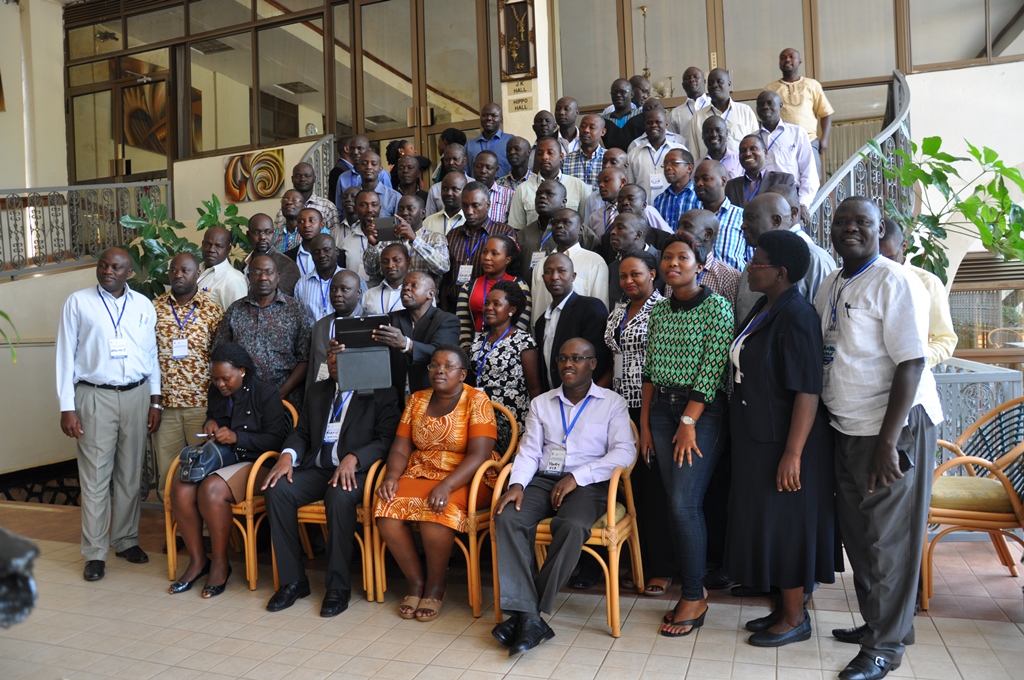 The validation workshop was held on 29 January in Mukono. Stakeholders from government ministries, departments, and agencies, farmer organizations, civil society organizations, private sector, development partners, research institutions, academia, and the media attended.
“MAAIF recognizes that climate change impacts can only be tackled through collaborative efforts,” Sunday Mutabaazi, chairperson of the MAAIF climate change task force, said in his opening remarks.
The guidelines are in line with the national ones developed by the National Planning Authority (NPA) in partnership with Climate Change Department (CCD) in 2014 to harmonize sector specific guidelines and ensure that they are aligned to national development plans.
The draft agriculture sector guidelines were developed through a consultative bottoms-up approach led by MAAIF that took nearly a year starting in November 2014.
During the validation workshop, the participants, grouped by subsectors (crop, livestock, and fisheries), scrutinized the document and gave their inputs.
Their feedback will be consolidated and integrated into the draft guidelines to be approved by the ministry, and rolled out for implementation by different climate change participants.
“Once validated, stakeholders at all levels should ensure that the guidelines are implemented,” said Chebet Maikut, commissioner, Climate Change Department, Ministry of Water and Environment. He appealed to the districts that had not integrated climate change into their District Development Plans to urgently do so.
The guidelines will facilitate mainstreaming of climate change issues into the agriculture sector policies, plans, programs, and activities by providing basic and flexible guidance on entry points. They also include basic steps and tools on how to mainstream climate change adaptation into agriculture policy processes.
PACCA is a CGIAR Research Program on Climate Change, Agriculture and Food Security (CCAFS) flagship project (policies and institutions) implemented by IITA, the International Center for Tropical Agriculture (CIAT), the World Agroforestry Centre (ICRAF), the International Livestock Research Institute (ILRI), and Bioversity International.
The validation workshop was held on 29 January in Mukono. Stakeholders from government ministries, departments, and agencies, farmer organizations, civil society organizations, private sector, development partners, research institutions, academia, and the media attended.
“MAAIF recognizes that climate change impacts can only be tackled through collaborative efforts,” Sunday Mutabaazi, chairperson of the MAAIF climate change task force, said in his opening remarks.
The guidelines are in line with the national ones developed by the National Planning Authority (NPA) in partnership with Climate Change Department (CCD) in 2014 to harmonize sector specific guidelines and ensure that they are aligned to national development plans.
The draft agriculture sector guidelines were developed through a consultative bottoms-up approach led by MAAIF that took nearly a year starting in November 2014.
During the validation workshop, the participants, grouped by subsectors (crop, livestock, and fisheries), scrutinized the document and gave their inputs.
Their feedback will be consolidated and integrated into the draft guidelines to be approved by the ministry, and rolled out for implementation by different climate change participants.
“Once validated, stakeholders at all levels should ensure that the guidelines are implemented,” said Chebet Maikut, commissioner, Climate Change Department, Ministry of Water and Environment. He appealed to the districts that had not integrated climate change into their District Development Plans to urgently do so.
The guidelines will facilitate mainstreaming of climate change issues into the agriculture sector policies, plans, programs, and activities by providing basic and flexible guidance on entry points. They also include basic steps and tools on how to mainstream climate change adaptation into agriculture policy processes.
PACCA is a CGIAR Research Program on Climate Change, Agriculture and Food Security (CCAFS) flagship project (policies and institutions) implemented by IITA, the International Center for Tropical Agriculture (CIAT), the World Agroforestry Centre (ICRAF), the International Livestock Research Institute (ILRI), and Bioversity International.
Group photograph of participants at the workshop
Contributed by
Recent stories
No items found