
NEWS

IITA, Biotalys, and Nigeria’s Ministry of Environment meet to strengthen biocontrol solutions for food security
February 14, 2025


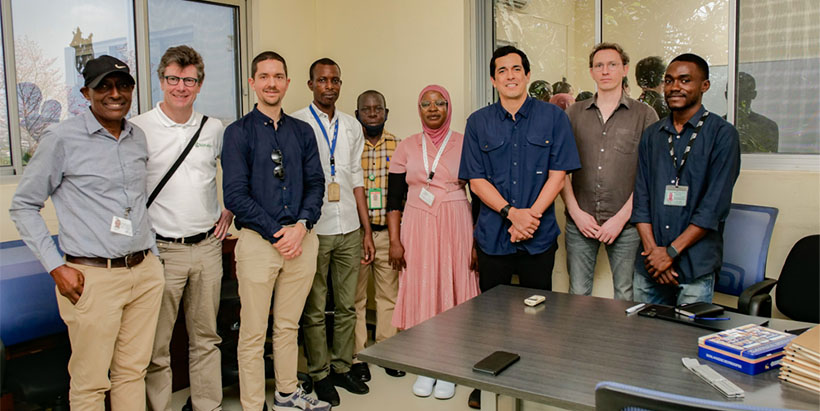
IITA and Biotalys team building on Michael Idu’s presentation on cowpea leaf-spot disease to fine-tune the project activities.

IITACGIAR hosted a three-day visit with scientists from Biotalys and representatives of Nigeria’s Ministry of Environment from 20 to 22 January 2025. The visit aimed to strengthen collaborative efforts in developing protein-based biocontrol solutions to address food security challenges in Nigeria. A key focus of the visit was to track the progress of a research project led by IITA graduate student Michael Iduh. His studies focus on identifying the causal agents of cowpea leaf-spot disease by Cercospora across different agroecological zones in Nigeria. The findings from this research will provide a foundation for developing targeted sustainable biocontrol solutions for cowpea farmers through the cutting-edge protein-based technology of Biotalys. The project involves the exchange of fungal genetic resources, which requires approval from the Ministry of Environment to comply with appropriate Access and Benefits sharing under the Convention of Biodiversity.

Apart from the laboratory activities in Pathology and Mycotoxin/Aflasafe Unit, IITA–CGIAR facilitated interactions with other units for the visiting Biotalys scientists and Ministry of Environment officers. The visitors interacted with scientists from cowpea, maize, yam, cassava breeding programs, and GRC, Virology, and GHU.
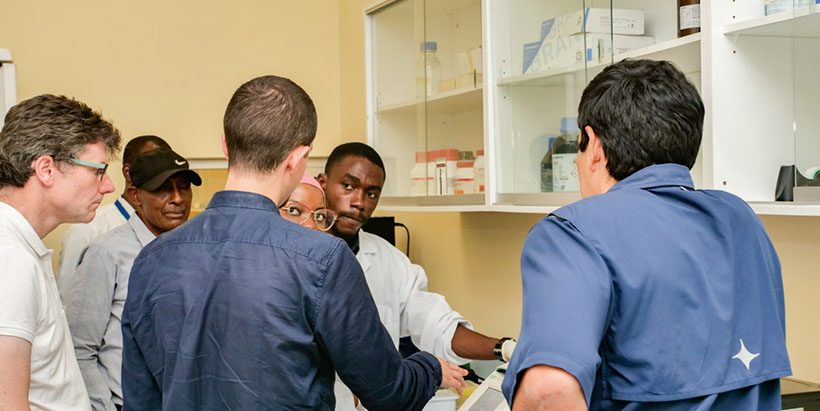
IITA and Biotalys team discussing progress of the project and optimizing laboratory protocols.

Hafsat Adeyemi, Assistant Chief Scientific Officer, Nigeria’s Ministry of Environment, expressed her appreciation for the training and its broad impact. Because of the importance of the project, Adeyemi assured the IITA and Biotalys teams of the delegate’s full support in obtaining the approval of the material transfer permits to facilitate the research work.  In addition, she highlighted the session on aflatoxins in maize and groundnuts as particularly eye-opening, recognizing the importance of mitigating this toxin in Nigerian food systems. “We’ve seen and learned a lot that we will take back with us, one of which is the danger of aflatoxins in maize,” she said. “We assure you of our full support and collaboration with IITA to disseminate crucial information about aflatoxins and IITA’s Aflasafe products to combat it. We can confidently stand as Aflasafe ambassadors now.”

Alejandro Ortega-Beltran, IITA–CGIAR Senior Plant Pathologist, emphasized the need for broader collaboration, proposing roundtable discussions among IITA, Biotalys, the Federal Ministry of Agriculture and Food Security, the Federal Ministry of Health and Social Welfare, and the Federal Ministry of Environment. “Bringing together stakeholders from these ministries will create a more cohesive and effective approach to addressing food security and food safety challenges,” he stated. He also suggested organizing a workshop on cowpea research funded by the Gates Foundation to keep stakeholders informed on cowpea innovations.
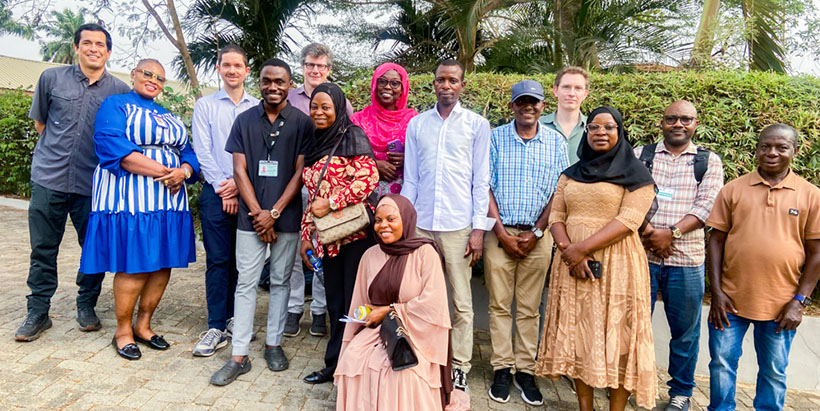
IITA, Biotalys, and the Nigerian Ministry of Environment teams at the end of the 3-day workshop, prepared to advance the project activities.

Carlo Boutton, Biotalys’ Chief Scientific Officer, welcomed the Ministry’s commitment to expediting the permit process. “Allowing the exchange of pathogens and pests for research has long-term economic value. The sooner we can conduct critical research, the sooner we can develop effective solutions that benefit farmers and the wider agricultural industry,” he remarked.

All training participants agreed to continue the collaboration to allow scientific innovations translate into practical solutions for smallholder farmers. As discussions and research progress, this partnership will contribute to deliver an effective, sustainable biocontrol solution to cowpea producers, ultimately improving food security in Nigeria and beyond. Nigerian Ministry of Environment to allow scientific innovations to translate into practical solutions for smallholder farmers. As discussions and research progress, this partnership will contribute to delivering an effective, sustainable biocontrol solution to cowpea producers, ultimately improving food security in Nigeria and beyond.

Contributed by Folake Oduntan and Alejandro Ortega-Beltran

Related Stories:

Aflasafe technology showcased at international, high-level biocontrol events

Transferring aflatoxin biocontrol experiences to partners from Mali, Niger, and Pakistan


Contributed by

Recent stories

No items found

Leave a Reply

Your email address will not be published. Required fields are marked *

Scroll to Top
Olaosebikan, Olamide

Olamide Deborah Nwanze is a Senior Research Associate specializing in gender mainstreaming research to inform participatory and inclusive breeding, variety development, and seed systems policies regarding root, tuber, and banana (RTB) crops in the International Institute of Tropical Agriculture Headquarters, Ibadan, Nigeria. She is a PhD candidate at the University of Ibadan and holds an MSc and B. Agric in Agricultural Extension and Rural Development. Olamide is a fellow of the African Women in Agricultural Research and Development – Gender Responsive Agricultural Systems Policy (AWARD-GRASP) and the Gender Responsive Researchers Equipped for Agricultural Transformation (GREAT). She seeks to apply her gender-mainstreaming learnings, gender-responsive research, and policy development, and review expertise to facilitate women, youth, children, and vulnerable social group’s access to and adoption of agricultural Innovations that guarantee food, nutrition, income, and livelihood security in Africa. Her current roles include mentoring research fellows, development of guides and training manuals, implementation and adaptation of gender frameworks and tools, value chain actors’ engagement as citizen science partners, policy review and redesign, data management, and analysis. Her current research explores mixed methods and participatory and interdisciplinary approaches to capture and highlight gender dynamics, needs, preferences, and challenges stakeholders face within the agricultural livelihood value chain to prioritize gender-inclusive strategies in breeding programs, policy design, and implementation.

At IITA, she contributes to the implementation of the CGIAR Accelerated Breeding Initiative and Genetic Innovation Programs; participatory and gender research within the NextGen CassavaHarvestPlusRTBFoods, and Tricot-ClimMob 1000Farms Projects; and gender knowledge communication via the G-LENS webinar series, video documentary, policy briefspublications, and blogs.


Recent publications

de Sousa, K., van Etten, J., Manners, R. Bello, A., Teeken, B., Olaosebikan, O., et al. 2024. The tricot approach: an agile framework for decentralized on-farm testing supported by citizen science. A retrospective. Agron. Sustain. Dev. 44, 8. https://doi.org/10.1007/s13593-023-00937-1

Madu, T., Onwuka, S., Nwafor, S., Onyemauwa, N., Ejechi, M., Ofoeze, M., Ukeje, B., Eluagu, C., Olaosebikan, O., Okoye, B., 2024. Gender-Inclusive Consumer Studies Improve Cassava Breeding in Nigeria in: Frontiers in Sociology, volume 9, number: 1224504, doi: 10.3389/fsoc.2024.1224504

Olaosebikan, O.; Bello, A.; Utoblo, O.; Okoye, B.; Olutegbe, N.; Garner, E.; Teeken, B.; Bryan, E.; Forsythe, L.; Cole, S.; Madu, T. 2023.  Stressors and Resilience within the Cassava Value Chain in Nigeria: Preferred Cassava Variety Traits and Response Strategies of Men and Women to Inform Breeding. Sustainability 15, 7837. https://doi.org/10.3390/su15107837

Okoye, B., Ofoeze, M., Ejechi, M., Onwuka, S., Nwafor, S., Onyemauwa, N., Ukeje, B., Eluagu, C., Obidiegwu, J.*, Olaosebikan, O., Madu, T.* 2023. Prioritizing preferred traits in the yam value chain in Nigeria: a gender situation analysis in: Frontiers in Sociology, volume 8, number: 1232626, pages 1 – 9, ISSN 2297-7775, 2023. https://www.frontiersin.org/articles/10.3389/fsoc.2023.1232626/full

Olaosebikan, O., Bello, A. A., de Sousa, K., Ndjouenkeu, R., Adesokan, M., Alamu, E. O., Agbona, A., van Etten, J., Kegah, F. N.*, Dufour, D., Bouniol, A., Teeken, B. 2023. Consumer acceptability of cassava gari-eba food products across cultural and environmental settings using the triadic comparison of technologies approach (tricot) in: Journal of the Science of Food and Agriculture,

Teeken, B., Olaosebikan, O., Bello, A. A., Madu, T.*, Cole, S. M. 2023. Qualitative assessment on the positionality and preferences of dyads in relation to cassava-related activities: working with tricot trial citizen scientists https://hdl.handle.net/10568/138326 Type: Manual

Bouniol, A., Ceballos, H., Bello, A. A., Teeken, B., Olaosebikan, O., Owoade, D., Agbona, A., Fotso Kuate, A., Madu, T.*, Okoye, B.*, Ofoeze, M.*, Nwafor, S.*, Onyemauwa, N.*, Adinsi, L.*, Forsythe, L., Dufour, D. 2023. Varietal impact on women’s labour, workload and related drudgery in processing root, tuber and banana crops: focus on cassava in sub-Saharan Africa in: Journal of the Science of Food and Agriculture, pages 1 – 25, ISSN 0022-5142,

Bello, A. A., Agbona, A., Olaosebikan, O., Edughaen, G., Dufour, D., Bouniol, A., Iluebbey, P., Ndjouenkeu, R.*, Rabbi, I. Y., Teeken, B. 2023. Genetic and environmental effects on processing productivity and food product yield: drudgery of women’s work in: Journal of the Science of Food and Agriculture, pages 1 – 32, ISSN 0022-5142, 5

Cavicchioli, M., Zimbiti, T., Teeken, B., Nwanze, D.O., Liani, M., Parkes, E. & Bello, A. 2023. IITA-Gender Responsive Breeding Training Report. Genetic Resources Center, IITA-HQ, Ibadan, 21-23 September, 2022. Ibadan, Nigeria: IITA, (34 p.).https://hdl.handle.net/10568/131368

Agbona, A. Peteti P., Teeken B., Olaosebikan O. Bello, A. A., Parkes, E., Rabbi, I. Y., Mueller, L., Egesi, C., Kulakow, P. 2022. Data Management in Multi-disciplinary African RTB Crop Breeding Programs. In: Williamson, H.F., Leonelli, S. (eds) Towards Responsible Plant Data Linkage: Data Challenges for Agricultural Research and Development. Springer, Cham. https://doi.org/10.1007/978-3-031-13276-6_5

Lora Forsythe, Pricilla Marimo, Sarah Mayanja, Olamide D. Olaosebikan, Esme Stuart, Bela Teeken, Benjamin Okoye, Tessy Madu, (2021). Cross-product Gender Analysis of RTBfoods Step 2 Gendered Food Mapping on RTB Products. Understanding the Drivers of Trait Preferences and the Development of Multi-user RTB Product Profiles, WP1. London, UK: RTBfoods Field Scientific Report, 30 p.

Teeken, B., Garner, E., Agbona, A., Balogun, I., Olaosebikan, O., Bello, A., Madu, T., Okoye, B., Egesi, C., Kulakow, P. and Tufan, H.A. 2021. Beyond “Women’s Traits”: Exploring How Gender, Social Difference, and Household Characteristics Influence Trait Preferences. Frontiers Sustainable Food Systems 5:740926. https://doi.org/10.3389/fsufs.2021.740926

Teeken, B., Agbona, A., Bello, A., Olaosebikan, O., Alamu, E., Adesokan, M., Awoyale, W., Madu, T., Okoye, B., Chijioke, U., Owoade, D., Okoro, M., Bouniol, A., Dufour, D., Hershey, C., Rabbi, I., Maziya‐Dixon, B., Egesi, C., Tufan, H. and Kulakow, P. (020. Understanding cassava varietal preferences through pairwise ranking of gari‐eba and fufu prepared by local farmer–processors. Int J Food Sci Technol. https://doi.org/10.1111/ijfs.14862

Bela Teeken, Olamide Olaosebikan, Ireti Balogun, Benjamin Okoye, Tessy Madu, Steven Cole, Abolore Bello, Elizabeth Parkes. (2020). Piloting the G+ customer and product profile tools for gender-responsive cassava breeding in Nigeria. Nigeria: International Institute of Tropical Agriculture (IITA). https://hdl.handle.net/20.500.11766/13000