
IITA NEWS

Long-lasting biocontrol products empower Africans in the fight against aflatoxins
May 6, 2025

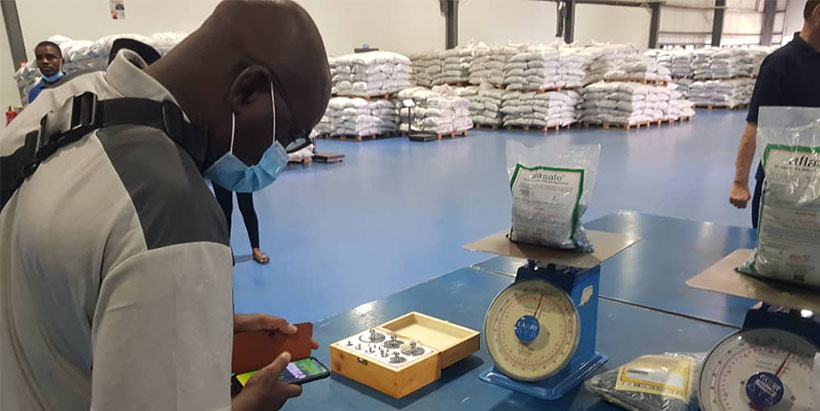
Institute of Rural Economy (IER-Mali) official Mamadou Konate examines a pack of Aflasafe produced by Harvestfield Industries Limited (HIL), the licensed manufacturer and distributor of Aflasafe in Nigeria. During the visit, HIL staff underscored the importance of reliable biocontrol products with long shelf-life in effective aflatoxin mitigation.

Food safety and security threats from aflatoxins have hampered the health and livelihoods of many African consumers and farmers, frequently affecting staples such as maize, groundnut, and sorghum. These harmful toxins are produced by a fungus called Aspergillus flavus and can cause liver cancer, suppress the immune system, and stunt children’s growth. They also make it harder for farmers to sell their crops in global markets, where strict limits are placed on aflatoxin levels.

But scientists have developed an innovative way to fight back, using non-toxic strains of the same fungus to protect crops from dangerous aflatoxin-producing strains. In African countries, biocontrol products under the tradename Aflasafe have been developed by IITACGIAR, USDA-ARS, and national partners. Aflasafe products contain safe versions of A. flavus that are applied to crops in the field, outcompeting their toxic cousins and reducing aflatoxin levels by as much as 100%.

A study published in 2024 (Impact of storage conditions on the shelf life of aflatoxin biocontrol products containing atoxigenic isolates of Aspergillus flavus as active ingredient applied in various countries in Africa) revealed that the products remain stable for long periods. Researchers from IITA and partner organizations found that Aflasafe products can stay effective for up to four years, even when stored in warm conditions. The research explored the long-term stability of biocontrol products designed to mitigate aflatoxin contamination. It evaluated their shelf life and resilience under different storage conditions, confirming their effectiveness in various agricultural environments.

The findings are useful to farmers, manufacturers, and distributors because there is no need for expensive refrigeration to keep these products effective. The biocontrol agents still produce large quantities of spores—the fungal cells that help them spread—even after long storage times.
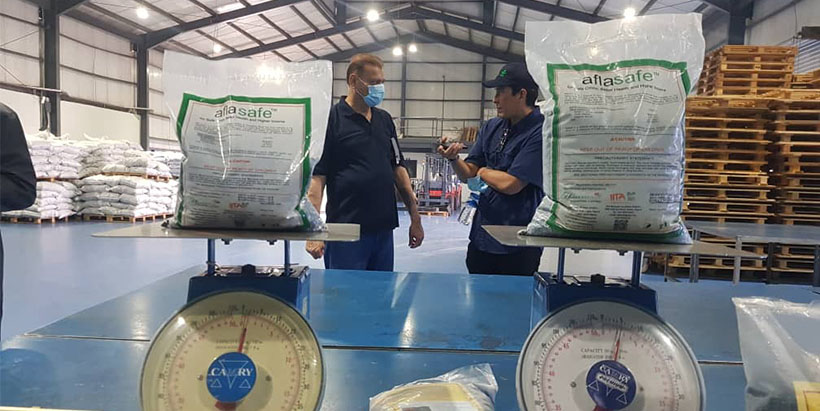
Dr Khalid Aziz from Rafhan Maize Co. Ltd., Pakistan, and Dr Alejandro Ortega-Beltran of IITA discuss during a visit to HIL facility how Aflasafe biocontrol manufacturing processes allow maintaining the long-term stability of Aflasafe—critical for ensuring product effectiveness in diverse storage and distribution conditions.
Dr Khalid Aziz from Rafhan Maize Co. Ltd., Pakistan, and Dr Alejandro Ortega-Beltran of IITA discuss during a visit to HIL facility how Aflasafe biocontrol manufacturing processes allow maintaining the long-term stability of Aflasafe, critical for ensuring product effectiveness in diverse storage and distribution conditions.

This development is important because it makes Aflasafe easier to store and transport, especially in tropical climates where keeping products cool can be complicated and expensive. Since refrigeration is unnecessary, it also means that stockpiles of Aflasafe won’t go to waste if demand is low for a season, ensuring the product is always available when needed.

The study also showed that Aflasafe can withstand high temperatures—up to 54°C (129°F)—for two weeks, simulating the kind of heat the product might experience during transportation. Despite this extreme heat, the product’s ability to produce spores in the required quantity remained unaffected, which gives manufacturers and farmers peace of mind about its reliability.

This research is timely with the growing adoption of biocontrol products to address aflatoxin contamination in Africa. The findings are particularly important for manufacturers, distributors, and policymakers, as they reduce concerns about product expiration and ensure a consistent supply of effective aflatoxin mitigation tools for farmers. With this long-lasting, practical solution in place, the battle against aflatoxins is set to strengthen, leading to safer food supplies and better livelihoods for millions of farmers.

Contributed by Uzoma Agha


Contributed by

Related news

No items found

Leave a Reply

Your email address will not be published. Required fields are marked *

Scroll to Top
Olaosebikan, Olamide

Olamide Deborah Nwanze is a Senior Research Associate specializing in gender mainstreaming research to inform participatory and inclusive breeding, variety development, and seed systems policies regarding root, tuber, and banana (RTB) crops in the International Institute of Tropical Agriculture Headquarters, Ibadan, Nigeria. She is a PhD candidate at the University of Ibadan and holds an MSc and B. Agric in Agricultural Extension and Rural Development. Olamide is a fellow of the African Women in Agricultural Research and Development – Gender Responsive Agricultural Systems Policy (AWARD-GRASP) and the Gender Responsive Researchers Equipped for Agricultural Transformation (GREAT). She seeks to apply her gender-mainstreaming learnings, gender-responsive research, and policy development, and review expertise to facilitate women, youth, children, and vulnerable social group’s access to and adoption of agricultural Innovations that guarantee food, nutrition, income, and livelihood security in Africa. Her current roles include mentoring research fellows, development of guides and training manuals, implementation and adaptation of gender frameworks and tools, value chain actors’ engagement as citizen science partners, policy review and redesign, data management, and analysis. Her current research explores mixed methods and participatory and interdisciplinary approaches to capture and highlight gender dynamics, needs, preferences, and challenges stakeholders face within the agricultural livelihood value chain to prioritize gender-inclusive strategies in breeding programs, policy design, and implementation.

At IITA, she contributes to the implementation of the CGIAR Accelerated Breeding Initiative and Genetic Innovation Programs; participatory and gender research within the NextGen CassavaHarvestPlusRTBFoods, and Tricot-ClimMob 1000Farms Projects; and gender knowledge communication via the G-LENS webinar series, video documentary, policy briefspublications, and blogs.


Recent publications

de Sousa, K., van Etten, J., Manners, R. Bello, A., Teeken, B., Olaosebikan, O., et al. 2024. The tricot approach: an agile framework for decentralized on-farm testing supported by citizen science. A retrospective. Agron. Sustain. Dev. 44, 8. https://doi.org/10.1007/s13593-023-00937-1

Madu, T., Onwuka, S., Nwafor, S., Onyemauwa, N., Ejechi, M., Ofoeze, M., Ukeje, B., Eluagu, C., Olaosebikan, O., Okoye, B., 2024. Gender-Inclusive Consumer Studies Improve Cassava Breeding in Nigeria in: Frontiers in Sociology, volume 9, number: 1224504, doi: 10.3389/fsoc.2024.1224504

Olaosebikan, O.; Bello, A.; Utoblo, O.; Okoye, B.; Olutegbe, N.; Garner, E.; Teeken, B.; Bryan, E.; Forsythe, L.; Cole, S.; Madu, T. 2023.  Stressors and Resilience within the Cassava Value Chain in Nigeria: Preferred Cassava Variety Traits and Response Strategies of Men and Women to Inform Breeding. Sustainability 15, 7837. https://doi.org/10.3390/su15107837

Okoye, B., Ofoeze, M., Ejechi, M., Onwuka, S., Nwafor, S., Onyemauwa, N., Ukeje, B., Eluagu, C., Obidiegwu, J.*, Olaosebikan, O., Madu, T.* 2023. Prioritizing preferred traits in the yam value chain in Nigeria: a gender situation analysis in: Frontiers in Sociology, volume 8, number: 1232626, pages 1 – 9, ISSN 2297-7775, 2023. https://www.frontiersin.org/articles/10.3389/fsoc.2023.1232626/full

Olaosebikan, O., Bello, A. A., de Sousa, K., Ndjouenkeu, R., Adesokan, M., Alamu, E. O., Agbona, A., van Etten, J., Kegah, F. N.*, Dufour, D., Bouniol, A., Teeken, B. 2023. Consumer acceptability of cassava gari-eba food products across cultural and environmental settings using the triadic comparison of technologies approach (tricot) in: Journal of the Science of Food and Agriculture,

Teeken, B., Olaosebikan, O., Bello, A. A., Madu, T.*, Cole, S. M. 2023. Qualitative assessment on the positionality and preferences of dyads in relation to cassava-related activities: working with tricot trial citizen scientists https://hdl.handle.net/10568/138326 Type: Manual

Bouniol, A., Ceballos, H., Bello, A. A., Teeken, B., Olaosebikan, O., Owoade, D., Agbona, A., Fotso Kuate, A., Madu, T.*, Okoye, B.*, Ofoeze, M.*, Nwafor, S.*, Onyemauwa, N.*, Adinsi, L.*, Forsythe, L., Dufour, D. 2023. Varietal impact on women’s labour, workload and related drudgery in processing root, tuber and banana crops: focus on cassava in sub-Saharan Africa in: Journal of the Science of Food and Agriculture, pages 1 – 25, ISSN 0022-5142,

Bello, A. A., Agbona, A., Olaosebikan, O., Edughaen, G., Dufour, D., Bouniol, A., Iluebbey, P., Ndjouenkeu, R.*, Rabbi, I. Y., Teeken, B. 2023. Genetic and environmental effects on processing productivity and food product yield: drudgery of women’s work in: Journal of the Science of Food and Agriculture, pages 1 – 32, ISSN 0022-5142, 5

Cavicchioli, M., Zimbiti, T., Teeken, B., Nwanze, D.O., Liani, M., Parkes, E. & Bello, A. 2023. IITA-Gender Responsive Breeding Training Report. Genetic Resources Center, IITA-HQ, Ibadan, 21-23 September, 2022. Ibadan, Nigeria: IITA, (34 p.).https://hdl.handle.net/10568/131368

Agbona, A. Peteti P., Teeken B., Olaosebikan O. Bello, A. A., Parkes, E., Rabbi, I. Y., Mueller, L., Egesi, C., Kulakow, P. 2022. Data Management in Multi-disciplinary African RTB Crop Breeding Programs. In: Williamson, H.F., Leonelli, S. (eds) Towards Responsible Plant Data Linkage: Data Challenges for Agricultural Research and Development. Springer, Cham. https://doi.org/10.1007/978-3-031-13276-6_5

Lora Forsythe, Pricilla Marimo, Sarah Mayanja, Olamide D. Olaosebikan, Esme Stuart, Bela Teeken, Benjamin Okoye, Tessy Madu, (2021). Cross-product Gender Analysis of RTBfoods Step 2 Gendered Food Mapping on RTB Products. Understanding the Drivers of Trait Preferences and the Development of Multi-user RTB Product Profiles, WP1. London, UK: RTBfoods Field Scientific Report, 30 p.

Teeken, B., Garner, E., Agbona, A., Balogun, I., Olaosebikan, O., Bello, A., Madu, T., Okoye, B., Egesi, C., Kulakow, P. and Tufan, H.A. 2021. Beyond “Women’s Traits”: Exploring How Gender, Social Difference, and Household Characteristics Influence Trait Preferences. Frontiers Sustainable Food Systems 5:740926. https://doi.org/10.3389/fsufs.2021.740926

Teeken, B., Agbona, A., Bello, A., Olaosebikan, O., Alamu, E., Adesokan, M., Awoyale, W., Madu, T., Okoye, B., Chijioke, U., Owoade, D., Okoro, M., Bouniol, A., Dufour, D., Hershey, C., Rabbi, I., Maziya‐Dixon, B., Egesi, C., Tufan, H. and Kulakow, P. (020. Understanding cassava varietal preferences through pairwise ranking of gari‐eba and fufu prepared by local farmer–processors. Int J Food Sci Technol. https://doi.org/10.1111/ijfs.14862

Bela Teeken, Olamide Olaosebikan, Ireti Balogun, Benjamin Okoye, Tessy Madu, Steven Cole, Abolore Bello, Elizabeth Parkes. (2020). Piloting the G+ customer and product profile tools for gender-responsive cassava breeding in Nigeria. Nigeria: International Institute of Tropical Agriculture (IITA). https://hdl.handle.net/20.500.11766/13000