
IITA NEWS

Minister of Communication, Innovation, and Digital Economy explores strategic partnership opportunities with IITA in agriculture
May 9, 2025

As an institute committed to partnerships with both government and the private sector, IITACGIAR was pleased to host Nigeria’s Minister of Communication, Innovation and Digital Economy, Dr Bosun Tijani, at its headquarters in Ibadan on 2 May. The Minister’s visit aimed to explore how digital innovation can be leveraged to transform agricultural outcomes in Nigeria through strategic collaboration between the Ministry and IITA.
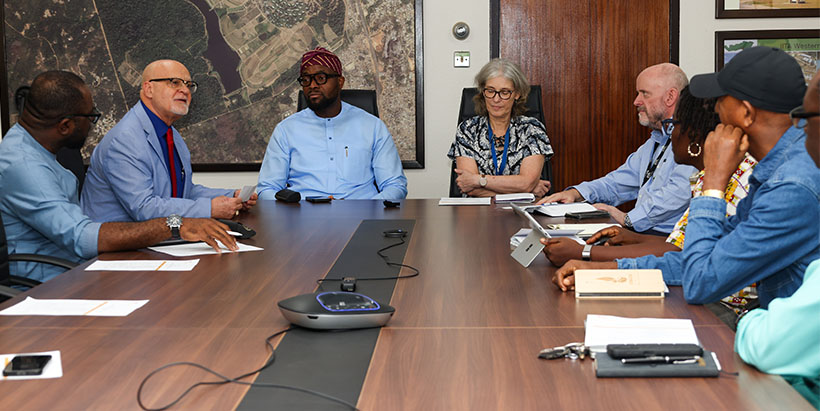
An introductory meeting of IITA to the Minister of Communication, Innovation, and Digital Economy, Dr Bosun Tijani

Welcoming the Minister, Former IITA Deputy Director General, Partnerships for Delivery, Kenton Dashiell, encouraged staff to consider how IITA could support the Ministry’s success. “There is great potential for a strong partnership,” he said, noting Dr Tijani’s dual role as a policymaker and a farmer.

Deputy Director General for Corporate Services, Hilde Koper, introduced IITA’s scope through a documentary highlighting the Institute’s regional activities across sub-Saharan Africa. Senior scientists and program leaders then shared insights into their work. Director for West Africa, Michael Abberton, highlighted the activities of IITA in the West Africa hub, including some of the digital tools developed by the hub, such as the IITA Seed Tracker and other plant health apps aimed at improving farming systems.

Delphine Amah, a Plantain Breeder, highlighted breeding efforts in the plantain and banana programs to improve food security through high-yielding varieties and agronomic practices. Maize Breeder Abebe Menkir emphasized IITA’s release of 78 climate-resilient and nutritious maize varieties, proposing further collaboration to reduce Nigeria’s dependence on imported animal feed.

Head of the IITA Youth in Agribusiness (IYA) program, Tola Adenmosun, showcased how IITA drives youth engagement in agriculture through innovation and strategic partnerships with AFDB, IFAD, and the Mastercard Foundation. “Digital agriculture is changing young people’s perception of the sector,” she noted.
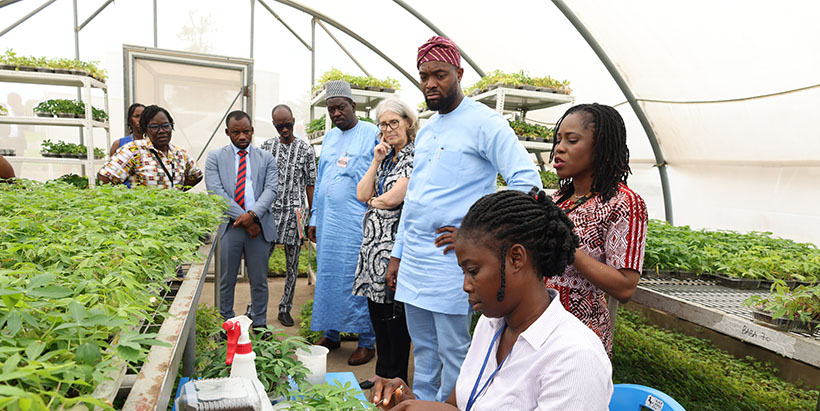
 Tijani visits the Semi-Autotrophic Hydroponics (SAH) cassava greenhouse, as he tours IITA facilities
Tijani visits the Semi-Autotrophic Hydroponics (SAH) cassava greenhouse, as he tours IITA facilities

BIP Head of Administration and Corporate Governance, Wole Oladokun, explained the Business Incubation Platform’s (BIP) role in bridging science and agribusiness through partnerships and entrepreneurial training. Head of IITA’s Communication Office, Katherine Lopez, presented the Institute’s hybrid communication approach, including RadioIITA, IITA TV, and farmer outreach platforms like OGFIMS, which has reached over 160,000 farmers in Ogun State.

In response, Dr Tijani emphasized the critical role of agriculture in Nigeria’s future. “With a growing population, we must prioritize science and research to feed our people and create jobs,” he said, noting that the government had already funded 55 AI-related research projects.

Following a tour of IITA’s facilities—including the Genetic Resources Center, bioscience labs, plantain/banana research site, and the Semi-Autotrophic Hydroponics (SAH) cassava greenhouse—Dr Tijani praised the Institute’s technological innovations. “The work here has the potential to truly contribute to managing the global food crisis,” he remarked.

He expressed enthusiasm for future collaboration, including scaling medium to large-scale farms, leveraging RadioIITA, and adopting IITA’s technologies on his farm. “We are blessed to have you on the continent,” he said.

Dashiell closed the visit by reaffirming IITA’s commitment to supporting the Ministry’s vision for digitally transforming agriculture in Nigeria. This visit begins a promising partnership to empower farmers, enhance productivity, and build resilient food systems.

Contributed by Ochuwa Favour Daramola


Contributed by

Related news

No items found

Leave a Reply

Your email address will not be published. Required fields are marked *

Scroll to Top
Olaosebikan, Olamide

Olamide Deborah Nwanze is a Senior Research Associate specializing in gender mainstreaming research to inform participatory and inclusive breeding, variety development, and seed systems policies regarding root, tuber, and banana (RTB) crops in the International Institute of Tropical Agriculture Headquarters, Ibadan, Nigeria. She is a PhD candidate at the University of Ibadan and holds an MSc and B. Agric in Agricultural Extension and Rural Development. Olamide is a fellow of the African Women in Agricultural Research and Development – Gender Responsive Agricultural Systems Policy (AWARD-GRASP) and the Gender Responsive Researchers Equipped for Agricultural Transformation (GREAT). She seeks to apply her gender-mainstreaming learnings, gender-responsive research, and policy development, and review expertise to facilitate women, youth, children, and vulnerable social group’s access to and adoption of agricultural Innovations that guarantee food, nutrition, income, and livelihood security in Africa. Her current roles include mentoring research fellows, development of guides and training manuals, implementation and adaptation of gender frameworks and tools, value chain actors’ engagement as citizen science partners, policy review and redesign, data management, and analysis. Her current research explores mixed methods and participatory and interdisciplinary approaches to capture and highlight gender dynamics, needs, preferences, and challenges stakeholders face within the agricultural livelihood value chain to prioritize gender-inclusive strategies in breeding programs, policy design, and implementation.

At IITA, she contributes to the implementation of the CGIAR Accelerated Breeding Initiative and Genetic Innovation Programs; participatory and gender research within the NextGen CassavaHarvestPlusRTBFoods, and Tricot-ClimMob 1000Farms Projects; and gender knowledge communication via the G-LENS webinar series, video documentary, policy briefspublications, and blogs.


Recent publications

de Sousa, K., van Etten, J., Manners, R. Bello, A., Teeken, B., Olaosebikan, O., et al. 2024. The tricot approach: an agile framework for decentralized on-farm testing supported by citizen science. A retrospective. Agron. Sustain. Dev. 44, 8. https://doi.org/10.1007/s13593-023-00937-1

Madu, T., Onwuka, S., Nwafor, S., Onyemauwa, N., Ejechi, M., Ofoeze, M., Ukeje, B., Eluagu, C., Olaosebikan, O., Okoye, B., 2024. Gender-Inclusive Consumer Studies Improve Cassava Breeding in Nigeria in: Frontiers in Sociology, volume 9, number: 1224504, doi: 10.3389/fsoc.2024.1224504

Olaosebikan, O.; Bello, A.; Utoblo, O.; Okoye, B.; Olutegbe, N.; Garner, E.; Teeken, B.; Bryan, E.; Forsythe, L.; Cole, S.; Madu, T. 2023.  Stressors and Resilience within the Cassava Value Chain in Nigeria: Preferred Cassava Variety Traits and Response Strategies of Men and Women to Inform Breeding. Sustainability 15, 7837. https://doi.org/10.3390/su15107837

Okoye, B., Ofoeze, M., Ejechi, M., Onwuka, S., Nwafor, S., Onyemauwa, N., Ukeje, B., Eluagu, C., Obidiegwu, J.*, Olaosebikan, O., Madu, T.* 2023. Prioritizing preferred traits in the yam value chain in Nigeria: a gender situation analysis in: Frontiers in Sociology, volume 8, number: 1232626, pages 1 – 9, ISSN 2297-7775, 2023. https://www.frontiersin.org/articles/10.3389/fsoc.2023.1232626/full

Olaosebikan, O., Bello, A. A., de Sousa, K., Ndjouenkeu, R., Adesokan, M., Alamu, E. O., Agbona, A., van Etten, J., Kegah, F. N.*, Dufour, D., Bouniol, A., Teeken, B. 2023. Consumer acceptability of cassava gari-eba food products across cultural and environmental settings using the triadic comparison of technologies approach (tricot) in: Journal of the Science of Food and Agriculture,

Teeken, B., Olaosebikan, O., Bello, A. A., Madu, T.*, Cole, S. M. 2023. Qualitative assessment on the positionality and preferences of dyads in relation to cassava-related activities: working with tricot trial citizen scientists https://hdl.handle.net/10568/138326 Type: Manual

Bouniol, A., Ceballos, H., Bello, A. A., Teeken, B., Olaosebikan, O., Owoade, D., Agbona, A., Fotso Kuate, A., Madu, T.*, Okoye, B.*, Ofoeze, M.*, Nwafor, S.*, Onyemauwa, N.*, Adinsi, L.*, Forsythe, L., Dufour, D. 2023. Varietal impact on women’s labour, workload and related drudgery in processing root, tuber and banana crops: focus on cassava in sub-Saharan Africa in: Journal of the Science of Food and Agriculture, pages 1 – 25, ISSN 0022-5142,

Bello, A. A., Agbona, A., Olaosebikan, O., Edughaen, G., Dufour, D., Bouniol, A., Iluebbey, P., Ndjouenkeu, R.*, Rabbi, I. Y., Teeken, B. 2023. Genetic and environmental effects on processing productivity and food product yield: drudgery of women’s work in: Journal of the Science of Food and Agriculture, pages 1 – 32, ISSN 0022-5142, 5

Cavicchioli, M., Zimbiti, T., Teeken, B., Nwanze, D.O., Liani, M., Parkes, E. & Bello, A. 2023. IITA-Gender Responsive Breeding Training Report. Genetic Resources Center, IITA-HQ, Ibadan, 21-23 September, 2022. Ibadan, Nigeria: IITA, (34 p.).https://hdl.handle.net/10568/131368

Agbona, A. Peteti P., Teeken B., Olaosebikan O. Bello, A. A., Parkes, E., Rabbi, I. Y., Mueller, L., Egesi, C., Kulakow, P. 2022. Data Management in Multi-disciplinary African RTB Crop Breeding Programs. In: Williamson, H.F., Leonelli, S. (eds) Towards Responsible Plant Data Linkage: Data Challenges for Agricultural Research and Development. Springer, Cham. https://doi.org/10.1007/978-3-031-13276-6_5

Lora Forsythe, Pricilla Marimo, Sarah Mayanja, Olamide D. Olaosebikan, Esme Stuart, Bela Teeken, Benjamin Okoye, Tessy Madu, (2021). Cross-product Gender Analysis of RTBfoods Step 2 Gendered Food Mapping on RTB Products. Understanding the Drivers of Trait Preferences and the Development of Multi-user RTB Product Profiles, WP1. London, UK: RTBfoods Field Scientific Report, 30 p.

Teeken, B., Garner, E., Agbona, A., Balogun, I., Olaosebikan, O., Bello, A., Madu, T., Okoye, B., Egesi, C., Kulakow, P. and Tufan, H.A. 2021. Beyond “Women’s Traits”: Exploring How Gender, Social Difference, and Household Characteristics Influence Trait Preferences. Frontiers Sustainable Food Systems 5:740926. https://doi.org/10.3389/fsufs.2021.740926

Teeken, B., Agbona, A., Bello, A., Olaosebikan, O., Alamu, E., Adesokan, M., Awoyale, W., Madu, T., Okoye, B., Chijioke, U., Owoade, D., Okoro, M., Bouniol, A., Dufour, D., Hershey, C., Rabbi, I., Maziya‐Dixon, B., Egesi, C., Tufan, H. and Kulakow, P. (020. Understanding cassava varietal preferences through pairwise ranking of gari‐eba and fufu prepared by local farmer–processors. Int J Food Sci Technol. https://doi.org/10.1111/ijfs.14862

Bela Teeken, Olamide Olaosebikan, Ireti Balogun, Benjamin Okoye, Tessy Madu, Steven Cole, Abolore Bello, Elizabeth Parkes. (2020). Piloting the G+ customer and product profile tools for gender-responsive cassava breeding in Nigeria. Nigeria: International Institute of Tropical Agriculture (IITA). https://hdl.handle.net/20.500.11766/13000