
IITA NEWS

YAS redistributes input equipment to young farmers in Oyo
May 26, 2025

The IITA Youth in Agribusiness (YAS) project has supported trained participants in Oyo State with input and various equipment to facilitate business start-up and expansion in agriculture. The event continues with similar exercises held in Abuja, Kano, and Ogun.
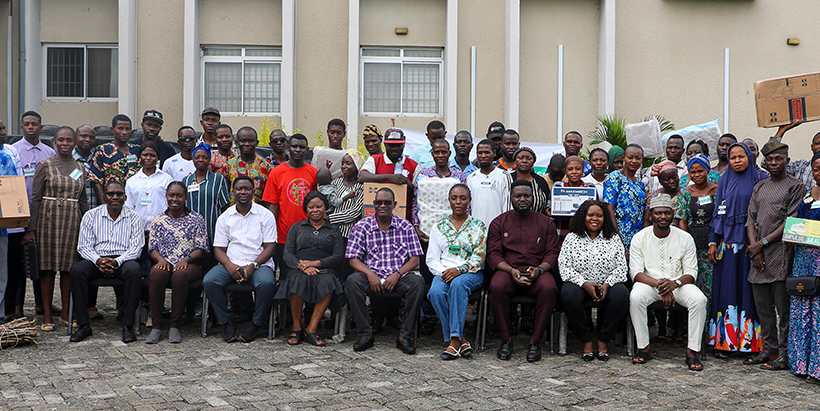
A group photograph of the participants and the IYA team

The support items include a solar irrigation system, rotary slashers, a de-feathering machine, improved cassava stems, fertilizers, Garri fryers, water tanks, vegetable seeds, fish and poultry feed, seedling trays, coco peat, packs of improved maize varieties, generator, irrigation drips, knapsack sprayers, and Garri pressers.

Speaking at the event, Head of IITA Genetic Resources Center (IITA-GRC), Professor Michael Abberton, who represented the Senior Management Team, congratulated the participants for being courageous and dedicated during the training. He advised them to leverage the support network created by the project to move their businesses forward.

He stated, “Engagement of youths in agribusiness has been the IITA Youth Agripreneurs (IYA) focus over the last decade, so this initiative is very important to IITA. In return, your businesses will be able to scale up, in addition to the people you bring into employment by your expansion and the businesses you create. So, congratulations for being part of this. We appreciate the sponsor, the Kingdom of the Netherlands, for supporting young agripreneurs.
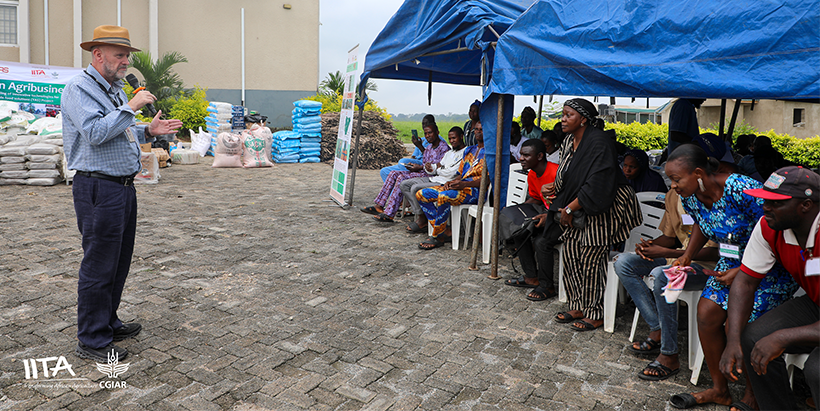
Prof. Michael Abberton, Head of the Genetic Resources Center at IITA, representing the Senior Management Team, addressing the participants

“With your cassava, fish, horticulture, poultry, cassava processing, and other commodities you are involved in, this is a good start. The support network has been created, and I hope you will continue to leverage it to expand your businesses. We look forward to seeing your businesses expand.”

The Chief Executive Officer, IITA Youth Agripreneurs, Aline Mugisho, represented by a Business Development Expert in the unit, Idowu Osun, called on the participants to embrace the coaching and mentorship program for all past project participants.

He added, “We have a large pool of participants year after year with whom you can network, and we have a top-notch coaching and mentorship program that will help you. We encourage you to stay in touch. Feel free to disturb us; that is our work. Agribusiness is big business, and we are here to support you.”

Additionally, the Project Coordinator, Adebayo Awotodunbo, said YAS would continue to sustain its relationship with its participants, adding, “We want the training to translate to enterprises and then to big businesses, which is why we supported you with items that are critical to your agro-businesses.
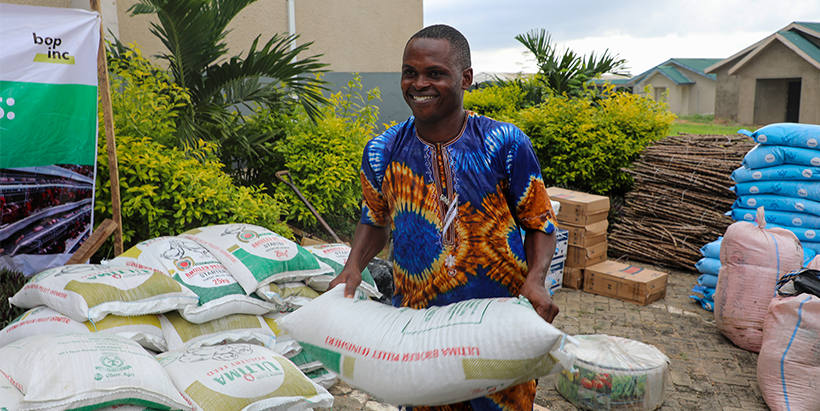
One of the participants carrying one of his items

“We want you to scale up your businesses to get better income and be employers of labor in your communities, and these inputs will help to make it happen. Above that, we want you to contribute to food security in Nigeria.

“We thank the Kingdom of the Netherlands for sponsoring this project. As the monitoring and evaluation team visited all the businesses for evaluation, they will be back to see the level of your utilization of this input and recommend whether we should provide more input. But you are out of the scheme if you have sold the items.”

One of the participants, Kushimo-Festus Oluwakemi, thanked the project for the training and support. She added, “You have impacted us, and we will not let you down. For all the input you have given us today, we promise to make you proud because we will use it wisely, and by the time you come back to check on us, you will be glad you gave us this support.”

The project partners represented at the event included the International Livestock Research Institute (ILRI), HortiNigeria, YSJ Limited, and Farm Help Agro.

Benedict Ukpukpen, who represented HortiNigeria, stated, “We are proud to be part of this impactful initiative, a critical step towards empowering young agripreneurs and strengthening our agricultural value chains. At Horti Nigeria, we believe that access to the right input, knowledge, and network is key to unlocking the potential of youth in transforming agriculture. We encourage you to make the most of them, apply climate-smart practices, and continue to build agribusinesses that contribute to food security, economic growth, and sustainable development.”

In addition, the representative of ILRI, Dr Odekunle, congratulated the IITA and YAS project for the “unrelenting efforts,” adding, “I facilitated some of the training for poultry farmers, and I’m so happy seeing some of the faces in class here. Look at this support as a great opportunity. Using all the things given to you and practicing what you were taught will go a long way in your business. Do not dump the materials given to you, and do not be like those who sell the support they receive. When you practice what you have been trained in, together with this support, it will encourage other young people to embrace agriculture.”

Contributed by Jesutofunmi Robinson


Contributed by

Related news

No items found

Leave a Reply

Your email address will not be published. Required fields are marked *

Scroll to Top
Olaosebikan, Olamide

Olamide Deborah Nwanze is a Senior Research Associate specializing in gender mainstreaming research to inform participatory and inclusive breeding, variety development, and seed systems policies regarding root, tuber, and banana (RTB) crops in the International Institute of Tropical Agriculture Headquarters, Ibadan, Nigeria. She is a PhD candidate at the University of Ibadan and holds an MSc and B. Agric in Agricultural Extension and Rural Development. Olamide is a fellow of the African Women in Agricultural Research and Development – Gender Responsive Agricultural Systems Policy (AWARD-GRASP) and the Gender Responsive Researchers Equipped for Agricultural Transformation (GREAT). She seeks to apply her gender-mainstreaming learnings, gender-responsive research, and policy development, and review expertise to facilitate women, youth, children, and vulnerable social group’s access to and adoption of agricultural Innovations that guarantee food, nutrition, income, and livelihood security in Africa. Her current roles include mentoring research fellows, development of guides and training manuals, implementation and adaptation of gender frameworks and tools, value chain actors’ engagement as citizen science partners, policy review and redesign, data management, and analysis. Her current research explores mixed methods and participatory and interdisciplinary approaches to capture and highlight gender dynamics, needs, preferences, and challenges stakeholders face within the agricultural livelihood value chain to prioritize gender-inclusive strategies in breeding programs, policy design, and implementation.

At IITA, she contributes to the implementation of the CGIAR Accelerated Breeding Initiative and Genetic Innovation Programs; participatory and gender research within the NextGen CassavaHarvestPlusRTBFoods, and Tricot-ClimMob 1000Farms Projects; and gender knowledge communication via the G-LENS webinar series, video documentary, policy briefspublications, and blogs.


Recent publications

de Sousa, K., van Etten, J., Manners, R. Bello, A., Teeken, B., Olaosebikan, O., et al. 2024. The tricot approach: an agile framework for decentralized on-farm testing supported by citizen science. A retrospective. Agron. Sustain. Dev. 44, 8. https://doi.org/10.1007/s13593-023-00937-1

Madu, T., Onwuka, S., Nwafor, S., Onyemauwa, N., Ejechi, M., Ofoeze, M., Ukeje, B., Eluagu, C., Olaosebikan, O., Okoye, B., 2024. Gender-Inclusive Consumer Studies Improve Cassava Breeding in Nigeria in: Frontiers in Sociology, volume 9, number: 1224504, doi: 10.3389/fsoc.2024.1224504

Olaosebikan, O.; Bello, A.; Utoblo, O.; Okoye, B.; Olutegbe, N.; Garner, E.; Teeken, B.; Bryan, E.; Forsythe, L.; Cole, S.; Madu, T. 2023.  Stressors and Resilience within the Cassava Value Chain in Nigeria: Preferred Cassava Variety Traits and Response Strategies of Men and Women to Inform Breeding. Sustainability 15, 7837. https://doi.org/10.3390/su15107837

Okoye, B., Ofoeze, M., Ejechi, M., Onwuka, S., Nwafor, S., Onyemauwa, N., Ukeje, B., Eluagu, C., Obidiegwu, J.*, Olaosebikan, O., Madu, T.* 2023. Prioritizing preferred traits in the yam value chain in Nigeria: a gender situation analysis in: Frontiers in Sociology, volume 8, number: 1232626, pages 1 – 9, ISSN 2297-7775, 2023. https://www.frontiersin.org/articles/10.3389/fsoc.2023.1232626/full

Olaosebikan, O., Bello, A. A., de Sousa, K., Ndjouenkeu, R., Adesokan, M., Alamu, E. O., Agbona, A., van Etten, J., Kegah, F. N.*, Dufour, D., Bouniol, A., Teeken, B. 2023. Consumer acceptability of cassava gari-eba food products across cultural and environmental settings using the triadic comparison of technologies approach (tricot) in: Journal of the Science of Food and Agriculture,

Teeken, B., Olaosebikan, O., Bello, A. A., Madu, T.*, Cole, S. M. 2023. Qualitative assessment on the positionality and preferences of dyads in relation to cassava-related activities: working with tricot trial citizen scientists https://hdl.handle.net/10568/138326 Type: Manual

Bouniol, A., Ceballos, H., Bello, A. A., Teeken, B., Olaosebikan, O., Owoade, D., Agbona, A., Fotso Kuate, A., Madu, T.*, Okoye, B.*, Ofoeze, M.*, Nwafor, S.*, Onyemauwa, N.*, Adinsi, L.*, Forsythe, L., Dufour, D. 2023. Varietal impact on women’s labour, workload and related drudgery in processing root, tuber and banana crops: focus on cassava in sub-Saharan Africa in: Journal of the Science of Food and Agriculture, pages 1 – 25, ISSN 0022-5142,

Bello, A. A., Agbona, A., Olaosebikan, O., Edughaen, G., Dufour, D., Bouniol, A., Iluebbey, P., Ndjouenkeu, R.*, Rabbi, I. Y., Teeken, B. 2023. Genetic and environmental effects on processing productivity and food product yield: drudgery of women’s work in: Journal of the Science of Food and Agriculture, pages 1 – 32, ISSN 0022-5142, 5

Cavicchioli, M., Zimbiti, T., Teeken, B., Nwanze, D.O., Liani, M., Parkes, E. & Bello, A. 2023. IITA-Gender Responsive Breeding Training Report. Genetic Resources Center, IITA-HQ, Ibadan, 21-23 September, 2022. Ibadan, Nigeria: IITA, (34 p.).https://hdl.handle.net/10568/131368

Agbona, A. Peteti P., Teeken B., Olaosebikan O. Bello, A. A., Parkes, E., Rabbi, I. Y., Mueller, L., Egesi, C., Kulakow, P. 2022. Data Management in Multi-disciplinary African RTB Crop Breeding Programs. In: Williamson, H.F., Leonelli, S. (eds) Towards Responsible Plant Data Linkage: Data Challenges for Agricultural Research and Development. Springer, Cham. https://doi.org/10.1007/978-3-031-13276-6_5

Lora Forsythe, Pricilla Marimo, Sarah Mayanja, Olamide D. Olaosebikan, Esme Stuart, Bela Teeken, Benjamin Okoye, Tessy Madu, (2021). Cross-product Gender Analysis of RTBfoods Step 2 Gendered Food Mapping on RTB Products. Understanding the Drivers of Trait Preferences and the Development of Multi-user RTB Product Profiles, WP1. London, UK: RTBfoods Field Scientific Report, 30 p.

Teeken, B., Garner, E., Agbona, A., Balogun, I., Olaosebikan, O., Bello, A., Madu, T., Okoye, B., Egesi, C., Kulakow, P. and Tufan, H.A. 2021. Beyond “Women’s Traits”: Exploring How Gender, Social Difference, and Household Characteristics Influence Trait Preferences. Frontiers Sustainable Food Systems 5:740926. https://doi.org/10.3389/fsufs.2021.740926

Teeken, B., Agbona, A., Bello, A., Olaosebikan, O., Alamu, E., Adesokan, M., Awoyale, W., Madu, T., Okoye, B., Chijioke, U., Owoade, D., Okoro, M., Bouniol, A., Dufour, D., Hershey, C., Rabbi, I., Maziya‐Dixon, B., Egesi, C., Tufan, H. and Kulakow, P. (020. Understanding cassava varietal preferences through pairwise ranking of gari‐eba and fufu prepared by local farmer–processors. Int J Food Sci Technol. https://doi.org/10.1111/ijfs.14862

Bela Teeken, Olamide Olaosebikan, Ireti Balogun, Benjamin Okoye, Tessy Madu, Steven Cole, Abolore Bello, Elizabeth Parkes. (2020). Piloting the G+ customer and product profile tools for gender-responsive cassava breeding in Nigeria. Nigeria: International Institute of Tropical Agriculture (IITA). https://hdl.handle.net/20.500.11766/13000