2025 Southern Africa Hub (SAH) retreat: Charting regional strategies and enhancing impact
May 26, 2025
The 2025 IITA Southern Africa Hub (SAH) Retreat, held at Ciela Pleasure Resort in Lusaka, Zambia from April 27 to May 3, 2025, served as a platform for strategic alignment and in-depth work planning for staff across the Southern Africa Hub. The retreat brought together key IITA staff from Angola, Malawi, Mozambique, Namibia, and Zambia to define regional strategies, strengthen work synergy and enhance the impact of agricultural research and development across Southern Africa.
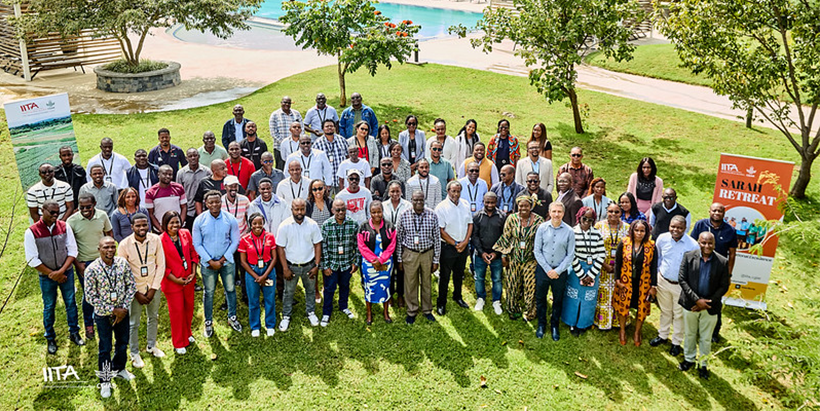
IITA Southern Africa Hub staff during the retreat.
The retreat focused on reviewing IITA’s research activities, assessing unique priorities, and contexts of each country within the region.
With the aim of promoting collaboration and knowledge exchange, IITA staff collectively explored strategic directions that will maximize the institute’s presence and contribution to agricultural transformation, food security, and improved livelihoods in the region.
Focusing on translating broad objectives into actionable, country-specific strategies grounded in IITA’s core strengths, the week-long retreat served as a forum for strategic planning, country-specific dialogue, and enhanced regional collaboration.
Key themes and discussions
Central to the retreat was the introduction and application of the PO3 framework— Purpose, Objectives, and Outputs. This model helped frame IITA’s strategic engagement by answering why the institute is active in a given country, what its goals are, and how these goals will be achieved through research outputs and partnerships.
Country-specific updates were presented for Angola, Malawi, Mozambique, and Zambia, showcasing ongoing activities, achievements, and future plans. These sessions revealed unique agricultural challenges and opportunities, such as climate variability impacting maize production in Malawi and Angola’s potential for large-scale arable farming.
Featuring the importance of partnerships, there was also emphasis on collaboration with national agricultural research systems (NARS), government agencies, the private sector, and international organizations.
Communication and visibility were highlighted as crucial to funding, stakeholder engagement, innovation adoption and research impact.
This framework analysed audience-focused messaging, targeted channels, and measurable outcomes.
By proactively showcasing value and impact, IITA Southern Africa Hub is enhancing reach, strengthening partnerships, and ensuring agriculture research and innovation reaches the farmers in Africa.
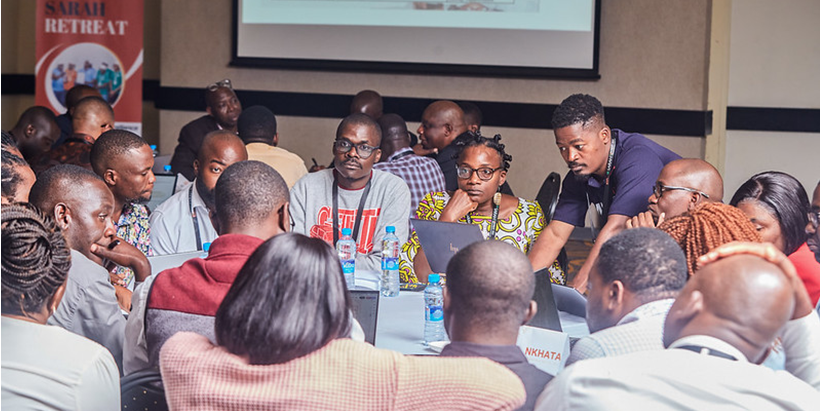
Some of IITA Southern Africa Hub staff during a breakout session at the retreat.
Regional opportunities and expansion
Discussion around regional collaboration explored cross-border opportunities—such as tapping into the cowpea market in Botswana— while looking at expansion into new opportunity countries – Botswana, Eswatini, Lesotho, Namibia, South Africa, and Zimbabwe with focus on agroecological fit and IITA’s comparative advantages.
Strategic outcomes and recommendations
With a reaffirmed commitment to tailoring research and development initiatives to national agricultural agenda and moving away from a one-size-fits-all model, the retreat emphasized strengthening national research systems (NARS) as essential to IITA’s sustainable impact strategy.Focusing on strategic priorities, there was strong consensus during the retreat on the need to pursue regional initiatives and leverage shared resources for greater impact. Critical areas of impact like climate-resilient crops for Malawi, support to NARS in Mozambique, crop diversification in Zambia, and focus on banana and cassava production in Angola were highlighted, with opportunities in dryland agriculture for Namibia and broader expansion in Zimbabwe also recognized.
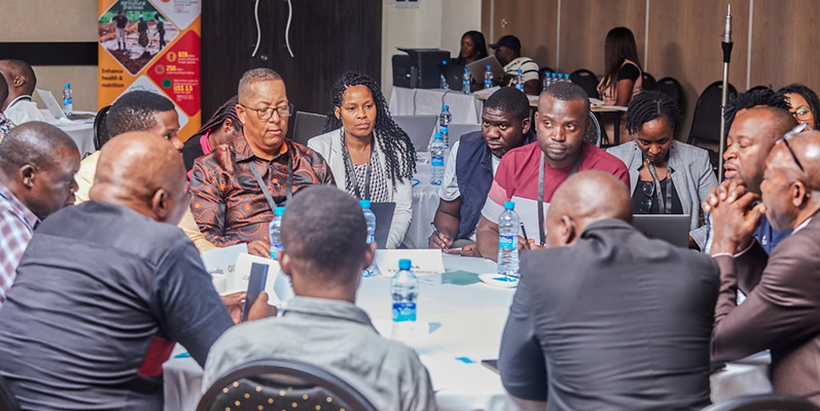
Group breakout session during the retreat.
Identifying challenges like lack of capacity for seed companies to scale innovation, non-existent criteria for new country engagements, inconsistent donor support for collaborative initiatives, and provision for risk management – unanticipated losses from uncontrollable occurrences, participants at the retreat proposed solutions to address these areas.
From supporting seed enterprises and diversified scaling strategies, active resource mobilization through well-aligned proposal, to robust contingency planning and risk mitigation measures, outcomes from the retreat will serve as a roadmap for IITA’s continued engagement in Southern Africa.
With tailored approaches, strong partnerships, and strategically expanding into new areas, IITA-SAH is positioned to amplify impact on innovation scaling, agricultural transformation and improve livelihoods across the region.
Contributed by IITA-Southern Africa Hub
Olamide Deborah Nwanze is a Senior Research Associate specializing in gender mainstreaming research to inform participatory and inclusive breeding, variety development, and seed systems policies regarding root, tuber, and banana (RTB) crops in the International Institute of Tropical Agriculture Headquarters, Ibadan, Nigeria. She is a PhD candidate at the University of Ibadan and holds an MSc and B. Agric in Agricultural Extension and Rural Development. Olamide is a fellow of the African Women in Agricultural Research and Development – Gender Responsive Agricultural Systems Policy (AWARD-GRASP) and the Gender Responsive Researchers Equipped for Agricultural Transformation (GREAT). She seeks to apply her gender-mainstreaming learnings, gender-responsive research, and policy development, and review expertise to facilitate women, youth, children, and vulnerable social group’s access to and adoption of agricultural Innovations that guarantee food, nutrition, income, and livelihood security in Africa. Her current roles include mentoring research fellows, development of guides and training manuals, implementation and adaptation of gender frameworks and tools, value chain actors’ engagement as citizen science partners, policy review and redesign, data management, and analysis. Her current research explores mixed methods and participatory and interdisciplinary approaches to capture and highlight gender dynamics, needs, preferences, and challenges stakeholders face within the agricultural livelihood value chain to prioritize gender-inclusive strategies in breeding programs, policy design, and implementation.
de Sousa, K., van Etten, J., Manners, R. Bello, A., Teeken, B., Olaosebikan, O., et al. 2024. The tricot approach: an agile framework for decentralized on-farm testing supported by citizen science. A retrospective. Agron. Sustain. Dev. 44, 8. https://doi.org/10.1007/s13593-023-00937-1
Madu, T., Onwuka, S., Nwafor, S., Onyemauwa, N., Ejechi, M., Ofoeze, M., Ukeje, B., Eluagu, C., Olaosebikan, O., Okoye, B., 2024. Gender-Inclusive Consumer Studies Improve Cassava Breeding in Nigeria in: Frontiers in Sociology, volume 9, number: 1224504, doi: 10.3389/fsoc.2024.1224504
Olaosebikan, O.; Bello, A.; Utoblo, O.; Okoye, B.; Olutegbe, N.; Garner, E.; Teeken, B.; Bryan, E.; Forsythe, L.; Cole, S.; Madu, T. 2023. Stressors and Resilience within the Cassava Value Chain in Nigeria: Preferred Cassava Variety Traits and Response Strategies of Men and Women to Inform Breeding. Sustainability 15, 7837. https://doi.org/10.3390/su15107837
Okoye, B., Ofoeze, M., Ejechi, M., Onwuka, S., Nwafor, S., Onyemauwa, N., Ukeje, B., Eluagu, C., Obidiegwu, J.*, Olaosebikan, O., Madu, T.* 2023. Prioritizing preferred traits in the yam value chain in Nigeria: a gender situation analysis in: Frontiers in Sociology, volume 8, number: 1232626, pages 1 – 9, ISSN 2297-7775, 2023. https://www.frontiersin.org/articles/10.3389/fsoc.2023.1232626/full
Olaosebikan, O., Bello, A. A., de Sousa, K., Ndjouenkeu, R., Adesokan, M., Alamu, E. O., Agbona, A., van Etten, J., Kegah, F. N.*, Dufour, D., Bouniol, A., Teeken, B. 2023. Consumer acceptability of cassava gari-eba food products across cultural and environmental settings using the triadic comparison of technologies approach (tricot) in: Journal of the Science of Food and Agriculture,
Teeken, B., Olaosebikan, O., Bello, A. A., Madu, T.*, Cole, S. M. 2023. Qualitative assessment on the positionality and preferences of dyads in relation to cassava-related activities: working with tricot trial citizen scientists https://hdl.handle.net/10568/138326 Type: Manual
Bouniol, A., Ceballos, H., Bello, A. A., Teeken, B., Olaosebikan, O., Owoade, D., Agbona, A., Fotso Kuate, A., Madu, T.*, Okoye, B.*, Ofoeze, M.*, Nwafor, S.*, Onyemauwa, N.*, Adinsi, L.*, Forsythe, L., Dufour, D. 2023. Varietal impact on women’s labour, workload and related drudgery in processing root, tuber and banana crops: focus on cassava in sub-Saharan Africa in: Journal of the Science of Food and Agriculture, pages 1 – 25, ISSN 0022-5142,
Bello, A. A., Agbona, A., Olaosebikan, O., Edughaen, G., Dufour, D., Bouniol, A., Iluebbey, P., Ndjouenkeu, R.*, Rabbi, I. Y., Teeken, B. 2023. Genetic and environmental effects on processing productivity and food product yield: drudgery of women’s work in: Journal of the Science of Food and Agriculture, pages 1 – 32, ISSN 0022-5142, 5
Cavicchioli, M., Zimbiti, T., Teeken, B., Nwanze, D.O., Liani, M., Parkes, E. & Bello, A. 2023. IITA-Gender Responsive Breeding Training Report. Genetic Resources Center, IITA-HQ, Ibadan, 21-23 September, 2022. Ibadan, Nigeria: IITA, (34 p.).https://hdl.handle.net/10568/131368
Agbona, A. Peteti P., Teeken B., Olaosebikan O. Bello, A. A., Parkes, E., Rabbi, I. Y., Mueller, L., Egesi, C., Kulakow, P. 2022. Data Management in Multi-disciplinary African RTB Crop Breeding Programs. In: Williamson, H.F., Leonelli, S. (eds) Towards Responsible Plant Data Linkage: Data Challenges for Agricultural Research and Development. Springer, Cham. https://doi.org/10.1007/978-3-031-13276-6_5
Lora Forsythe, Pricilla Marimo, Sarah Mayanja, Olamide D. Olaosebikan, Esme Stuart, Bela Teeken, Benjamin Okoye, Tessy Madu, (2021). Cross-product Gender Analysis of RTBfoods Step 2 Gendered Food Mapping on RTB Products. Understanding the Drivers of Trait Preferences and the Development of Multi-user RTB Product Profiles, WP1. London, UK: RTBfoods Field Scientific Report, 30 p.
Teeken, B., Garner, E., Agbona, A., Balogun, I., Olaosebikan, O., Bello, A., Madu, T., Okoye, B., Egesi, C., Kulakow, P. and Tufan, H.A. 2021. Beyond “Women’s Traits”: Exploring How Gender, Social Difference, and Household Characteristics Influence Trait Preferences. Frontiers Sustainable Food Systems 5:740926. https://doi.org/10.3389/fsufs.2021.740926
Teeken, B., Agbona, A., Bello, A., Olaosebikan, O., Alamu, E., Adesokan, M., Awoyale, W., Madu, T., Okoye, B., Chijioke, U., Owoade, D., Okoro, M., Bouniol, A., Dufour, D., Hershey, C., Rabbi, I., Maziya‐Dixon, B., Egesi, C., Tufan, H. and Kulakow, P. (020. Understanding cassava varietal preferences through pairwise ranking of gari‐eba and fufu prepared by local farmer–processors. Int J Food Sci Technol.https://doi.org/10.1111/ijfs.14862
Bela Teeken, Olamide Olaosebikan, Ireti Balogun, Benjamin Okoye, Tessy Madu, Steven Cole, Abolore Bello, Elizabeth Parkes. (2020). Piloting the G+ customer and product profile tools for gender-responsive cassava breeding in Nigeria. Nigeria: International Institute of Tropical Agriculture (IITA). https://hdl.handle.net/20.500.11766/13000