
IITA NEWS

DG Ehui commends IITA Benin staff, visits innovations and conservation efforts
June 20, 2025

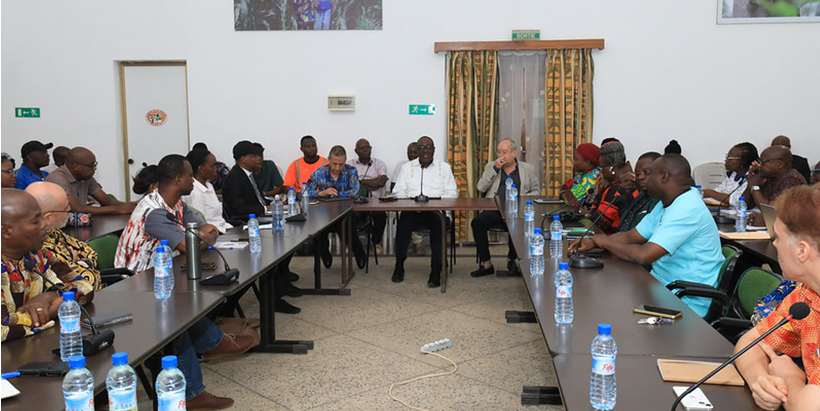
IITA Benin staff during the meeting with the Dr Simeon Ehui.

From June 3 to 6, 2025, Dr Simeon Ehui, IITA Director General and CGIAR Regional Director for Continental Africa, visited the IITA Station in Cotonou, Benin. The visit provided a platform to interact with staff, assess ongoing research innovations, and explore opportunities to further strengthen IITA’s agricultural research efforts and partnerships in the Republic of Benin.

DG Ehui, accompanied by Lahcen Ennahli, Special Advisor to the DG, Toyin Oke, Manager, Resource Mobilization, Protocol and External Liaison (RMPEL), and Sukurate Suleman, Executive Assistant to the DG, toured the Arthropod Biodiversity Research and Conservation Center—the largest insect and mite reference collection in West Africa.
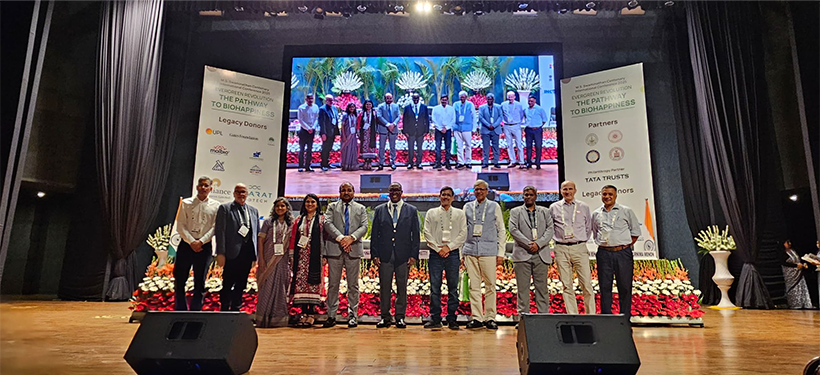
Dr Simeon Ehui with the IITA Benin staff during his visit to the station.

With over 385,000 insect specimens and 30,000 mite slides, the unit is vital in identifying invasive species and supporting the region’s biodiversity efforts. The DG lauded the team’s work and stressed the importance of increasing the visibility of this “hidden jewel” through enhanced communication and completing the DNA fingerprinting of more than 6,000 identified arthropod species.

It is currently estimated that 40-50% of the sub-region’s known arthropod biodiversity is preserved in this collection. IITA’s effort in this area has been instrumental in the interception of major invasive alien species, such as the papaya mealybug and the fall armyworm. It continues to provide an efficient arthropod identification service in West Africa.
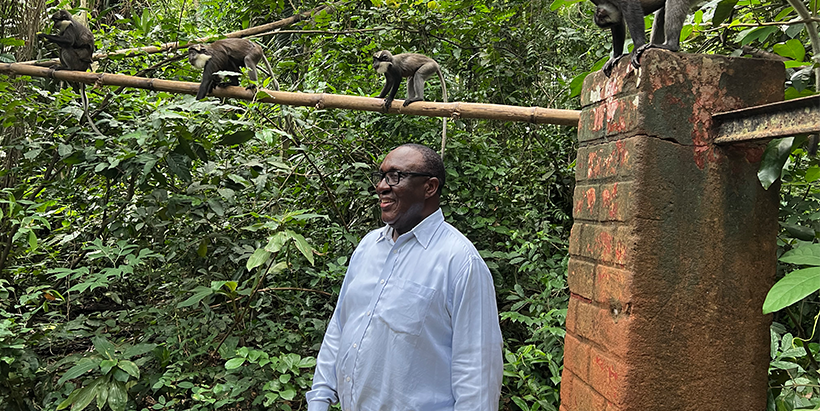
Dr Simeon Ehui visiting the Drabo Gbo forest sanctuary—home to endangered red-bellied monkeys.

He also visited the Agro-Eco-Health platform and lab, where IITA Molecular Entomologist Dr Rousseau Djouaka explained IITA’s work in a circular bio-economy using Black Soldier Flies (BSF). DG Ehui witnessed the full production cycle—from organic waste recycling to the production of high-protein animal feed and compost—highlighting how innovation intersects with sustainability and food systems.

At the Chemical Ecology research and training lab, IITA Benin Country representative Manuele Tamò and Entomologist and Chemical Ecologist Hilaire Kpongbe gave DG Ehui a tour of the facilities, focusing on volatile extraction, GC-MS analysis, and behavioral assays using olfactometers and wind tunnels. These technologies support agricultural and medical entomology solutions, including identifying pheromones of disease vectors like black flies.
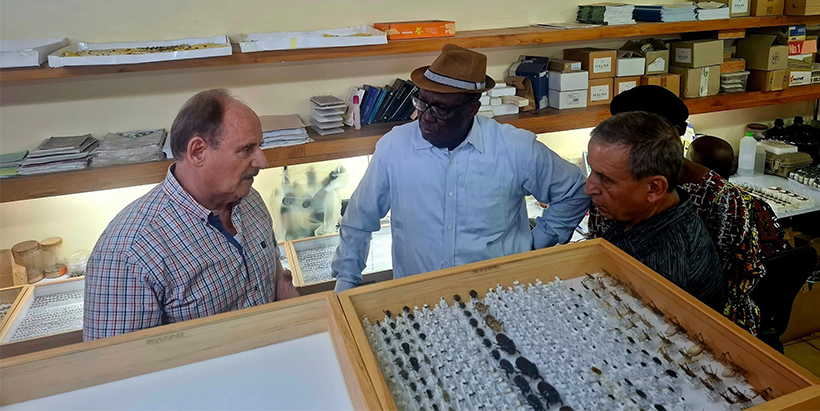
Dr Simeon Ehui visiting the Arthropod Biodiversity Research and Conservation Center.

During the visit, DG Ehui engaged with the TAAT Clearinghouse team, expressing interest in the TAAT e-catalog and the ENABLE TAAT youth agripreneurship initiative. He applauded the team for their impactful collaborations with the African Development Bank (AfDB) and Islamic Development Bank (IsDB).

A key highlight of the visit was the trip to the Drabo Gbo forest sanctuary—home to endangered red-bellied monkeys and rare tree species, where IITA Emeritus Scientist Peter Neuenschwander narrated the forest’s journey from fallow land to a 14-hectare conservation zone. Discussions with DG Ehui explored strategies for preserving its ecological, educational, and research value amid climate-related challenges.

In a town hall with staff, DG Ehui shared updates from IITA and CGIAR, stressing the need for collaboration with other CGIAR centers and strengthening partnerships, especially with national systems and technology adoption in Benin. He emphasized support for youth initiatives, conservation research, and expanding access to technologies such as Semi-Autotrophic Hydroponics (SAH), biofortified crops, and Aflasafe.

Contributed by ‘Timilehin Osunde


Contributed by

Related news

No items found

Leave a Reply

Your email address will not be published. Required fields are marked *

Scroll to Top
Olaosebikan, Olamide

Olamide Deborah Nwanze is a Senior Research Associate specializing in gender mainstreaming research to inform participatory and inclusive breeding, variety development, and seed systems policies regarding root, tuber, and banana (RTB) crops in the International Institute of Tropical Agriculture Headquarters, Ibadan, Nigeria. She is a PhD candidate at the University of Ibadan and holds an MSc and B. Agric in Agricultural Extension and Rural Development. Olamide is a fellow of the African Women in Agricultural Research and Development – Gender Responsive Agricultural Systems Policy (AWARD-GRASP) and the Gender Responsive Researchers Equipped for Agricultural Transformation (GREAT). She seeks to apply her gender-mainstreaming learnings, gender-responsive research, and policy development, and review expertise to facilitate women, youth, children, and vulnerable social group’s access to and adoption of agricultural Innovations that guarantee food, nutrition, income, and livelihood security in Africa. Her current roles include mentoring research fellows, development of guides and training manuals, implementation and adaptation of gender frameworks and tools, value chain actors’ engagement as citizen science partners, policy review and redesign, data management, and analysis. Her current research explores mixed methods and participatory and interdisciplinary approaches to capture and highlight gender dynamics, needs, preferences, and challenges stakeholders face within the agricultural livelihood value chain to prioritize gender-inclusive strategies in breeding programs, policy design, and implementation.

At IITA, she contributes to the implementation of the CGIAR Accelerated Breeding Initiative and Genetic Innovation Programs; participatory and gender research within the NextGen CassavaHarvestPlusRTBFoods, and Tricot-ClimMob 1000Farms Projects; and gender knowledge communication via the G-LENS webinar series, video documentary, policy briefspublications, and blogs.


Recent publications

de Sousa, K., van Etten, J., Manners, R. Bello, A., Teeken, B., Olaosebikan, O., et al. 2024. The tricot approach: an agile framework for decentralized on-farm testing supported by citizen science. A retrospective. Agron. Sustain. Dev. 44, 8. https://doi.org/10.1007/s13593-023-00937-1

Madu, T., Onwuka, S., Nwafor, S., Onyemauwa, N., Ejechi, M., Ofoeze, M., Ukeje, B., Eluagu, C., Olaosebikan, O., Okoye, B., 2024. Gender-Inclusive Consumer Studies Improve Cassava Breeding in Nigeria in: Frontiers in Sociology, volume 9, number: 1224504, doi: 10.3389/fsoc.2024.1224504

Olaosebikan, O.; Bello, A.; Utoblo, O.; Okoye, B.; Olutegbe, N.; Garner, E.; Teeken, B.; Bryan, E.; Forsythe, L.; Cole, S.; Madu, T. 2023.  Stressors and Resilience within the Cassava Value Chain in Nigeria: Preferred Cassava Variety Traits and Response Strategies of Men and Women to Inform Breeding. Sustainability 15, 7837. https://doi.org/10.3390/su15107837

Okoye, B., Ofoeze, M., Ejechi, M., Onwuka, S., Nwafor, S., Onyemauwa, N., Ukeje, B., Eluagu, C., Obidiegwu, J.*, Olaosebikan, O., Madu, T.* 2023. Prioritizing preferred traits in the yam value chain in Nigeria: a gender situation analysis in: Frontiers in Sociology, volume 8, number: 1232626, pages 1 – 9, ISSN 2297-7775, 2023. https://www.frontiersin.org/articles/10.3389/fsoc.2023.1232626/full

Olaosebikan, O., Bello, A. A., de Sousa, K., Ndjouenkeu, R., Adesokan, M., Alamu, E. O., Agbona, A., van Etten, J., Kegah, F. N.*, Dufour, D., Bouniol, A., Teeken, B. 2023. Consumer acceptability of cassava gari-eba food products across cultural and environmental settings using the triadic comparison of technologies approach (tricot) in: Journal of the Science of Food and Agriculture,

Teeken, B., Olaosebikan, O., Bello, A. A., Madu, T.*, Cole, S. M. 2023. Qualitative assessment on the positionality and preferences of dyads in relation to cassava-related activities: working with tricot trial citizen scientists https://hdl.handle.net/10568/138326 Type: Manual

Bouniol, A., Ceballos, H., Bello, A. A., Teeken, B., Olaosebikan, O., Owoade, D., Agbona, A., Fotso Kuate, A., Madu, T.*, Okoye, B.*, Ofoeze, M.*, Nwafor, S.*, Onyemauwa, N.*, Adinsi, L.*, Forsythe, L., Dufour, D. 2023. Varietal impact on women’s labour, workload and related drudgery in processing root, tuber and banana crops: focus on cassava in sub-Saharan Africa in: Journal of the Science of Food and Agriculture, pages 1 – 25, ISSN 0022-5142,

Bello, A. A., Agbona, A., Olaosebikan, O., Edughaen, G., Dufour, D., Bouniol, A., Iluebbey, P., Ndjouenkeu, R.*, Rabbi, I. Y., Teeken, B. 2023. Genetic and environmental effects on processing productivity and food product yield: drudgery of women’s work in: Journal of the Science of Food and Agriculture, pages 1 – 32, ISSN 0022-5142, 5

Cavicchioli, M., Zimbiti, T., Teeken, B., Nwanze, D.O., Liani, M., Parkes, E. & Bello, A. 2023. IITA-Gender Responsive Breeding Training Report. Genetic Resources Center, IITA-HQ, Ibadan, 21-23 September, 2022. Ibadan, Nigeria: IITA, (34 p.).https://hdl.handle.net/10568/131368

Agbona, A. Peteti P., Teeken B., Olaosebikan O. Bello, A. A., Parkes, E., Rabbi, I. Y., Mueller, L., Egesi, C., Kulakow, P. 2022. Data Management in Multi-disciplinary African RTB Crop Breeding Programs. In: Williamson, H.F., Leonelli, S. (eds) Towards Responsible Plant Data Linkage: Data Challenges for Agricultural Research and Development. Springer, Cham. https://doi.org/10.1007/978-3-031-13276-6_5

Lora Forsythe, Pricilla Marimo, Sarah Mayanja, Olamide D. Olaosebikan, Esme Stuart, Bela Teeken, Benjamin Okoye, Tessy Madu, (2021). Cross-product Gender Analysis of RTBfoods Step 2 Gendered Food Mapping on RTB Products. Understanding the Drivers of Trait Preferences and the Development of Multi-user RTB Product Profiles, WP1. London, UK: RTBfoods Field Scientific Report, 30 p.

Teeken, B., Garner, E., Agbona, A., Balogun, I., Olaosebikan, O., Bello, A., Madu, T., Okoye, B., Egesi, C., Kulakow, P. and Tufan, H.A. 2021. Beyond “Women’s Traits”: Exploring How Gender, Social Difference, and Household Characteristics Influence Trait Preferences. Frontiers Sustainable Food Systems 5:740926. https://doi.org/10.3389/fsufs.2021.740926

Teeken, B., Agbona, A., Bello, A., Olaosebikan, O., Alamu, E., Adesokan, M., Awoyale, W., Madu, T., Okoye, B., Chijioke, U., Owoade, D., Okoro, M., Bouniol, A., Dufour, D., Hershey, C., Rabbi, I., Maziya‐Dixon, B., Egesi, C., Tufan, H. and Kulakow, P. (020. Understanding cassava varietal preferences through pairwise ranking of gari‐eba and fufu prepared by local farmer–processors. Int J Food Sci Technol. https://doi.org/10.1111/ijfs.14862

Bela Teeken, Olamide Olaosebikan, Ireti Balogun, Benjamin Okoye, Tessy Madu, Steven Cole, Abolore Bello, Elizabeth Parkes. (2020). Piloting the G+ customer and product profile tools for gender-responsive cassava breeding in Nigeria. Nigeria: International Institute of Tropical Agriculture (IITA). https://hdl.handle.net/20.500.11766/13000