
IITA NEWS

Madagascar delegation explores IITA innovations for agricultural transformation
September 30, 2025

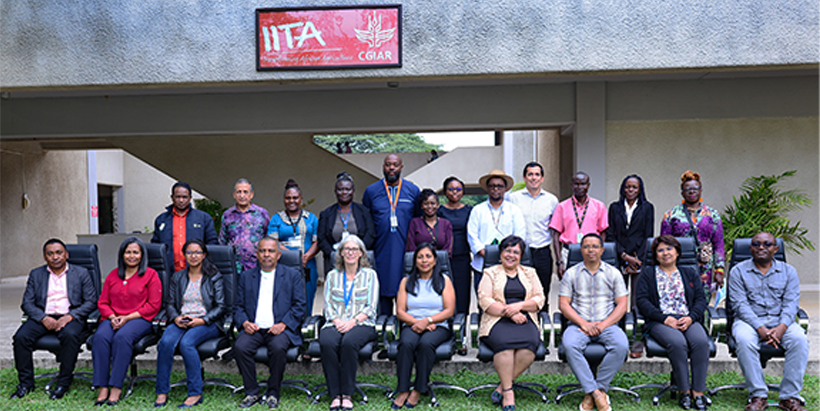
The Madagascar delegates in a welcome photograph with IITA scientists and members of senior management team

A high-level delegation from Madagascar visited IITACGIAR during 8 – 12 September, on an immersion mission to explore the Institute’s cutting-edge agricultural technologies, research programs, and innovations. The delegation identified innovative technologies suitable to support the country’s agricultural transformation agenda. The mission reflects the country’s vision to transform its agricultural systems to become the “Breadbasket of the Indian Ocean.”

The 9-member delegation included senior technical and policy leaders from Madagascar’s Ministry of Agriculture and Livestock alongside its national institutes (FOFIFA, DPV, SOC), the Food Systems Resilience Program (FSRP), and the World Bank. Among the senior officials were Rakotomalala Ny Riana, Technical Advisor to the Minister of Agriculture and Livestock; Leong Pock Tsy Jean Michel, Director General of FOFIFA, the National Agricultural Research Institute; and Rafalimanana Oliva, National Coordinator of the FSRP. Their mission was to identify technologies and partnerships that can strengthen Madagascar’s current food safety project, seed systems, soil fertility management, and resilience to pests, diseases, and climate aggravated challenges.

The visit aligned with the vision of the President of Madagascar to achieve food self-sufficiency and national prosperity. Delegates examined opportunities to link Madagascar’s nine agricultural transformation programs with IITA’s innovations. Discussions focused on seed quality improvement systems, laboratory capacity building, phytosanitary protection, and incubating agricultural start-ups through a potential collaboration between FOFIFA Academy and IITA’s Business Incubation Platform (BIP).

With an FSRP-funded Aflasafe project already underway in Madagascar, the delegation’s visit placed strong emphasis on reviewing progress and planning upcoming biocontrol trials and construction of a laboratory and small-scale biocontrol manufacturing facility. A central element of the discussions was how to strengthen sustainable public–private sector collaboration. To this end, the delegates visited HarvestField Industries Limited, IITA’s licensed partner in Nigeria that manufactures and commercializes Aflasafe. The visit offered practical insights into the production process, distribution models, and regulatory pathways that support large-scale deployment of aflatoxin control solutions—lessons that can inform the ongoing efforts in Madagascar.
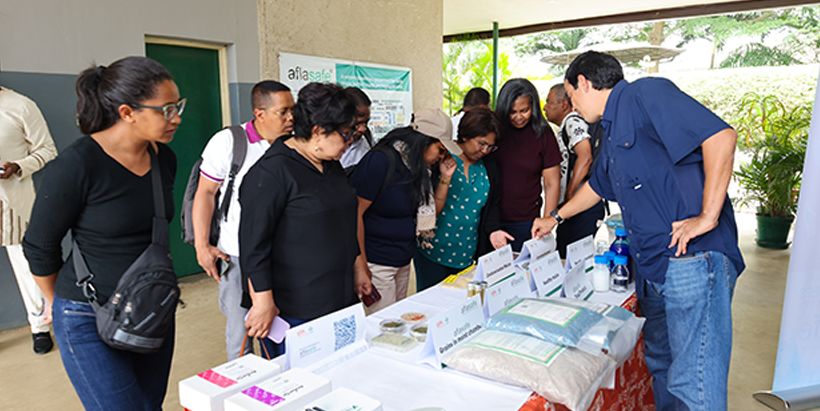
Alejandro Ortega-Beltran, IITA Senior Plant Pathologist and Head of Pathology and Mycotoxin/Aflasafe Unit taking the delegates through IITA’s Aflasafe biocontrol solution to aflatoxin, a common food safety threat across sub-Saharan Africa.

The delegates also engaged with IITA’s Deputy Director General, Corporate Services, Hilde Koper-Limbourg, who provided an overview of IITA’s corporate operations. She highlighted the Institute’s project management systems, budgeting and costing processes, manpower funding, and collaboration with national partners, giving participants a comprehensive understanding of the support structures driving IITA’s research and delivery.

During the visit, IITA’s Seed Tracker technology received enthusiastic attention. This digital platform enhances transparency, traceability, and quality control across seed systems, providing real-time data accessible to farmers, processors, regulators, donors, and other stakeholders. According to Lava Kumar, IITA Virologist and Head of Germplasm Health Unit, “the Seed Tracker tool has features relevant to all value chain actors. Its integration could provide Madagascar with a more transparent and effective seed delivery system.”

During one of the learning sessions, the delegation explored how the Regional Hub for Fertilizer and Soil Health for West Africa and the Sahel leverages data science, advanced modeling, and integrated soil fertility management techniques to deliver tailored fertilizer recommendations to farmers. These approaches aim to improve soil health, boost agricultural productivity, enhance farmers’ resilience to climate change, and sustain profitability. Delegates also explored IITA’s Semi-Autotrophic Hydroponics (SAH) technology, which enables the rapid multiplication of disease-free cassava and yam planting materials—essential for food security in root crop-dependent regions.

Food safety and nutrition were central themes throughout the mission. Mercy Lung’aho, IITA’s Program Lead for Food Security, Nutrition, and Health, engaged the team in conversations around nutrition optimization strategies. Titilayo Falade, IITA Food Safety Scientist, engaged the team in deliberations on aflatoxin mitigation and other food safety studies and interventions relevant to the Madagascar context.
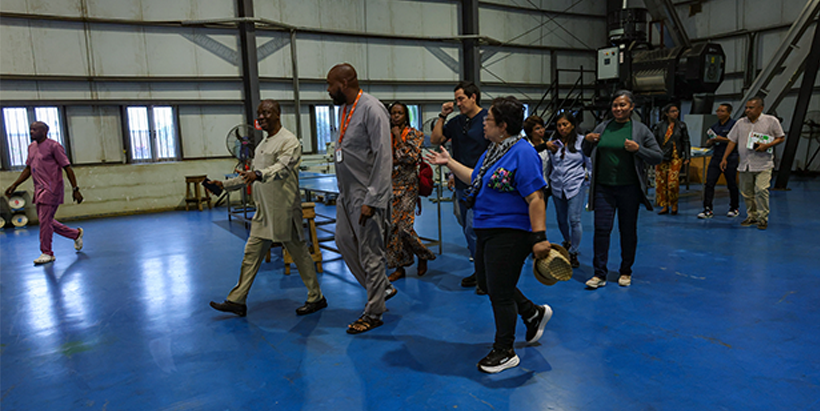
The Madagascar delegates with the HarvestField Industries Limited (HIL) staff after touring the facility to learn operation and production processes.

At IITA headquarters in Ibadan, the delegation toured field stations and laboratories, engaging with scientists and technical experts from IITA’s maize, soybean, cowpea, cassava, and plantain/banana research programs. They also interacted with AfricaRice representatives on advanced rice technologies adaptable to Madagascar’s production systems.

Another highlight was the visit to IITA’s Cassava Processing Unit, where the team sampled a variety of cassava-based products ranging from cakes and bread rolls to chips, shawarma, and ice cream. This showcased the economic opportunities of post-harvest processing and value addition.

Reflecting on the visit, Andriampeno Tanteliniaina, Deputy Coordinator of FSRP noted, “each technology we observed directly responds to Madagascar’s priorities for food security, improved nutrition, sustainable livelihoods, and capacity development.” Leong Jean Michel, Director General of FOFIFA added, “the exchanges we had with researchers and experts will enable us to progress in direct research and ultimately improve food production in Madagascar.”

The mission concluded with drafting of a concept note outlining priority areas for intervention, including strengthening the current Aflasafe project in Madagascar, and new areas of collaboration with IITA such as seed systems, soil fertility management, and strengthening Malagasy research capacity. This marks a significant milestone in the collaboration between IITA and Madagascar, building on earlier engagements and existing working partnerships with IITA.

In his closing remarks, acting IITA Deputy Director General, Partnerships for Delivery, Abdoulaye Tahirou, commended IITA staff and scientists for providing the delegation with an enriching and immersive experience. He emphasized that the identified areas of collaboration hold the potential to transform African agriculture—not only for Madagascar, but also for humanity as a whole.

For IITA, the visit reaffirms its role as an Institute of agricultural innovation and a trusted partner for governments and donors seeking transformative food systems solutions. For Madagascar, it signals a concrete step toward scaling technologies that will empower farmers, strengthen value chains, and secure the country’s place as a food production leader in the Indian Ocean.

Contributed by Folake Oduntan and Alejandro Ortega-Beltran


Contributed by

Related news

No items found

Leave a Reply

Your email address will not be published. Required fields are marked *

Scroll to Top
Olaosebikan, Olamide

Olamide Deborah Nwanze is a Senior Research Associate specializing in gender mainstreaming research to inform participatory and inclusive breeding, variety development, and seed systems policies regarding root, tuber, and banana (RTB) crops in the International Institute of Tropical Agriculture Headquarters, Ibadan, Nigeria. She is a PhD candidate at the University of Ibadan and holds an MSc and B. Agric in Agricultural Extension and Rural Development. Olamide is a fellow of the African Women in Agricultural Research and Development – Gender Responsive Agricultural Systems Policy (AWARD-GRASP) and the Gender Responsive Researchers Equipped for Agricultural Transformation (GREAT). She seeks to apply her gender-mainstreaming learnings, gender-responsive research, and policy development, and review expertise to facilitate women, youth, children, and vulnerable social group’s access to and adoption of agricultural Innovations that guarantee food, nutrition, income, and livelihood security in Africa. Her current roles include mentoring research fellows, development of guides and training manuals, implementation and adaptation of gender frameworks and tools, value chain actors’ engagement as citizen science partners, policy review and redesign, data management, and analysis. Her current research explores mixed methods and participatory and interdisciplinary approaches to capture and highlight gender dynamics, needs, preferences, and challenges stakeholders face within the agricultural livelihood value chain to prioritize gender-inclusive strategies in breeding programs, policy design, and implementation.

At IITA, she contributes to the implementation of the CGIAR Accelerated Breeding Initiative and Genetic Innovation Programs; participatory and gender research within the NextGen CassavaHarvestPlusRTBFoods, and Tricot-ClimMob 1000Farms Projects; and gender knowledge communication via the G-LENS webinar series, video documentary, policy briefspublications, and blogs.


Recent publications

de Sousa, K., van Etten, J., Manners, R. Bello, A., Teeken, B., Olaosebikan, O., et al. 2024. The tricot approach: an agile framework for decentralized on-farm testing supported by citizen science. A retrospective. Agron. Sustain. Dev. 44, 8. https://doi.org/10.1007/s13593-023-00937-1

Madu, T., Onwuka, S., Nwafor, S., Onyemauwa, N., Ejechi, M., Ofoeze, M., Ukeje, B., Eluagu, C., Olaosebikan, O., Okoye, B., 2024. Gender-Inclusive Consumer Studies Improve Cassava Breeding in Nigeria in: Frontiers in Sociology, volume 9, number: 1224504, doi: 10.3389/fsoc.2024.1224504

Olaosebikan, O.; Bello, A.; Utoblo, O.; Okoye, B.; Olutegbe, N.; Garner, E.; Teeken, B.; Bryan, E.; Forsythe, L.; Cole, S.; Madu, T. 2023.  Stressors and Resilience within the Cassava Value Chain in Nigeria: Preferred Cassava Variety Traits and Response Strategies of Men and Women to Inform Breeding. Sustainability 15, 7837. https://doi.org/10.3390/su15107837

Okoye, B., Ofoeze, M., Ejechi, M., Onwuka, S., Nwafor, S., Onyemauwa, N., Ukeje, B., Eluagu, C., Obidiegwu, J.*, Olaosebikan, O., Madu, T.* 2023. Prioritizing preferred traits in the yam value chain in Nigeria: a gender situation analysis in: Frontiers in Sociology, volume 8, number: 1232626, pages 1 – 9, ISSN 2297-7775, 2023. https://www.frontiersin.org/articles/10.3389/fsoc.2023.1232626/full

Olaosebikan, O., Bello, A. A., de Sousa, K., Ndjouenkeu, R., Adesokan, M., Alamu, E. O., Agbona, A., van Etten, J., Kegah, F. N.*, Dufour, D., Bouniol, A., Teeken, B. 2023. Consumer acceptability of cassava gari-eba food products across cultural and environmental settings using the triadic comparison of technologies approach (tricot) in: Journal of the Science of Food and Agriculture,

Teeken, B., Olaosebikan, O., Bello, A. A., Madu, T.*, Cole, S. M. 2023. Qualitative assessment on the positionality and preferences of dyads in relation to cassava-related activities: working with tricot trial citizen scientists https://hdl.handle.net/10568/138326 Type: Manual

Bouniol, A., Ceballos, H., Bello, A. A., Teeken, B., Olaosebikan, O., Owoade, D., Agbona, A., Fotso Kuate, A., Madu, T.*, Okoye, B.*, Ofoeze, M.*, Nwafor, S.*, Onyemauwa, N.*, Adinsi, L.*, Forsythe, L., Dufour, D. 2023. Varietal impact on women’s labour, workload and related drudgery in processing root, tuber and banana crops: focus on cassava in sub-Saharan Africa in: Journal of the Science of Food and Agriculture, pages 1 – 25, ISSN 0022-5142,

Bello, A. A., Agbona, A., Olaosebikan, O., Edughaen, G., Dufour, D., Bouniol, A., Iluebbey, P., Ndjouenkeu, R.*, Rabbi, I. Y., Teeken, B. 2023. Genetic and environmental effects on processing productivity and food product yield: drudgery of women’s work in: Journal of the Science of Food and Agriculture, pages 1 – 32, ISSN 0022-5142, 5

Cavicchioli, M., Zimbiti, T., Teeken, B., Nwanze, D.O., Liani, M., Parkes, E. & Bello, A. 2023. IITA-Gender Responsive Breeding Training Report. Genetic Resources Center, IITA-HQ, Ibadan, 21-23 September, 2022. Ibadan, Nigeria: IITA, (34 p.).https://hdl.handle.net/10568/131368

Agbona, A. Peteti P., Teeken B., Olaosebikan O. Bello, A. A., Parkes, E., Rabbi, I. Y., Mueller, L., Egesi, C., Kulakow, P. 2022. Data Management in Multi-disciplinary African RTB Crop Breeding Programs. In: Williamson, H.F., Leonelli, S. (eds) Towards Responsible Plant Data Linkage: Data Challenges for Agricultural Research and Development. Springer, Cham. https://doi.org/10.1007/978-3-031-13276-6_5

Lora Forsythe, Pricilla Marimo, Sarah Mayanja, Olamide D. Olaosebikan, Esme Stuart, Bela Teeken, Benjamin Okoye, Tessy Madu, (2021). Cross-product Gender Analysis of RTBfoods Step 2 Gendered Food Mapping on RTB Products. Understanding the Drivers of Trait Preferences and the Development of Multi-user RTB Product Profiles, WP1. London, UK: RTBfoods Field Scientific Report, 30 p.

Teeken, B., Garner, E., Agbona, A., Balogun, I., Olaosebikan, O., Bello, A., Madu, T., Okoye, B., Egesi, C., Kulakow, P. and Tufan, H.A. 2021. Beyond “Women’s Traits”: Exploring How Gender, Social Difference, and Household Characteristics Influence Trait Preferences. Frontiers Sustainable Food Systems 5:740926. https://doi.org/10.3389/fsufs.2021.740926

Teeken, B., Agbona, A., Bello, A., Olaosebikan, O., Alamu, E., Adesokan, M., Awoyale, W., Madu, T., Okoye, B., Chijioke, U., Owoade, D., Okoro, M., Bouniol, A., Dufour, D., Hershey, C., Rabbi, I., Maziya‐Dixon, B., Egesi, C., Tufan, H. and Kulakow, P. (020. Understanding cassava varietal preferences through pairwise ranking of gari‐eba and fufu prepared by local farmer–processors. Int J Food Sci Technol. https://doi.org/10.1111/ijfs.14862

Bela Teeken, Olamide Olaosebikan, Ireti Balogun, Benjamin Okoye, Tessy Madu, Steven Cole, Abolore Bello, Elizabeth Parkes. (2020). Piloting the G+ customer and product profile tools for gender-responsive cassava breeding in Nigeria. Nigeria: International Institute of Tropical Agriculture (IITA). https://hdl.handle.net/20.500.11766/13000