The Kano government and stakeholders applaud Youth in Agribusiness impactful networking conference
October 27, 2025
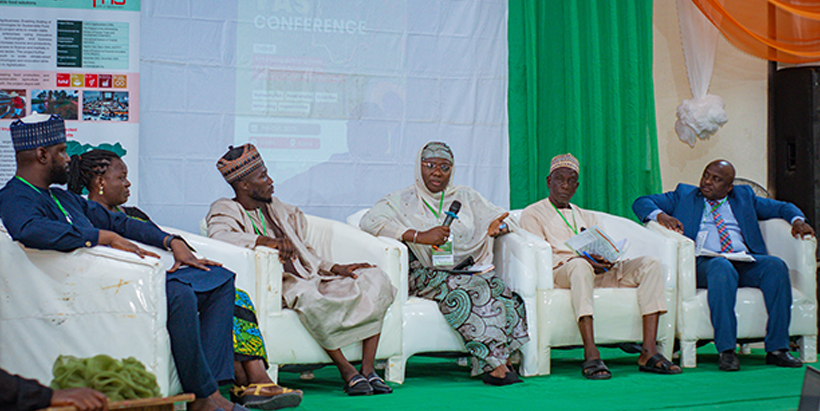
L-R: Human Resource Manager, Nutri K, Mr Bashir Yerima; Zonal Coordinator, Nigerian Stored Products Research Institute (NSPRI), Dr Ajani Alice Olapade; CEO/Executive Director, SMART Agribus, Mr Ridwan Adebisi; Chief Regulatory Officer of the National Agency for Food and Drug Administration and Control (NAFDAC) in Kano, Hajiya Halima Abdulkarim; Director, Irrigation, Kano State Ministry of Agriculture, Mallam Ado Ibrahim; and Regional Manager, North-West, Fidelity Bank, Mr Abdulazeez Suleiman, during the panel session.
The Kano State Government has commended the IITA–CGIAR Youth in Agribusiness: Enabling scaling of innovative technologies for sustainable food solutions, also known as YAS Project, for its significant contribution to driving youth involvement in agriculture, bolstering better livelihoods, and increasing food availability in the state.
The Commissioner for Women, Children, and Persons with Disabilities, represented by the Director of Women Affairs in the Ministry, Hajiya Nafisa Yakasi, gave the remark at the conference organized by YAS recently in Kano State. She commended IITA-CGIAR for its gender inclusion approach and deliberate efforts in empowering women in agriculture.
The conference, which had the theme ‘Enhancing Public–Private Partnership to Sustain the Capacity of Youth in Agribusiness’ was attended by project participants, partners, government representatives, community leaders, representatives from food regulatory and certification agencies, financial institutions, and other development partners. The conference provided a networking platform for participants and other stakeholders.
The YAS Project Coordinator, Adebayo Awotodunbo, noted that the project, had, since its inception three years ago, enhanced youth participation in agriculture through training, mentorship, and enterprise support. According to him, this facilitated the establishment of several youth-led enterprises.
The Country Director of BopInc, YAS’ implementing partner, Mercy Mayaki, emphasized that public–private partnerships remain essential to addressing the critical challenges faced by young agripreneurs, including access to finance, market opportunities, and innovative technologies.
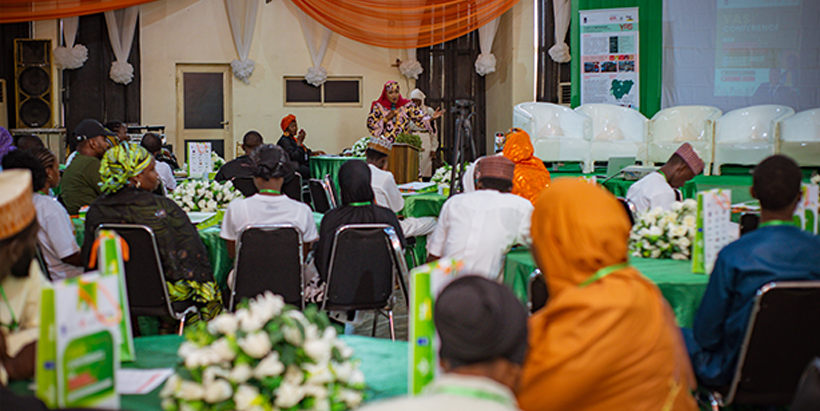
One of the speakers addressing the participants
A major highlight of the event was the business pitch competition by past participants. The judges included the Chief Regulatory Officer of the National Agency for Food and Drug Administration and Control (NAFDAC) in Kano, Hajiya Halima Abdulkarim; Human Resource Manager, Nutri K, Bashir Yerima; and the Accountant of the International Crops Research Institute for the Semi-Arid Tropics (ICRISAT), Kano, Bashir Abdullahi.
At the end of the competition, Gambo Zakari, a catfish farmer, was declared the winner; Hassana Abdulaziz emerged as the first runner-up, and Fiddausi Galadima the second runner-up, while Mohammad Suleiman Mahe and Safiya Mohammad came fourth and fifth respectively.
The winner would receive N500,000 worth of inputs; the second-place winner would receive N300,000 worth of inputs, the third-place winner N200,000 worth of inputs, while the fourth- and fifth-place winners would receive consolation prizes of N100,000 worth of inputs, respectively. Impressed by their performance, one of the project’s partners and CEO/Executive Director, SMART Agribus, Ridwan Adebisi, promised to reward Mahe and Safiya with an additional N50,000 each.
During the panel session, Mallam Ado Ibrahim, Director of Irrigation at the Kano State Ministry of Agriculture, noted that the Ministry of Water Resources had recently allocated land to the YAS project for training participants. He added that the government was committed to collaborations that foster a supportive ecosystem for youth agripreneurs.
Similarly, Dr Ajani Alice Olapade, Zonal Coordinator at the Nigerian Stored Products Research Institute (NSPRI), stated that the institute recently trained 40 YAS participants in the processing of tomatoes, dates, and maize into various products. She listed the innovations deployed by the institute, including a parabolic solar dryer for drying farm produce, hermetic steel drums for storing dried products, bulk storage units for grains and seeds, and an agrometeorological station that provides data on humidity, temperature, sunshine, and wind direction.
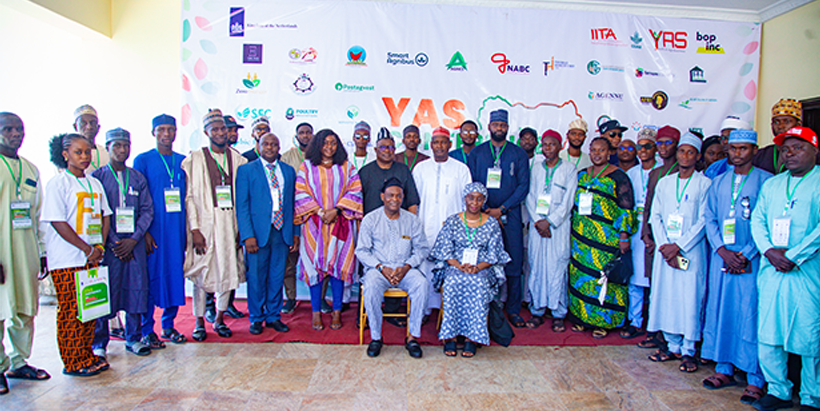
The YAS Project Coordinator, Adebayo Awotodunbo; the Country Director of BopInc, Mercy Mayaki, and other guests after the event.
Speaking on the issue of access to finance, Abdulazeez Suleiman, North-West Regional Manager of Fidelity Bank, stated that while zero-interest loans desired by many might not be available, there are low-interest loans that young agripreneurs can take advantage of, whether as startups or existing business owners.
Similarly, Yerima of Nutri-K urged the youth to embrace opportunities in the sector, noting that the company was sourcing peanuts and other raw materials from farmers to support the local economy and smallholder farmers. He called on young farmers to apply for opportunities that offer funding and visibility, join hubs that provide access to mentorship, prepare feasible business plans to qualify for integrated credit schemes, and invest in financial literacy to navigate formal financial systems effectively.
Speaking about the bottlenecks people face during product registration, Abdulkarim from NAFDAC emphasized that business owners must comply with regulatory standards before they could obtain approval, noting that branding and packaging also play key roles in product acceptability.
The Station Administrator at IITA Kano, Shuaibu Rabo-Ado, who thanked the Netherlands Embassy for supporting the YAS project, charged financial institutions to fulfill their role as key enablers of agribusiness growth by improving access to credit and financial advisory services. He called for products that support young agripreneurs. Through the YAS project, IITA has significantly contributed to economic development by empowering over 10,000 youths across Nigeria. Such interventions should complement, not replace, the government’s broader mandate of youth and citizen empowerment,” he added.
Participants also had the opportunity to share their success stories. Jibril Lawal said he started his fish farm relying on guesswork, which resulted in huge losses. However, he said after participating in the YAS training, his farm became profitable, and he was able to expand significantly. He added that he ensured that the knowledge he received had been stepped down to many young people in his Madobi community. “From the profit I made, I now cultivate soybeans and okra on three hectares of land, which has augmented my income significantly,” he added.
Contributed by Babatunde Ajaja
Olamide Deborah Nwanze is a Senior Research Associate specializing in gender mainstreaming research to inform participatory and inclusive breeding, variety development, and seed systems policies regarding root, tuber, and banana (RTB) crops in the International Institute of Tropical Agriculture Headquarters, Ibadan, Nigeria. She is a PhD candidate at the University of Ibadan and holds an MSc and B. Agric in Agricultural Extension and Rural Development. Olamide is a fellow of the African Women in Agricultural Research and Development – Gender Responsive Agricultural Systems Policy (AWARD-GRASP) and the Gender Responsive Researchers Equipped for Agricultural Transformation (GREAT). She seeks to apply her gender-mainstreaming learnings, gender-responsive research, and policy development, and review expertise to facilitate women, youth, children, and vulnerable social group’s access to and adoption of agricultural Innovations that guarantee food, nutrition, income, and livelihood security in Africa. Her current roles include mentoring research fellows, development of guides and training manuals, implementation and adaptation of gender frameworks and tools, value chain actors’ engagement as citizen science partners, policy review and redesign, data management, and analysis. Her current research explores mixed methods and participatory and interdisciplinary approaches to capture and highlight gender dynamics, needs, preferences, and challenges stakeholders face within the agricultural livelihood value chain to prioritize gender-inclusive strategies in breeding programs, policy design, and implementation.
de Sousa, K., van Etten, J., Manners, R. Bello, A., Teeken, B., Olaosebikan, O., et al. 2024. The tricot approach: an agile framework for decentralized on-farm testing supported by citizen science. A retrospective. Agron. Sustain. Dev. 44, 8. https://doi.org/10.1007/s13593-023-00937-1
Madu, T., Onwuka, S., Nwafor, S., Onyemauwa, N., Ejechi, M., Ofoeze, M., Ukeje, B., Eluagu, C., Olaosebikan, O., Okoye, B., 2024. Gender-Inclusive Consumer Studies Improve Cassava Breeding in Nigeria in: Frontiers in Sociology, volume 9, number: 1224504, doi: 10.3389/fsoc.2024.1224504
Olaosebikan, O.; Bello, A.; Utoblo, O.; Okoye, B.; Olutegbe, N.; Garner, E.; Teeken, B.; Bryan, E.; Forsythe, L.; Cole, S.; Madu, T. 2023. Stressors and Resilience within the Cassava Value Chain in Nigeria: Preferred Cassava Variety Traits and Response Strategies of Men and Women to Inform Breeding. Sustainability 15, 7837. https://doi.org/10.3390/su15107837
Okoye, B., Ofoeze, M., Ejechi, M., Onwuka, S., Nwafor, S., Onyemauwa, N., Ukeje, B., Eluagu, C., Obidiegwu, J.*, Olaosebikan, O., Madu, T.* 2023. Prioritizing preferred traits in the yam value chain in Nigeria: a gender situation analysis in: Frontiers in Sociology, volume 8, number: 1232626, pages 1 – 9, ISSN 2297-7775, 2023. https://www.frontiersin.org/articles/10.3389/fsoc.2023.1232626/full
Olaosebikan, O., Bello, A. A., de Sousa, K., Ndjouenkeu, R., Adesokan, M., Alamu, E. O., Agbona, A., van Etten, J., Kegah, F. N.*, Dufour, D., Bouniol, A., Teeken, B. 2023. Consumer acceptability of cassava gari-eba food products across cultural and environmental settings using the triadic comparison of technologies approach (tricot) in: Journal of the Science of Food and Agriculture,
Teeken, B., Olaosebikan, O., Bello, A. A., Madu, T.*, Cole, S. M. 2023. Qualitative assessment on the positionality and preferences of dyads in relation to cassava-related activities: working with tricot trial citizen scientists https://hdl.handle.net/10568/138326 Type: Manual
Bouniol, A., Ceballos, H., Bello, A. A., Teeken, B., Olaosebikan, O., Owoade, D., Agbona, A., Fotso Kuate, A., Madu, T.*, Okoye, B.*, Ofoeze, M.*, Nwafor, S.*, Onyemauwa, N.*, Adinsi, L.*, Forsythe, L., Dufour, D. 2023. Varietal impact on women’s labour, workload and related drudgery in processing root, tuber and banana crops: focus on cassava in sub-Saharan Africa in: Journal of the Science of Food and Agriculture, pages 1 – 25, ISSN 0022-5142,
Bello, A. A., Agbona, A., Olaosebikan, O., Edughaen, G., Dufour, D., Bouniol, A., Iluebbey, P., Ndjouenkeu, R.*, Rabbi, I. Y., Teeken, B. 2023. Genetic and environmental effects on processing productivity and food product yield: drudgery of women’s work in: Journal of the Science of Food and Agriculture, pages 1 – 32, ISSN 0022-5142, 5
Cavicchioli, M., Zimbiti, T., Teeken, B., Nwanze, D.O., Liani, M., Parkes, E. & Bello, A. 2023. IITA-Gender Responsive Breeding Training Report. Genetic Resources Center, IITA-HQ, Ibadan, 21-23 September, 2022. Ibadan, Nigeria: IITA, (34 p.).https://hdl.handle.net/10568/131368
Agbona, A. Peteti P., Teeken B., Olaosebikan O. Bello, A. A., Parkes, E., Rabbi, I. Y., Mueller, L., Egesi, C., Kulakow, P. 2022. Data Management in Multi-disciplinary African RTB Crop Breeding Programs. In: Williamson, H.F., Leonelli, S. (eds) Towards Responsible Plant Data Linkage: Data Challenges for Agricultural Research and Development. Springer, Cham. https://doi.org/10.1007/978-3-031-13276-6_5
Lora Forsythe, Pricilla Marimo, Sarah Mayanja, Olamide D. Olaosebikan, Esme Stuart, Bela Teeken, Benjamin Okoye, Tessy Madu, (2021). Cross-product Gender Analysis of RTBfoods Step 2 Gendered Food Mapping on RTB Products. Understanding the Drivers of Trait Preferences and the Development of Multi-user RTB Product Profiles, WP1. London, UK: RTBfoods Field Scientific Report, 30 p.
Teeken, B., Garner, E., Agbona, A., Balogun, I., Olaosebikan, O., Bello, A., Madu, T., Okoye, B., Egesi, C., Kulakow, P. and Tufan, H.A. 2021. Beyond “Women’s Traits”: Exploring How Gender, Social Difference, and Household Characteristics Influence Trait Preferences. Frontiers Sustainable Food Systems 5:740926. https://doi.org/10.3389/fsufs.2021.740926
Teeken, B., Agbona, A., Bello, A., Olaosebikan, O., Alamu, E., Adesokan, M., Awoyale, W., Madu, T., Okoye, B., Chijioke, U., Owoade, D., Okoro, M., Bouniol, A., Dufour, D., Hershey, C., Rabbi, I., Maziya‐Dixon, B., Egesi, C., Tufan, H. and Kulakow, P. (020. Understanding cassava varietal preferences through pairwise ranking of gari‐eba and fufu prepared by local farmer–processors. Int J Food Sci Technol.https://doi.org/10.1111/ijfs.14862
Bela Teeken, Olamide Olaosebikan, Ireti Balogun, Benjamin Okoye, Tessy Madu, Steven Cole, Abolore Bello, Elizabeth Parkes. (2020). Piloting the G+ customer and product profile tools for gender-responsive cassava breeding in Nigeria. Nigeria: International Institute of Tropical Agriculture (IITA). https://hdl.handle.net/20.500.11766/13000