
IITA NEWS

IITA empowers smallholder farmers through farmer field school days in Cameroon
November 6, 2025

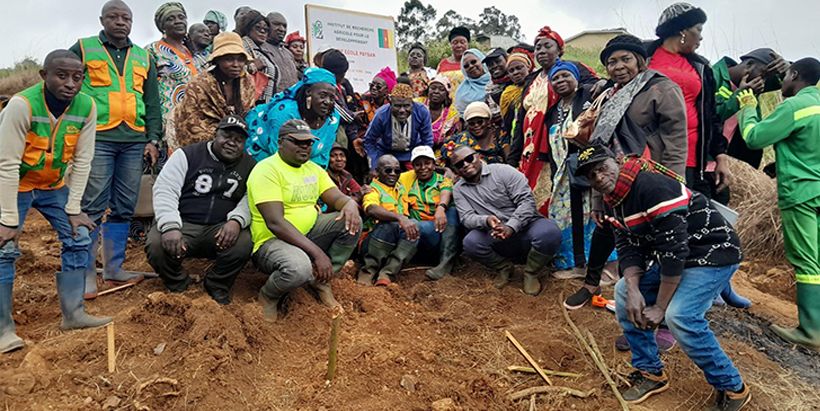
Farmers and IITA trainers after a successful Farmer Field School training session

Across Cameroon, agriculture remains the backbone of rural livelihoods. Yet, most smallholder farmers continue to rely on rudimentary farming tools and traditional methods, often using non-certified planting materials that limit yields and worsen challenges such as food insecurity and malnutrition.

Recognizing this gap, the IITACGIAR, in collaboration with the Ministry of Scientific Research and Innovation (MINRESI), has introduced Farmer Field Days — a hands-on learning platform designed to transform smallholder agriculture through knowledge sharing and innovation.

IITA organized a Farmer Field Day in Bandjoun, an event that brought together farmers, researchers, and policymakers to promote sustainable and productive farming techniques. Locally known as Journées Scientifiques and Champs-Écoles Paysans (CEP), the event took place at the Tchala and Touegoue sites, attracting over 10,000 farmers eager to learn about improved agricultural practices.

A multidisciplinary team of experts from IITA, the Institute of Agricultural Research for Development (IRAD), and the International Potato Center (CIP) facilitated interactive, field-based sessions focusing on key crops including plantain, maize, and beans. Farmers had the opportunity to gain practical knowledge on soil preparation, pest management, and crop husbandry techniques that could directly enhance their productivity and income.

The field demonstrations extended to cassava and potato cultivation, where farmers learned how to prepare sites and plant improved varieties such as cassava TME419 and TME693, and potato DOSA. These participatory sessions enable farmers to observe and practice new methods, thereby reinforcing their confidence in adopting improved technologies on their own farms.

“The idea behind these farmer field school days is to bridge the gap between scientific research and local farming practices,” explained Dr Nanga Samuel, a researcher from IITA. “We want farmers to see, touch, and test improved technologies in real field conditions because when they learn by doing, adoption becomes faster and more sustainable.”

Importantly, the initiative also emphasized inclusivity, empowering women farmers and ensuring they play an active role in decision-making and agricultural innovation. The hands-on learning approach not only strengthened technical capacity but also fostered collaboration among farmers, researchers, and local authorities.

“I used to plant my cassava without proper spacing or improved stems,” said Tchoumba, a farmer from Bandjoun. “During the field day, I learned how to prepare the soil and use certified varieties like TME419. I plan to apply these methods on my own farm next season to increase my yield and income.”

“This experience opened my eyes,” shared Nguene, a female farmer from Touegoue. “Before, I didn’t know how to control pests effectively or use organic compost. Now I feel confident to teach other women in my group how to do it. We’ll start by improving our maize plots together.”

The Minister of Scientific Research and Innovation, Dr Madeleine Tchuente, attended the event and praised IITA’s contributions to seed production and agricultural development in Cameroon. Her presence underscored the government’s recognition of IITA’s pivotal role in advancing the country’s agricultural transformation agenda.

Dr Madeleine Tchuente, Minister of Scientific Research and Innovation, said: “IITA’s work is helping transform our agriculture from subsistence to innovation-driven productivity. These field days demonstrate how science can truly serve our farmers and strengthen Cameroon’s food security.”

IITA’s ongoing initiatives in Cameroon reflect a strong commitment to building resilient and productive agri-food systems through research, technology, and innovation. By engaging farmers directly in learning and experimentation, and by fostering partnerships with institutions like MINRESI, IRAD, and CIP, IITA continues to drive real change on the ground.

As these collaborative efforts expand, the future of agriculture in Cameroon looks increasingly promising, with farmers being better equipped, communities becoming more food-secure, and the nation’s agricultural landscape defined by innovation and opportunity.

Contributed by Ritha Bumwe


Contributed by

Related news

No items found

Leave a Reply

Your email address will not be published. Required fields are marked *

Scroll to Top
Olaosebikan, Olamide

Olamide Deborah Nwanze is a Senior Research Associate specializing in gender mainstreaming research to inform participatory and inclusive breeding, variety development, and seed systems policies regarding root, tuber, and banana (RTB) crops in the International Institute of Tropical Agriculture Headquarters, Ibadan, Nigeria. She is a PhD candidate at the University of Ibadan and holds an MSc and B. Agric in Agricultural Extension and Rural Development. Olamide is a fellow of the African Women in Agricultural Research and Development – Gender Responsive Agricultural Systems Policy (AWARD-GRASP) and the Gender Responsive Researchers Equipped for Agricultural Transformation (GREAT). She seeks to apply her gender-mainstreaming learnings, gender-responsive research, and policy development, and review expertise to facilitate women, youth, children, and vulnerable social group’s access to and adoption of agricultural Innovations that guarantee food, nutrition, income, and livelihood security in Africa. Her current roles include mentoring research fellows, development of guides and training manuals, implementation and adaptation of gender frameworks and tools, value chain actors’ engagement as citizen science partners, policy review and redesign, data management, and analysis. Her current research explores mixed methods and participatory and interdisciplinary approaches to capture and highlight gender dynamics, needs, preferences, and challenges stakeholders face within the agricultural livelihood value chain to prioritize gender-inclusive strategies in breeding programs, policy design, and implementation.

At IITA, she contributes to the implementation of the CGIAR Accelerated Breeding Initiative and Genetic Innovation Programs; participatory and gender research within the NextGen CassavaHarvestPlusRTBFoods, and Tricot-ClimMob 1000Farms Projects; and gender knowledge communication via the G-LENS webinar series, video documentary, policy briefspublications, and blogs.


Recent publications

de Sousa, K., van Etten, J., Manners, R. Bello, A., Teeken, B., Olaosebikan, O., et al. 2024. The tricot approach: an agile framework for decentralized on-farm testing supported by citizen science. A retrospective. Agron. Sustain. Dev. 44, 8. https://doi.org/10.1007/s13593-023-00937-1

Madu, T., Onwuka, S., Nwafor, S., Onyemauwa, N., Ejechi, M., Ofoeze, M., Ukeje, B., Eluagu, C., Olaosebikan, O., Okoye, B., 2024. Gender-Inclusive Consumer Studies Improve Cassava Breeding in Nigeria in: Frontiers in Sociology, volume 9, number: 1224504, doi: 10.3389/fsoc.2024.1224504

Olaosebikan, O.; Bello, A.; Utoblo, O.; Okoye, B.; Olutegbe, N.; Garner, E.; Teeken, B.; Bryan, E.; Forsythe, L.; Cole, S.; Madu, T. 2023.  Stressors and Resilience within the Cassava Value Chain in Nigeria: Preferred Cassava Variety Traits and Response Strategies of Men and Women to Inform Breeding. Sustainability 15, 7837. https://doi.org/10.3390/su15107837

Okoye, B., Ofoeze, M., Ejechi, M., Onwuka, S., Nwafor, S., Onyemauwa, N., Ukeje, B., Eluagu, C., Obidiegwu, J.*, Olaosebikan, O., Madu, T.* 2023. Prioritizing preferred traits in the yam value chain in Nigeria: a gender situation analysis in: Frontiers in Sociology, volume 8, number: 1232626, pages 1 – 9, ISSN 2297-7775, 2023. https://www.frontiersin.org/articles/10.3389/fsoc.2023.1232626/full

Olaosebikan, O., Bello, A. A., de Sousa, K., Ndjouenkeu, R., Adesokan, M., Alamu, E. O., Agbona, A., van Etten, J., Kegah, F. N.*, Dufour, D., Bouniol, A., Teeken, B. 2023. Consumer acceptability of cassava gari-eba food products across cultural and environmental settings using the triadic comparison of technologies approach (tricot) in: Journal of the Science of Food and Agriculture,

Teeken, B., Olaosebikan, O., Bello, A. A., Madu, T.*, Cole, S. M. 2023. Qualitative assessment on the positionality and preferences of dyads in relation to cassava-related activities: working with tricot trial citizen scientists https://hdl.handle.net/10568/138326 Type: Manual

Bouniol, A., Ceballos, H., Bello, A. A., Teeken, B., Olaosebikan, O., Owoade, D., Agbona, A., Fotso Kuate, A., Madu, T.*, Okoye, B.*, Ofoeze, M.*, Nwafor, S.*, Onyemauwa, N.*, Adinsi, L.*, Forsythe, L., Dufour, D. 2023. Varietal impact on women’s labour, workload and related drudgery in processing root, tuber and banana crops: focus on cassava in sub-Saharan Africa in: Journal of the Science of Food and Agriculture, pages 1 – 25, ISSN 0022-5142,

Bello, A. A., Agbona, A., Olaosebikan, O., Edughaen, G., Dufour, D., Bouniol, A., Iluebbey, P., Ndjouenkeu, R.*, Rabbi, I. Y., Teeken, B. 2023. Genetic and environmental effects on processing productivity and food product yield: drudgery of women’s work in: Journal of the Science of Food and Agriculture, pages 1 – 32, ISSN 0022-5142, 5

Cavicchioli, M., Zimbiti, T., Teeken, B., Nwanze, D.O., Liani, M., Parkes, E. & Bello, A. 2023. IITA-Gender Responsive Breeding Training Report. Genetic Resources Center, IITA-HQ, Ibadan, 21-23 September, 2022. Ibadan, Nigeria: IITA, (34 p.).https://hdl.handle.net/10568/131368

Agbona, A. Peteti P., Teeken B., Olaosebikan O. Bello, A. A., Parkes, E., Rabbi, I. Y., Mueller, L., Egesi, C., Kulakow, P. 2022. Data Management in Multi-disciplinary African RTB Crop Breeding Programs. In: Williamson, H.F., Leonelli, S. (eds) Towards Responsible Plant Data Linkage: Data Challenges for Agricultural Research and Development. Springer, Cham. https://doi.org/10.1007/978-3-031-13276-6_5

Lora Forsythe, Pricilla Marimo, Sarah Mayanja, Olamide D. Olaosebikan, Esme Stuart, Bela Teeken, Benjamin Okoye, Tessy Madu, (2021). Cross-product Gender Analysis of RTBfoods Step 2 Gendered Food Mapping on RTB Products. Understanding the Drivers of Trait Preferences and the Development of Multi-user RTB Product Profiles, WP1. London, UK: RTBfoods Field Scientific Report, 30 p.

Teeken, B., Garner, E., Agbona, A., Balogun, I., Olaosebikan, O., Bello, A., Madu, T., Okoye, B., Egesi, C., Kulakow, P. and Tufan, H.A. 2021. Beyond “Women’s Traits”: Exploring How Gender, Social Difference, and Household Characteristics Influence Trait Preferences. Frontiers Sustainable Food Systems 5:740926. https://doi.org/10.3389/fsufs.2021.740926

Teeken, B., Agbona, A., Bello, A., Olaosebikan, O., Alamu, E., Adesokan, M., Awoyale, W., Madu, T., Okoye, B., Chijioke, U., Owoade, D., Okoro, M., Bouniol, A., Dufour, D., Hershey, C., Rabbi, I., Maziya‐Dixon, B., Egesi, C., Tufan, H. and Kulakow, P. (020. Understanding cassava varietal preferences through pairwise ranking of gari‐eba and fufu prepared by local farmer–processors. Int J Food Sci Technol. https://doi.org/10.1111/ijfs.14862

Bela Teeken, Olamide Olaosebikan, Ireti Balogun, Benjamin Okoye, Tessy Madu, Steven Cole, Abolore Bello, Elizabeth Parkes. (2020). Piloting the G+ customer and product profile tools for gender-responsive cassava breeding in Nigeria. Nigeria: International Institute of Tropical Agriculture (IITA). https://hdl.handle.net/20.500.11766/13000